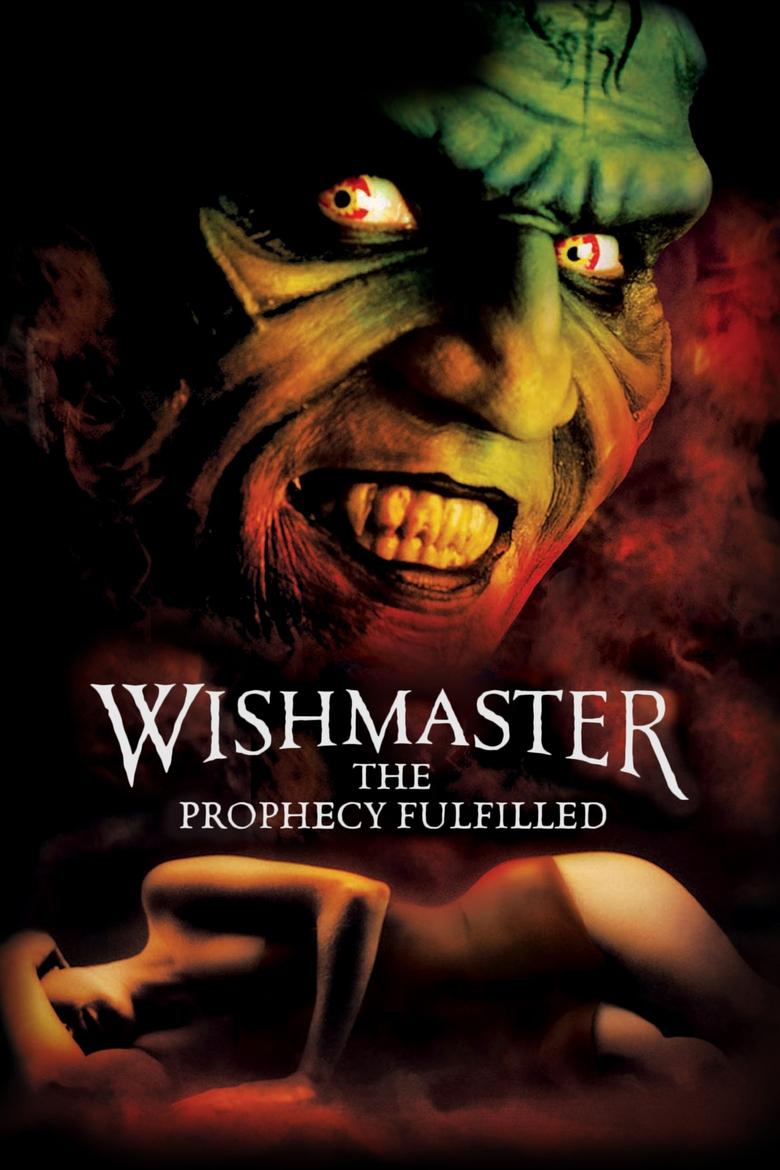
Wishmaster: The Prophecy Fulfilled
“Leave no soul unturned.”
The unspeakable evil of the soul-devouring djinn rises again in this fourth electrifying instalment of the unstoppable Wishmaster horror legacy! But now, as a host of new victims see their most nightmarish wishes come true, the world faces the ultimate demonic terror: an onslaught of multiple djinns hell-bent on destroying everything in their path!
About Wishmaster: The Prophecy Fulfilled
Lisa Burnley is still the reason this movie works
Start with the obvious: the engine is a wish. A jewel that acts as a prison is brought into Lisa Burnley’s orbit and wakes something old and hungry — a Djinn who then plays the long con, taking the shape of her lawyer to steer her toward three wishes.
That set-up could have been a neat party trick. Instead, the film stakes everything on Lisa: her relationship with her boyfriend Sam, the private strain left by his accident, and the choices she makes when desire and guilt begin to overlap.
Chris Angel keeps the running time tight — ninety-two minutes — and places Tara Spencer-Nairn’s Lisa at the centre. The result is a late-entry franchise slice that leans into romance and temptation as much as it does horror.
The idea that sets Wishmaster: The Prophecy Fulfilled in motion
At its cleanest, the film is a compact cautionary tale: a Djinn needs three wishes and will manipulate whatever intimacy is on offer to get them. The central trick is that the monster doesn’t brute-force its way to power; it engineers desire.
So the conflict isn’t a monster-on-the-street. It’s quieter and meaner: the Djinn nudges Lisa’s relationships and emotions until she becomes the instrument of her own danger.
That emphasis reshapes what you expect from a franchise entry — contemporary coverage picked up on how this chapter turns towards a love-story angle rather than the broader set-piece carnage of earlier instalments.
It’s a simple premise, delivered with the clarity you want from a sequel running under an hour and a half.
Why Lisa Burnley matters
Lisa is not just the person the Djinn targets; she’s the viewpoint character whose wants and compromises give the film weight. Her partner Sam’s accident and the resulting shift in their intimacy make her choices feel lived-in — not just plot-motivated.
That relationship is the film’s emotional lever. It’s where the Djinn finds purchase and where the audience’s sympathy is anchored: the horror comes from seeing a private fragility exposed and then exploited.
Casting-wise, Tara Spencer-Nairn carries Lisa through the story’s pragmatic and moral knots, while the credit line around her places the character front and centre of this instalment’s version of the franchise.
Why Tara Spencer-Nairn's performance matters
Published reviews and the credits make it clear who the leads are and that the film was being framed as a romance-tinged chapter in the series rather than a showcase for formal acting analysis.
That means commentary on individual turns is relatively scarce in contemporary coverage; what we can say with confidence is that the film places Lisa front and centre and builds its emotional stakes around her.
In plain terms: the picture asks you to care about Lisa’s decisions, and the way the narrative is assembled treats the lead role as the film’s primary responsibility.
Wishmaster: The Prophecy Fulfilled has more on its mind than the plot suggests
On the surface, it’s a supernatural thriller about wishes gone wrong. Underneath, the film keeps circling a few neat ideas: what happens when desire is weaponised, and how temptation corrodes judgement.
A throughline warns about the dangers of getting what you want without paying attention to the cost. The Djinn’s power rests on precise wording and warped generosity — an old myth given mean intent.
The romance thread isn’t decorative. Love and desire become the battleground for ethical choices: does Lisa use power to fix a relationship, and if so, who decides what ‘fixing’ looks like?
It’s tidy thematic work for a late franchise entry: familiar ideas, but they’re focused on people rather than spectacle.
How Wishmaster: The Prophecy Fulfilled was put together
This is a compact production with a specific crew credit line: music by Daryl Bennett and Jim Guttridge, cinematography by Curtis J. Petersen and editing by Marcus Manton.
Those names suggest a professional small-budget production that knows where to spend its effort: pacing, tone, and how scenes are cut together to keep the plot moving within a tight runtime.
Given the film’s focus on personal stakes and temptation, the practical choice to keep things concise — a 92-minute runtime — shapes the film’s identity as much as any single creative credit.
In short: the filmmaking choices underline the movie’s priorities — story, rhythm and a clear centre.
Wishmaster: The Prophecy Fulfilled could not belong to any other decade
Released in 2002 and sent straight to home video in the U.S., this film sits squarely in an early-00s moment when horror franchises increasingly found their afterlives on DVD rather than in theatres.
As the fourth instalment in a late-90s/early-00s series, it’s the sort of picture made to serve fans directly — compact, economical, and designed to slide onto the rental shelf without fuss.
That direct-to-video route says a lot about expectations: these films were made to keep a franchise breathing for an audience that enjoyed the premise, not to reinvent it.
It’s very much a product of the period’s distribution logic, and that practical fact helps explain the film’s scale and ambitions.
What has aged — and what hasn't
Some things about the production are fixed: the screenplay credit belongs to John Benjamin Martin and the series story credit to Peter Atkins, while the producers and distributor details place the film firmly in the independent, direct-to-home-video ecosystem.
That ecosystem is both a limitation and a benefit now. Scale limitations are obvious to a modern viewer, but the small, functional production values keep the focus on the narrative’s moral knots rather than blockbuster spectacle.
Because the film was designed to serve a clear franchise purpose, the parts that age best are the human ones — the decisions Lisa faces and the way the story twists desire into danger.
If you watch it today, you’re seeing a story that hasn’t been dressed up to be timeless; it’s a compact genre piece whose centre still holds.
Where Wishmaster: The Prophecy Fulfilled fits in
This is the fourth instalment in the Wishmaster sequence, the chapter that continues the franchise’s recurring Djinn-and-wish premise.
It’s paired closely with its immediate predecessor: Wishmaster 3 and this film were both directed by Chris Angel and produced back-to-back, which explains their shared tone and production footprint.
If you’re exploring the series, this one functions as the late-capstone — the instalment that takes the franchise’s central conceit and narrows it down to a single, relationship-driven story.
Why Wishmaster: The Prophecy Fulfilled still matters
This film is the fourth — and so far final — chapter of the franchise, the point where the series’ straight-to-video run finds its practical conclusion.
It didn’t launch theatrical follow-ups, but it remains part of franchise listings and filmographies as the closing chapter of a particular era of horror sequels.
Its memory lives less in influence than as a neat example of how genre series were kept alive for fans at the turn of the century: compact, sequel-minded, and willing to shift gears toward romance and temptation.
For viewers interested in the lifecycle of horror franchises, or in how a familiar monster might be reshaped around human relationships, it still has value.
Does Wishmaster: The Prophecy Fulfilled still hold up?
Short answer: yes — if your measure is a tightly written, relationship-led horror sequel that knows its constraints.
The film’s central engine — a Djinn manipulating a woman into making three wishes via an antique jewel introduced by her lawyer — is straightforward and reliably grim in its implications. That premise, and the way it leans on Lisa’s changed intimacy with Sam, keeps the stakes personal rather than performative.
Contemporary reviewers flagged the movie’s romance tilt, and that shift is the key to whether you’ll enjoy it: if you want a late-franchise psychological twist on wish-fulfilment and temptation, this is precisely the kind of small, focused entry that delivers it in 92 minutes.
If you want great leaps in scale or reinvention, look elsewhere. But as a final footnote to the series — directed by Chris Angel and produced alongside Wishmaster 3 — it wraps the franchise in a tidy, character-centred knot. It won’t surprise you. It will, on occasion, make you care.
Director & Cast