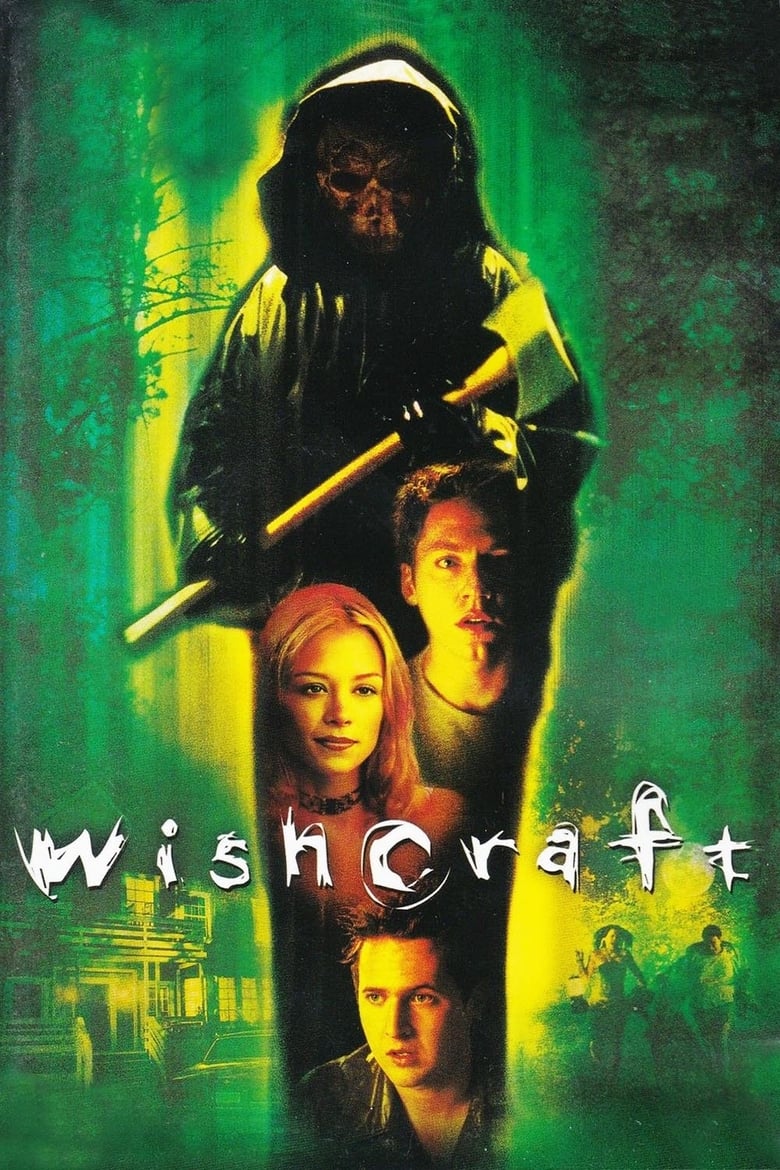
Wishcraft
“Be careful what you wish for.”
Brett is a high-school outcast who doesn't run with the in crowd, unlike Samantha, the cheerleader he has a desperate crush on. Then one day, he gets a parcel in the mail -- a totem with the power to grant his deepest, darkest desires. Brett wishes for Samantha to love him, and she does, although after a while her affection starts leaning toward obsession. Then murders start occurring in the school, which Brett gradually starts to connect to the totem.
About Wishcraft
Brett Bumpers is still the reason this movie works
Wishcraft centres on a simple, poisonous idea: Brett Bumpers finds a delivered package and with it a totem that grants three wishes. It’s the sort of premise that sounds like adolescent wish-fulfilment at first glance — and then remembers to bite back.
The engine of the film is the way those wishes twist ordinary high-school desires into something dangerous; what Brett asks for to solve a social problem keeps producing unintended, often violent outcomes. That tension — wanting something small and seeing the cost escalate — is the propulsive thing that makes the film worth returning to. It helps that the story hangs on a recognisable protagonist. Brett is awkward, morally tangled and driven by crushes that quickly become guilt-driven decisions; Michael Weston plays him. Richard Wenk (credited onscreen as Danny Graves) directs the whole thing like a familiar genre exercise, and Alexandra Holden turns up as Samantha Warren, the girl whose life is altered by Brett’s wishes.
The idea that sets Wishcraft in motion
At its cleanest, Wishcraft is a riff on the old cautionary-tale model: a magical object that grants desires, but with a nasty bill at the end. Brett’s wishes begin to rearrange who hangs out with whom at school — and that social domino effect is where the supernatural element meets the slasher beats.
Once the wishes have tangible consequences in the social world, the film folds in a cloaked killer who starts turning those consequences into a body count. The movie links the intimate nastiness of high-school life to the escalating violence of a slasher, which keeps things brisk and grim.
The totem itself isn’t a one-person toy. It can move from owner to owner, and the script makes a point of showing that its previous possessor used their wishes selfishly. That passing-on mechanic means the threat spreads: the talisman is a problem that can be inherited, not merely an isolated temptation.
And there are twists about who’s really pulling the strings — a figure the cast list makes plain. Austin Pendleton’s Mr Turner is revealed as the killer, which reframes several earlier scenes and ties the slasher threat directly into the school’s adult world.
Why Brett Bumpers matters
Brett isn’t heroic. He’s the sort of protagonist who makes mistakes because he’s trying to fix the humiliations and cruelties of being a teenage nobody. That’s what makes his choices interesting: they’re recognisable, even when they go wrong.
The film places him squarely in an ethical bind. His early wishes are driven by a crush — small, human impulses — and then the consequences force him into decisions motivated by guilt and, later, self-defence. The story rests on that slide from wanting to wanting to undo the wanting.
Because the drama is built on Brett’s errors, the audience is invited to watch how blame gets shared around. Samantha is cast as the object of his wish-driven desire, but she isn’t simply a prize: the movie gives her room to reclaim agency after being affected by those wishes.
Michael Weston is billed as the actor playing Brett Bumpers, and the character matters because he’s the hand that keeps turning the screw. Without someone who feels convincingly trapped between longing and responsibility, the moral knot at the movie’s centre would not hold.
Why Alexandra Holden's performance matters
Contemporary criticism of Wishcraft tended to judge the two leads as serviceable rather than show-stealing, but reviewers singled out Alexandra Holden’s part as comparatively stronger. That’s the useful baseline for watching the film now: Holden’s Samantha carries more of the emotional recoil from the wish-meddling.
Samantha’s role requires the film to make the audience care about someone who’s been altered by another person’s choices. The fact that Holden’s part was singled out gives the character some ballast — she isn’t entirely defined by Brett’s actions.
Put simply: if the film asks you to feel sympathy for the person whose life has been tampered with, it leans on the performer in that role to make the ethical problem land. Contemporary notice of Holden’s comparative prominence tells you the filmmakers at least gave Samantha some narrative weight. That doesn’t turn Wishcraft into a prestige drama overnight, but it does mean the movie often works by modest means: small performances carrying a larger gothic joke about wish fulfilment gone nasty.
Wishcraft has more on its mind than the plot suggests
On the surface it’s a slasher with a supernatural gimmick. Underneath, Wishcraft is fussing with uncomfortable questions about consent: is it ever acceptable to use a supernatural shortcut to change how someone feels or behaves? The film makes that unease part of its spine.
Closely connected is the idea that wish-fulfilment has a cost. The talisman hands out desires like candy, but each reward seems to come stamped with an unseen tax. That moral accounting — wants that create harm — is what keeps the narrative from being trivial.
And because the story plays out in a high-school ecosystem, teen social status is always in the room. The wishes attempt to alter the pecking order: who’s popular, who gets a dance date, who’s accepted. That turns ordinary adolescent anxieties into the battleground for supernatural consequences.
So the movie isn’t only about scares. It’s about who gets to decide for whom, and what happens when decisions intended to make you belong end up violating someone else’s autonomy.
Wishcraft could not belong to any other decade
Wishcraft is very much an early-2000s animal: it arrives in the post-Scream era when teen slasher movies were labelling themselves for a young audience and often flirting with genre self-awareness while adding a supernatural twist. That context explains a lot of its tonal choices.
It’s part of a small cluster of titles from the time that decided to marry wish-fulfilment fantasy with slasher mechanics. The combination lets the film satisfy two impulses at once — adolescent wish-fulfilment and the codified thrills of a body-count horror picture.
Released in 2002, Wishcraft sits neatly into that moment when horror-makers were less interested in reinventing the wheel than in mixing the wheel with a novel hubcap. Contemporary coverage tended to flag it as a picture for slasher fans of the era, and that’s an accurate marketing shorthand.
So when you watch it now, don’t expect the kind of revisionist cleverness that turned up elsewhere; expect instead a genre exercise that shows what the early-00s were trying to do with teen scares and supernatural hooks.
What has aged — and what hasn't
If you come to Wishcraft as a fan of teen horror, the basic ingredients are still recognisable: a high-school setting, wish-based complication and a slasher through-line. That familiarity is both an asset and a limitation for modern viewers.
The film’s engagement with teen social status — popularity, humiliation, the small cruelties of high school — remains a straightforward hook. Those dynamics are timeless enough to still register, particularly because they’re what prompt the central wishes in the first place.
Where the movie shows its age is less about story than ambition: Wishcraft plays as a genre entry aimed at fans rather than as a film attempting to broaden the form. If you want something that reinvents the wish-as-horror idea, this isn’t it; if you want a compact, early-00s slasher with a supernatural angle, it still fills that niche. Put another way: the premise and the teen-horror bones still work; the wider cultural packaging around it is very much of its moment.
Where Wishcraft fits in
Wishcraft belongs to a particular sub-genre: early-2000s horror that fuses wish-driven fantasy with slasher conventions. It’s a small cluster rather than a sweeping trend, but the films in it share a similar appetite for mixing adolescent longing with gruesome payback.
That pairing — magic that grants desire and killers who turn desire into danger — is the link between Wishcraft and its nearest cousins from the era. Watching them together shows how the same premise can be used either for tight, character-forward scares or for broader, gimmick-led thrills.
If you’re compiling a run of early-00s wish-slashers, Wishcraft fits neatly as an example of the form: modest, straightforward, and committed to the idea that adolescent wants can be dangerous when granted.
Why Wishcraft still matters
On release Wishcraft received modest critical attention, and its afterlife has been quiet rather than grand. That’s part of why it still matters: it’s a compact example of a specific, slightly oddball sub-genre rather than a film that ever tried to be or pretended to be a blockbuster.
Genre retrospectives that map the early-2000s horror scene often point to smaller entries like this to show how many filmmakers were playing with the wish-as-horror idea. In other words, its importance is illustrative — a useful footnote for anyone tracing how adolescent fantasies were weaponised in genre cinema that year.
Characters such as Brett Bumpers and Samantha Warren matter here as representative players in that experiment: the awkward kid making bad choices, the girl whose life is meddled with, and the adults who complicate matters. Mr Turner and others slot into the film’s broader point about responsibility and escalation.
So its legacy isn’t a grand one, but it is tidy: Wishcraft is remembered enough to be referenced when historians catalogue early-00s wish-based slashers, and that’s precisely the sort of afterlife you’d expect for a modest, genre-focused picture.
Does Wishcraft still hold up?
So, does Wishcraft still hold up? Yes — although watching a film from 2002 honestly means accepting that not every moment will land exactly as it once did.
The film still has something recognisable to say about wish-fulfillment and consequence, free will and consent and teen social status, and its characters stop those ideas from feeling abstract. Wishcraft remains worth revisiting because characters such as Brett Bumpers, Samantha Warren, Mr. Turner, Cody and Howie still feel like people rather than labels once the film gets underneath the stereotypes.
Director & Cast