
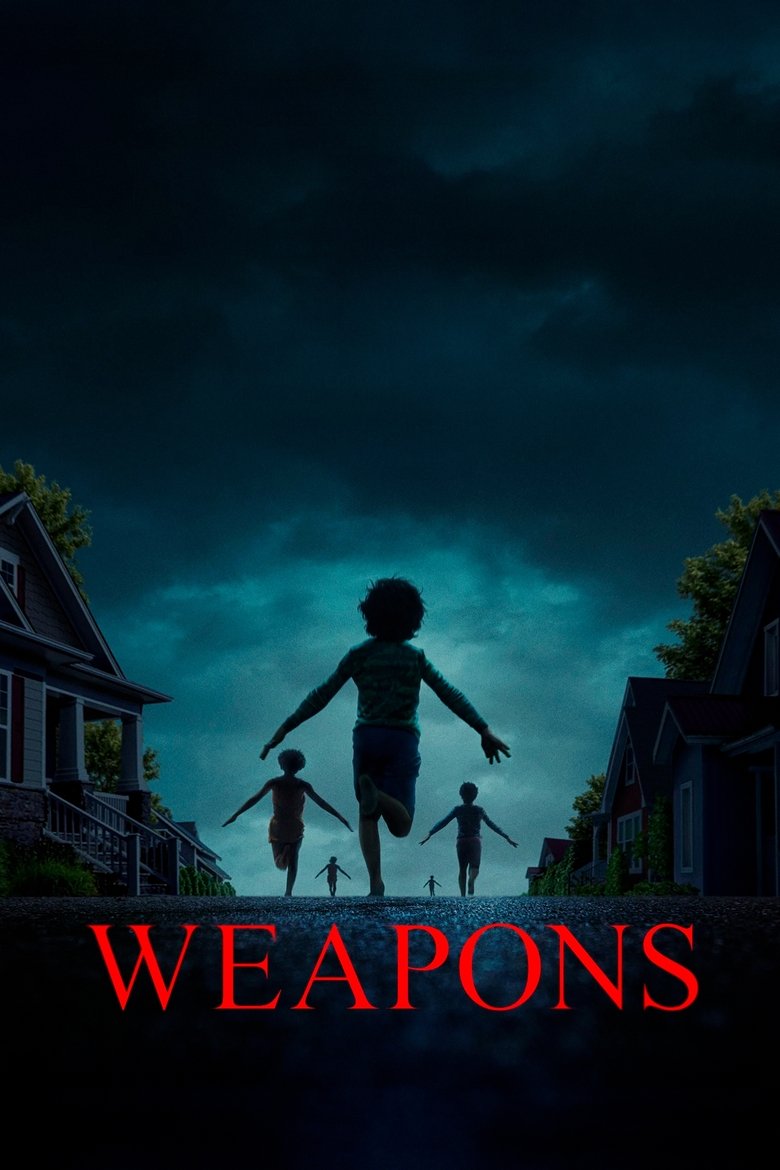
Weapons
“Last night at 2:17 AM, every child from Mrs. Gandy's class woke up, got out of bed, went downstairs, opened the front door, walked into the dark ...and they never came back.”
When all but one child from the same class mysteriously vanish on the same night at exactly the same time, a community is left questioning who or what is behind their disappearance.
About Weapons
Why Weapons still works
The first thing you notice is the narration: a kid calmly telling you that, at 2:17 a.m. on a Wednesday, seventeen children left their homes in Maybrook. That line does a lot of heavy lifting — it turns a neighbourhood into a crime scene and turns childhood into a public event.
Zach Cregger directs a movie that refuses to sit in a single box. It’s drama, mystery, horror and thriller at once, and that restless blend is what keeps the film moving across its two-hour-plus runtime rather than stalling on any one mood.
At the heart of the story are the adults who are supposed to answer for the children: Josh Brolin’s Archer Graff is the father who won’t let the police be the only ones asking questions, while Julia Garner’s Justine is the teacher caught between guilt and the urge to protect. Their worry is the engine — the missing kids are the spark.
The idea that sets Weapons in motion
The basic premise is tidy: one child remains from a missing class, and the grown-ups — parents, a teacher, a cop — are left to pick up the pieces. That single absence turns the town into a grid of suspicion.
Justine follows the lone child, Alex, home and finds a house that’s been turned inward — windows covered, parents sitting like mannequins. It’s the kind of detail that tells you this is no ordinary disappearance.
Archer, fed up with waiting for answers, stitches together footage from neighbourhood doorbells and realises the children’s routes were all pointing to the same mysterious destination. It’s a simple investigative hook that pulls personal grief into detective work.
Meanwhile, the police thread runs its own crooked path: an altercation with a homeless man escalates and leaves questions about how authority handles both guilt and evidence. Those strands — parental distrust, a teacher under suspicion, a faltering police response — are what make the premise feel immediate rather than procedural.
Why Archer Graff matters
Archer Graff is the father who refuses to let a mystery be tidy. He’s the kind of character that makes a noir move into domestic space: this is private panic turned public pursuit.
What anchors Archer is not just suspicion; it’s the fact he has skin in the game. One of his missing students is his own son, and that changes the tenor of his investigation from civic duty to personal necessity.
Archer’s mistrust collides with other adults’ failings — a teacher fighting her own demons, a police officer who lashes out and then covers tracks — and that collision is the film’s dramatic currency. Family here isn’t an abstract theme, it’s motive.
The deeper sting of the story comes when the breach of home is revealed: a parent who invited a dangerous relation into the house, and the notion that a house can be turned against the children it should shelter. Archer is what happens when protection becomes obsession.
Weapons has more on its mind than the plot suggests
At face value Weapons is a missing-children thriller. Underneath, it’s preoccupied with the household as an idea: who belongs there, who gets to decide what’s safe, and what happens when that boundary is violated.
Parental protection isn’t heroic in this film so much as fraught. Parents become detectives, accusers and, sometimes, the unwitting architects of danger. That makes family less a refuge and more a pressure cooker.
There’s also a blunt meditation on authority. When the police response falters or turns ugly, the film asks whether institutions can be trusted to protect the vulnerable — a question that makes every private anxiety political.
Mortality and loss hover like a weather system. The missing children become a measuring stick for how people grieve, how communities fracture, and how some forms of damage are slow to heal.
Weapons could not belong to any other decade
Weapons arrived in 2025, and that timing matters because the film sits squarely in a decade where genre lines blur and grown-up anxieties get foregrounded in thrillers.
It mixes drama, mystery, horror and thriller beats, a combination that’s very much of the 2020s appetite for tonal hybridity — nothing is polite, and the film refuses a single emotional register.
As a mid-20s release it also joins a wave of stories that make domestic life the site of dread rather than comfort. That emphasis on the household as a battleground feels like a particularly 2020s preoccupation.
Put simply: Weapons reads like a 2025 film because it uses genre to talk about real-life worries rather than to provide clean entertainment.
What has aged — and what hasn't
The opening narration — a child calmly cataloguing a mass disappearance — still lands. It’s a neat tonal trick: innocence describing a nightmare, which sets the emotional pitch that sustains the rest of the film.
The film’s focus on home and family has held up. Scenes where Justine follows Alex to a house whose windows are boarded and whose parents sit like statues still feel unsettling because they turn ordinary domestic detail into evidence of a larger horror.
Some elements look sharper in a modern light: the subplot where a cop punches a homeless man and then worries about the recorded consequences reads today as a crisp comment on accountability and violence from authority.
At the same time, the use of overt witchcraft to explain the disappearances is a very specific choice. It forces the film to move from procedural suspicion into folklore, which will divide viewers — some will find the leap cathartic, others will see it as a tonal pivot. Either way, the emotional throughline about protection and loss keeps the ending from feeling gratuitous.
Why Weapons still matters
People remember the premise — a small town’s children vanish and a single class is left hollow — because it so efficiently turns communal fear into a plot engine. The child narrator’s opening line is the memory hook: simple, eerie and impossible to forget.
The movie sticks with you for its moral messiness. Justine, accused and put on leave, and Archer, who won’t accept neat answers, give the story an emotional friction that doesn’t resolve into neat lessons about blame or blameworthiness.
There are violent, shameful detours: a cop’s temper, a homeless man’s discovery of the children, and the ugly consequences that follow. Those incidents make the film pulse with real-world stakes rather than staying purely symbolic.
Finally, the resolution — a household breached by a relative who weaponises intimate belongings, children brought back but not immediately whole, and a single child moved away to another aunt — leaves an aftertaste. That combination of rescue and lingering damage is what keeps the film in conversations: it’s not the ending you expect, and it’s the ending that feels earned by the specific hurts the film has catalogued.
Does Weapons still hold up?
Yes — but with a caveat. Weapons is worth seeing because it never forgets that its mystery is about people who are supposed to protect children. The film’s centre of gravity is parental panic and the ways adults fail one another; that emotional throughline keeps even the wilder plot turns anchored.
If you like your thrillers to be morally complicated rather than neatly comforting, Weapons delivers. Archer’s refusal to let the case go, Justine’s downward slide and the police subplot all combine to make the film feel lived-in rather than schematic.
The film’s turn into supernatural explanation will split audiences, but the choice does not negate the film’s concerns: the breach of home, the theft of safety, and the slow aftermath for the kids who return are what linger two years on.
So go watch it. Come for the mystery, stay for the way it makes you think about what ‘home’ actually means — and how easily the people who promise it can be the ones who break it.