Waxwork
“Stop on by and give afterlife a try.”
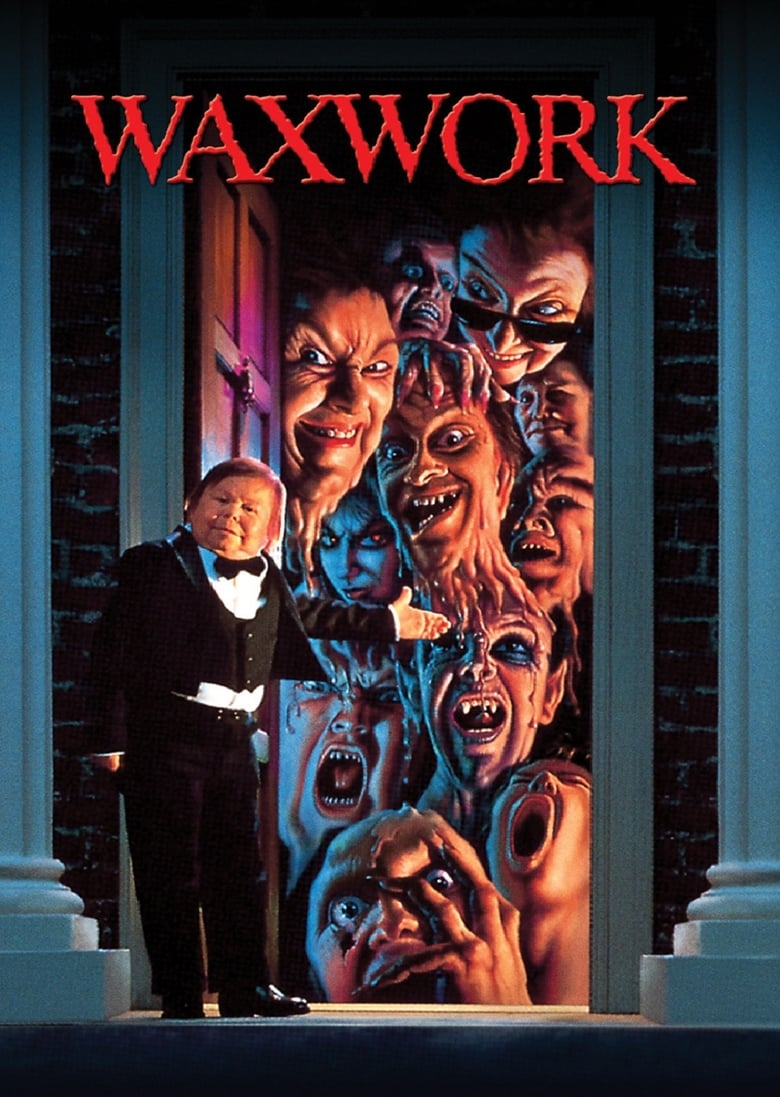
Wealthy slacker Mark, his new girlfriend Sarah, and their friends, are invited to a special showing at a mysterious wax museum which displays eighteen of the most evil men of all time. After his ex-girlfriend and another friend disappear, Mark becomes suspicious…
About Waxwork
Why Waxwork still stands out
There’s an appealingly daft premise at the heart of Waxwork: a tightknit group of college students wander into a strange wax museum and find the displays aren’t just dusty dioramas. That simple set-up — curiosity, a rope barrier crossed, rules ignored — is the engine that drives 93 minutes of mayhem, from a Gothic castle to a cabin in the woods.
Anthony Hickox directs with the sort of no-nonsense economy the idea demands. The film doesn’t over-explain; it keeps moving, which helps when your cast includes the likes of Zach Galligan, Deborah Foreman and Michelle Johnson as the young trio who bring the whole thing to life. It’s brisk, slightly silly, and never shy of sending characters into proper horror set-pieces. Then there’s the catalogue of monsters. Miles O’Keeffe turns up as Count Dracula and other familiar figures — including the Marquis de Sade — show the movie knows its horror tropes and isn’t above having a bit of fun with them. Waxwork wears its genre-mongering proudly; it’s a crossover playground where vampire fangs and zombie hands are expected party guests.
Why Count Dracula matters
Count Dracula in Waxwork isn't an abstract idea — he’s one of the museum’s actual ticketed attractions, and his appearance has consequences. China Webster ends up in a castle display where vampires do what vampires do, and Dracula’s bite turns her into one of them. That shift matters because it changes a friend into something recognisably dangerous for the group.
That moment also proves how the film treats its monsters: they’re stock figures from the horror canon, yes, but they get to act on the story’s emotional stakes. Dracula isn’t just a cameo; his sequence creates a real fracture in the friendship at the film’s centre, the kind that makes later scenes feel personal rather than just schematic.
There’s a further moral wobble in the way the museum operates. The exhibits aren’t neutral set-decoration — they’re filled with the past’s evils brought forward by a man who traffics in other people’s darkness. Placing Dracula in that context turns him into part of a larger, almost systematic threat to home and safety.
And when the bullets and chaos finally arrive, the film gives space to the aftermath: surviving characters have to accept that some likenesses aren’t the people they knew. Jenkins’s line about the vampire that looked like China — that it only looked like her — is short, blunt and a reminder that the horror here bites into friendship and family, not just flesh.
Waxwork has more on its mind than the plot suggests
On the surface Waxwork is a catalogue of horror set-pieces. Underneath it’s stitched from worries about family and the ordinary places we imagine to be safe. The museum’s threat interrupts a suburban life and drags the characters into consequences that have nothing to do with campus pranks.
Parental protection is threaded through the story: adults show up to fight properly, and family history—old murders, stolen trinkets—matters to how the threat is understood and confronted. The villains aren’t just monsters in a gallery; they’re connected to a theft of legacy, an attempt to resurrect bloody histories into the present.
Friendship is where the movie actually earns its beats. The group dynamic — who believes what, who rushes in, who stays behind — makes the danger emotional. When a friend is turned or reappears as a wax figure, it’s not a gimmick: it’s a rupture that the surviving characters must acknowledge or be broken by.
Finally, Waxwork loves its fears but asks for courage in return. The monsters test what the characters are willing to accept about mortality and identity; courage isn’t grand speeches, it’s choosing to enter the place that did this and try to stop it. That keeps the film from being mere pastiche: the scares have stakes for people you’ve followed across the runtime.
Waxwork could not belong to any other decade
Released in 1988, Waxwork sits neatly at the tail end of an era that loved blending genres. It’s very much an '80s movie in temperament: an appetite for mash-ups and for letting a ruinous idea run at full speed.
That era’s films often mixed horror with a wink — not to shrug off danger, but to make the fright feel like an outing rather than an endurance test. Waxwork treats its catalogue of creatures as a box of party tricks that can still bite, and that’s a distinctly late-’80s approach.
There’s also a confident efficiency to films of the period: a compact runtime, a premise you can explain in a sentence and the willingness to let set-pieces define tone. Waxwork’s 93-minute run-time is exactly the right length for a movie that prefers momentum to meditation. Put simply: Waxwork belongs to 1980s movie culture because it pairs a high-concept gimmick with a youthful cast and refuses to take itself too seriously while still caring about who survives the joke.
What has aged — and what hasn't
Some elements hold up genuinely well. The film’s riff on familiar monsters still reads as fun and immediate because those creatures are used to test character rather than exist as mere set-dressing. China’s Dracula sequence, for example, still lands because it changes how the group relates to one another.
Likewise, the movie’s central worries about home, safety and the cost of confronting a violent past remain readable. The backstory about stolen artifacts and an organised attempt to revive historical evils gives the plot a tidy spine that modern viewers can follow without needing extra explanation.
Things that feel more dated are the film’s reliance on stock horror types as quick shorthand. That was intentional — Waxwork trades on those familiar faces — but for some viewers today the rapid-fire parade of tropes can feel like the movie is keeping one eye on a checklist.
Still, there’s honesty in the film’s darker moments. The film doesn’t always reward its characters and it leaves a few things in a messy state — Sir Wilfred’s fate and the scuttling zombie hand are reminders the world this film scares up doesn’t neatly resolve. That bluntness helps the film keep a toe in genuine horror even while it chuckles.
Why Waxwork still matters
What keeps people remembering Waxwork isn’t a single scene or a single monster; it’s the movie’s basic recipe: a group of young friends, an uncanny museum, and the kind of escalation that turns jokey scares into real danger. That combination makes the film easy to talk about because you can point to moments — a werewolf attack, a Phantom display, a mummy’s revenge — and say, 'Remember that bit?'
David Lincoln, the taciturn gentleman who lures the group into the exhibit, gives the film a neat villain to hang the various sequences on. He’s the connective tissue that explains why these displays aren’t inert curiosities; they’re an active menace with a purpose tied to the past.
The film’s structural idea — people crossing a boundary and being absorbed into mythic scenarios — makes for memorable payoffs: friends gone missing, familiar faces reappearing as wax figures, and the chilling discovery that certain exhibits resemble the missing. Those moments turn a novelty into a consistent through-line.
Finally, there’s an emotional residue in the film’s endgame. When grown-ups arrive with guns and someone comforts a grieving hero with the point that the monster merely resembled a friend, the film acknowledges loss and substitution in ways a pure joke-fest would not. That balance is why Waxwork still turns up in conversations among viewers who grew up with it.
Does Waxwork still hold up?
Yes — if you want a compact, mischievous horror-comedy that treats its monsters as reasons to worry about people rather than occasions for effects reels. The premise is simple: a group of students visit a mysterious wax museum and discover the exhibits are dangerous, and the movie mostly does what it promises without dawdling.
If you’re looking for emotional subtlety you’ll find it in small places: the fallout of a friend turned into a vampire, the revelation of an older crime connected to family, and the idea that grown-ups will get violent to protect what’s left. Those are the threads that lift Waxwork above pure pastiche.
If you prefer horror that reinvents the wheel, Waxwork isn’t that. It revels in familiar monsters — Count Dracula and the Marquis de Sade among them — and uses those figures to create jolts and a few genuine little shocks, like the unsettling ending detail that the threat hasn’t entirely been snuffed out. So should you watch it now? If you enjoy genre-bending, late-’80s energy and don’t mind the occasional bluntness, it’s worth a sit-down. Waxwork still works as a crowd-pleasing, slightly grubby haunted-house movie that remembers friends and family while the wax melts.