Village of the Damned
“What Demonic Force Lurks Behind Those Eyes?”
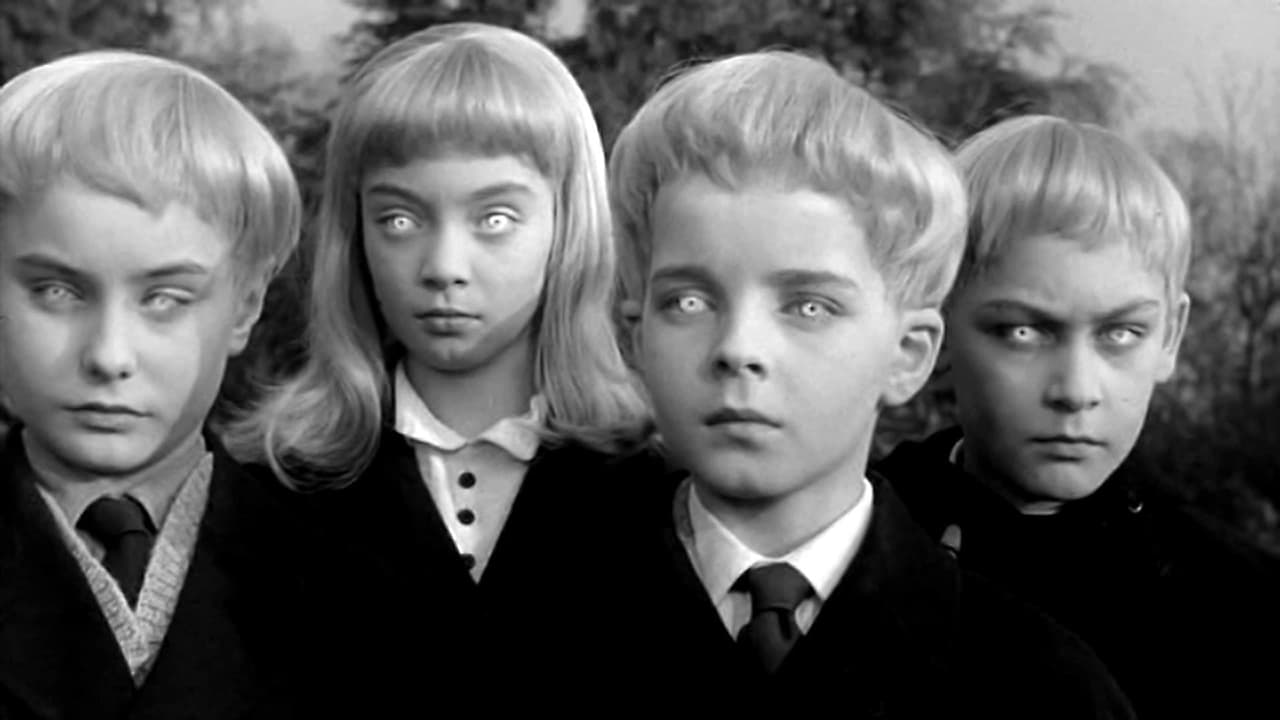
In a small English village everyone suddenly falls unconscious. When they awake every woman of child bearing age is pregnant. The resulting children have the same strange blond hair, eyes and a strong connection to each other.
About Village of the Damned
What makes Village of the Damned worth revisiting
There’s a moment at the start of Village of the Damned that never loses its power: Midwich simply goes quiet. Villagers slump where they stand, animals fall still, and the little English world freezes for a few mysterious hours. It’s a premise that hooks you before the credits have finished.
That premise is the film’s engine. Wolf Rilla keeps the running time tight — 77 minutes — and uses the mystery to ask questions about family and control rather than stretch into needless spectacle. When the sleepers wake, the trouble has already begun: pregnancies that don’t add up, children who mature too fast, and an entire village placed under military watch with a visibly baffled science on hand.
At the centre of it sits Professor Gordon Zellaby — George Sanders’ character — a man who becomes the film’s human way in. He’s the one trying to keep a family together while the town and the authorities try to figure out what to do with a very awkward new generation.
The idea that sets Village of the Damned in motion
The setup is economical and unnerving. Midwich experiences a blackout-like event that leaves everyone unconscious for a few hours; when they wake, life appears unchanged — until the dominoes fall. Scientists and the military immediately treat the village as a sealed experiment (they even discover a caged canary goes out the moment it crosses the village border and revives when removed), which gives the story a clinical edge.
Two months later the uncanny consequence becomes obvious: every woman and girl of child-bearing age is pregnant. The pregnancies run erratically — foetuses appear far more advanced than they should — and all the births happen on the same day. What starts as a mystery quickly turns into a problem the village must contain.
The children themselves are the hard part. They grow fast, think like adults, and form a telepathic bond that keeps them in step with one another. The town’s reaction is predictable: fear, suspicion, and the need to isolate them. The authorities move them into a separate school where they live and learn under watchful eyes.
And when world powers intervene — including a report that another country resorted to extreme measures against their own strange brood — the setup stops feeling like a local crisis and becomes a much starker moral question.
Why Gordon Zellaby matters
Gordon Zellaby is the personal anchor in a film that could easily reduce everyone to a collection of frightened reactions. He’s a professor, he’s the father of one of the strange children, and crucially he’s willing to engage with them rather than simply vilify them. That makes him the moral fulcrum of the story.
He sits in meetings with British Intelligence and hears the wider picture: Midwich is not unique. Other places on Earth have experienced the same blackout-and-pregnancy phenomenon, and what happened afterward varies wildly — in some towns the children died at birth, in others the communities turned on them, and in one case the children were reportedly being educated abroad. Those global notes push Zellaby to treat the children not just as a local danger but as a subject worth studying.
Zellaby’s drive is family-shaped. He wants to teach and learn; he wants to keep his son, David, safe. That parental impulse is sympathetic and sensible, even as the film steadily makes clear how fragile that sympathies becomes when the children prove able to bend minds and wills.
Finally, Zellaby’s choices carry the narrative weight. He is the father who tries to find a humane answer, and the film uses his struggle to force the audience into the same uncomfortable position: what do you do when the child you love becomes something that can harm others?
Village of the Damned has more on its mind than the plot suggests
On the surface it’s a tidy horror–science-fiction blend: strange event, strange children, escalating incidents. Underneath, Village of the Damned is quietly occupied with family and protection — and with how parental instincts collide with community fear and power. That tension is the film’s real engine.
The children’s telepathic bond and their ability to read minds and control people turns ordinary social ties into weapons. Their immaculate, adult manner — the way they always move as one and speak in measured tones — reads as both eerie and devastatingly efficient. The film translates that coldness into social panic; the villagers and even their dogs react with real fear.
Power is a recurring idea: the children have it in a literal, frightening sense, but institutions have it too. The military cordons the village; intelligence briefs intervene; other nations decide whether to isolate, educate or violently remove the problem. Those competing uses of force raise the question the movie keeps circling: who gets to decide what’s human, and who gets to act on that decision?
And because the children elicit both parental protection and communal self-preservation, the film makes the audience complicit. We understand Zellaby wanting to help, and we also glimpse the logic of containment. That tug-of-war is what stops Village of the Damned from being mere genre exercise and makes it an uneasy little study of power and fear.
Village of the Damned could not belong to any other decade
Released in 1960, Village of the Damned sits at a particular moment where postwar anxieties about control and the unknown were easy to channel into neat science-fiction scenarios. The picture’s willingness to treat a rural English village as a locus for an almost clinical mystery is very much of its time.
What helps is the film’s compression: at 77 minutes it doesn’t dilly-dally. That short, sharp storytelling feels efficient in a way films of the era could be — an economy of means that forces the script to focus on moral choices rather than spectacle.
At the same time the movie’s mix of horror and science-fiction — the uncanny children, the military cordons, and the international aftermath — captures a growing interest in stories where ordinary domestic life is invaded by something wider and less comfortable. It’s a neat, period-appropriate set of preoccupations that still reads clearly today.
What has aged — and what hasn't
The parts that age well are the story’s moral tightrope and its spare efficiency. The themes of family and fear — a parent trying to shelter a child whom the community increasingly distrusts — remain immediate and uncomfortable. Those human stakes don’t depend on style trends, so they hold up.
The children’s behaviour — their group movement, their adult manner, their coldness — still lands as genuinely unsettling. That composure is the film’s white-hot chill; it turns ordinary English domesticity into something quietly threatening, and that tone still reads as deliberate and unnerving.
Where the film is more dated is in the bluntness of some plot escalations. The international examples the authorities cite — other villages that reacted in extreme ways — make sense for raising the stakes, but they also announce answers to the dilemma rather than letting every moral choice simmer. Modern viewers used to more ambiguous slow-burns may find it a bit blunt in places.
Still, if you come for a compact, intelligent genre film that makes you squirm with questions rather than squall with effects, Village of the Damned largely delivers.
Why Village of the Damned still matters
Why does the film stick in people’s heads? Because it turns a neat speculative premise into domestic terror. The image of an entire village dropping unconscious and the subsequent discovery of uniformly strange children — with their arresting pale eyes, unusual hair and narrow nails — is the kind of specific detail that lodges in the memory.
The children are more than a look; their telepathic bond and the very adult ways they move through the village make them the movie’s persistent nightmare. When the film shows them using their power to cause accidental deaths to become deliberate, it converts a moral puzzle into visceral dread.
There’s also the human angle: Zellaby’s attempt to teach and understand the children gives the story a humane counterweight. That effort complicates the viewer’s sympathies, especially when the international reports surface — other communities reacted with fear or violence, and one nation apparently wiped out its unusual population. Those external notes widen the film’s scope and explain why viewers keep returning to it; it’s not just a local oddity, it’s a small story with big ethical echoes.
Finally, the escalation to a tragic last act — an attempt at a desperate solution that ends in catastrophe — keeps the film from being merely intriguing; it turns it into a cautionary tale about how good intentions and desperation can collide with deadly results.
Does Village of the Damned still hold up?
Yes — but with a small, important caveat. Village of the Damned remains an effective, compact piece of work precisely because it’s economical: a precise premise (a whole village blacks out), a clinical containment (the military tests with a canary and a gas-masked man), and a tense moral problem centered on one family and one curious professor. That economy keeps the film taut and gripping across its 77 minutes.
The show’s central question — how do you protect your child when that child can read your mind and force others to act — still cuts. Zellaby’s decision to engage with the children, to teach and understand rather than simply condemn, gives the film its emotional charge. But the story also makes clear the limits of that approach: when the children demonstrate they can compel death and when other nations answer with irreversible violence, the options narrow fast.
If you’re watching now for a modern scares-fest you’ll find it restrained; if you’re watching for a cold, morally tricky little film about power, fear and family, it’s worth a look. There’s bravery in the film’s refusal to paper over the consequences of its dilemma: good intentions don’t always save you, and the attempt to stop what’s coming can become the most dangerous act of all.
So yes — watch it. It’s short, smart and uncomfortably clear-headed about what happens when parental love collides with an unanswerable threat.