
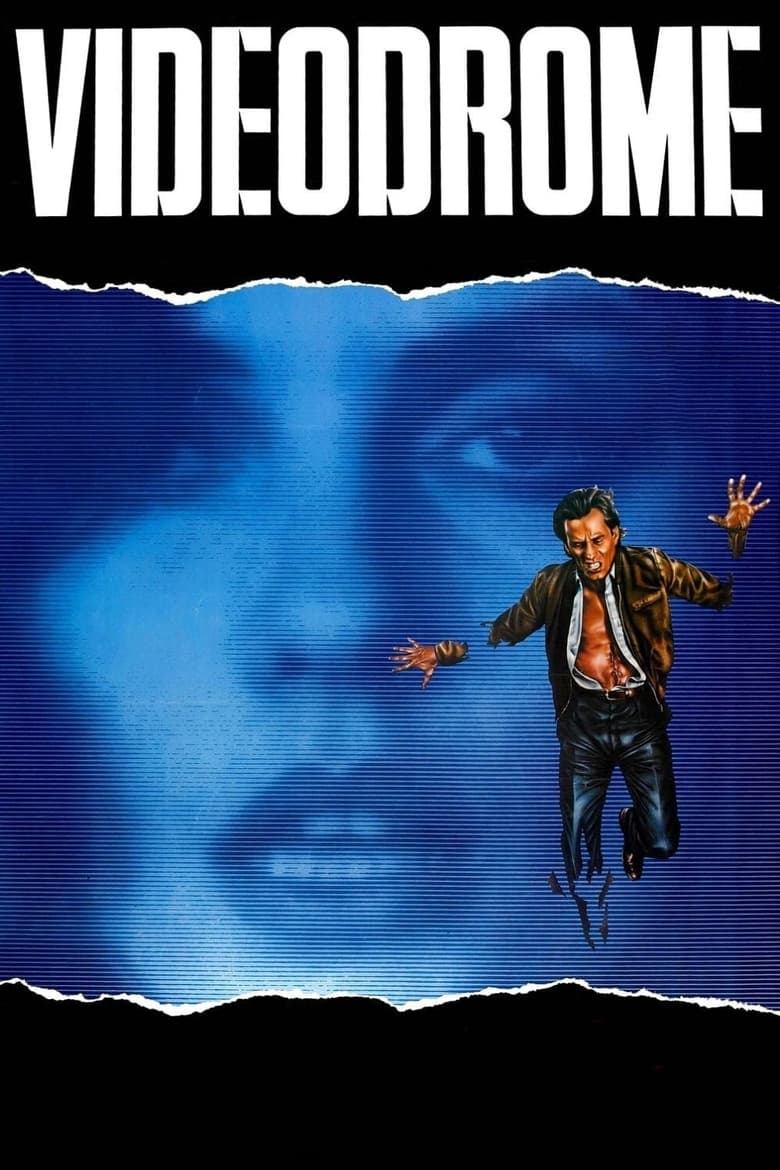
Videodrome
“First it controls your mind. Then it destroys your body.”
As the president of a trashy TV channel, Max Renn is desperate for new programming to attract viewers. When he happens upon "Videodrome," a TV show dedicated to gratuitous torture and punishment, Max sees a potential hit and broadcasts the show on his channel. However, after his girlfriend auditions for the show and never returns, Max investigates the truth behind Videodrome and discovers that the graphic violence may not be as fake as he thought.
About Videodrome
Why Videodrome still works
There’s a particular image from this film that lodges in your head: a television becoming, briefly, something that answers back. That moment — when the screen stops being a flat window and starts to behave like a living thing — tells you straight away what kind of movie this is. It’s short, sharp and unforgiving, and it doesn’t waste time getting weird.
At the centre is Max Renn, the president of CIVIC‑TV, a Toronto UHF outfit that trades in sensationalist programming. He’s the sort of man who spots the future on a late‑night feed and decides it’s worth chasing. That feed, shown to him by an operator called Harlan, is a programme called Videodrome: brutal, plot‑light broadcasts of torture and murder that Max thinks could be the next big thing for television. David Cronenberg directs, and the whole thing runs under an hour and a half. Layered on top of the body‑horror surface are clearer preoccupations — technology, family, corporate power, loss and mortality — and a small, memorable cast: James Woods as Max, Debbie Harry, Sonja Smits, Leslie Carlson and Jack Creley among them. Put it all together and you get a compact, distinctive film that still forces you to squint at the screen and ask what you’ve been feeding your brain.
The idea that sets Videodrome in motion
The engine of the film is simple and unsettling. Harlan, who runs CIVIC‑TV’s unofficial satellite dish, brings Max a programme called Videodrome — a sequence of filmed atrocities that looks like nothing on regular television and seems to exist for its own sake. Max’s instinct is business‑minded: this could be what viewers want, so start recording it.
That is the seed. From there the story pulls Max into other people’s orbit. Nicki Brand, a provocative radio host who becomes involved with him, reacts to one episode in a way that makes Max sit up and take it more seriously. And when Max asks around, he’s sent to people who treat this footage like something bigger than entertainment.
Masha, who deals in soft‑core material, tells Max the tapes are real and that a media theorist called Brian O’Blivion knows more. O’Blivion’s work and the strangers who gather around him offer a different reading: these broadcasts aren’t just spectacle, they’re a political and philosophical problem — and someone, somewhere, is trying to control the signal.
On a more practical level, the show’s indirect proof of danger — a missing person, a body that disappears, the frantic attempts to document what’s happening — keeps the narrative moving without turning into a blow‑by‑blow recap. The setup works because it gives Max a clean, professional reason to chase something that quickly becomes personal.
Why Max Renn matters
Max isn’t a heroic investigator. He’s a station boss who sees a gap in the market and leans into it. That matters because everything that happens to him grows out of professional calculation: this is what he sells, this is who he thinks his audience is, and he’s prepared to push boundaries to stay ahead.
Because he runs CIVIC‑TV, Max moves naturally between the business of broadcasting and the people who feed it — operators, fringe producers, on‑air personalities. That position makes him a useful point of contact for the film: a practical man whose curiosity pulls him from the boardroom into darker, stranger territory.
Max’s relationships also make the film sharper. His connection with figures such as Nicki, and his eventual discovery of Bianca’s involvement with her father’s vision, turn what could have been an abstract warning about media into something intimate. Family, in that sense, becomes literal and ideological: loyalties shift and the idea of who’s protecting whom gets complicated.
Put simply: Max matters because he’s both the reason the camera is on and the person who pays the price when the picture changes. He’s the pivot between small‑time television sleaze and the larger forces — philosophical, corporate, familial — that the film wants to interrogate.
Videodrome has more on its mind than the plot suggests
On the surface, it’s body horror and televised cruelty. Look a little deeper and the film is fussing with similar questions throughout: what does technology do to desire? How do corporations shape what passes for culture? And what gets lost along the way?
Technology is the obvious throughline. The show at the centre of the picture is itself a technological artefact — a signal that circulates, infects and changes behaviour — and the film repeatedly ties human choices to what the machines make possible.
Family is an unexpected but steady presence. It appears as literal kinship in the O’Blivion storyline and as a set of adopted loyalties — who cares for whom, who recruits whom — which makes the battles over ideology also feel like interpersonal struggles. Corporate power and loss sit beside those ideas. The forces trying to control the signal are not purely abstract; they are organised, interested and willing to use technology as an instrument. That combination — personal attachment plus institutional might — gives the film a weight that stops it being mere shock for shock’s sake.
Videodrome could not belong to any other decade
Videodrome arrived in 1983, and that placement matters. It’s a film that takes television — still a dominant cultural force for most audiences then — and treats it as a social vector: something that can spread ideas and alter behaviour.
Because the film is wired to that particular technology, it feels rooted to its time more than to a fashion. The anxieties it dramatises are the anxieties of an era in which broadcast signals and media economies were shaping public life in new, often invisible ways.
That 1983 timestamp gives the movie a specific tension: the collision between domestic screens and institutional power. It’s not nostalgia so much as a conversation with a moment when those conversations were only just beginning.
Seen in that light, Videodrome reads like a product of its decade without being reduced to it — a piece that uses the then‑present to ask questions that, as the film goes on to suggest, outlast any single year.
What has aged — and what hasn't
A lot of the film’s discomfort now comes from its ideas, which age better than surface shocks. The family element still reads as a useful engine: who you trust, who recruits you and how personal belief systems can be weaponised — those dynamics haven’t become quaint.
One surprisingly modern detail is the depiction of people who sit and watch for hours. Max’s search leads him to a homeless shelter where groups gather for marathon television viewing; the image of people surrendering to a continuous broadcast feels oddly contemporary in an age of bingeing.
On the other hand, some of the bodily moments remain blunt in ways viewers will either admire or flinch from. The film doesn’t shy away from physical jolts — waking up to a corpse in your bed is still the sort of thing that makes a modern audience wince.
Overall, Videodrome hasn’t mellowed into harmless retro oddity. Its concerns about media, attachment and the costs of obsession still read as purposeful, and the places where it aims to shock still get their point across.
Why Videodrome still matters
People who grew up with this film tend to remember how it marries a grubby television world to a larger intellectual itch. Max Renn’s CIVIC‑TV is small‑time sensationalism, but the show Harlan brings in — the thing called Videodrome — reads like an escalator to far wider consequences. That slippage, from petty commerce to political threat, is what lingers.
The film also gives you characters who stand for different readings of television. Masha and Nicki gesture to the business around image and desire; O’Blivion and his daughter Bianca frame the medium as a destiny or a religion. Those conflicts keep the story from being only gore and make it into a debate, in motion.
There are memorable beats that people come back to: the discovery of O’Blivion’s videotapes arguing the signal is a battleground, the unsettling hallucinatory moments where on‑screen figures seem to address Max directly, and the way alliances form and collapse as the stakes rise. And yes, the film’s darker turns — the vanishing body, the revelations about who is manipulating whom, the implanting of ideas through media devices — all help the movie remain a talking point. It doesn’t settle into a single mood; it keeps nudging you from sleaze to philosophy to physical dread, and that restless movement explains why it stays on people’s minds.
Does Videodrome still hold up?
Yes — if you’re willing to let a film be argumentative and abrasive in equal measure. Videodrome is not gentle. It asks you to follow a small‑time TV boss into ever stranger company and then forces you to reckon with the idea that media can do more than entertain: it can change what we want and who we are.
That compact 89‑minute runtime helps. The film never lingers where it doesn’t need to; it moves from Harlan’s late‑night feed to Masha, to O’Blivion, to the corporate figures trying to harness the signal, and those jumps keep the ideas crisp and the tension high. It is, simply put, economical in its strangeness.
If your tolerance for bodily grotesquery is low, parts will be hard going — waking up to a corpse and the film’s deliberate use of physical shock are meant to unsettle. But those elements are in service of the questions the film is asking about technology, family and corporate power; they aren’t gratuitous decoration.
So should you watch it today? Absolutely, if you want a short, smart provocation about screens and desire that doesn’t pretend to be comfortable company. Videodrome still bites, and that bite is exactly why it’s worth revisiting.