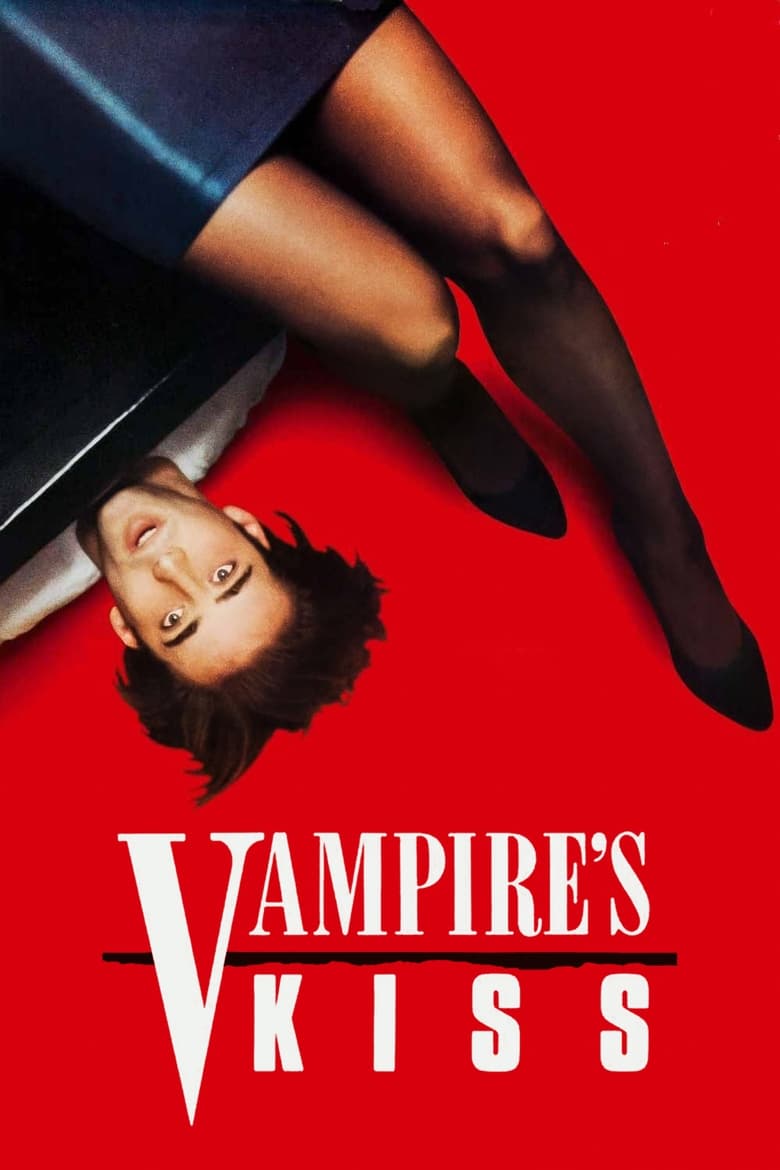
Vampire's Kiss
“Seduction. Romance. Murder. The things one does for love.”
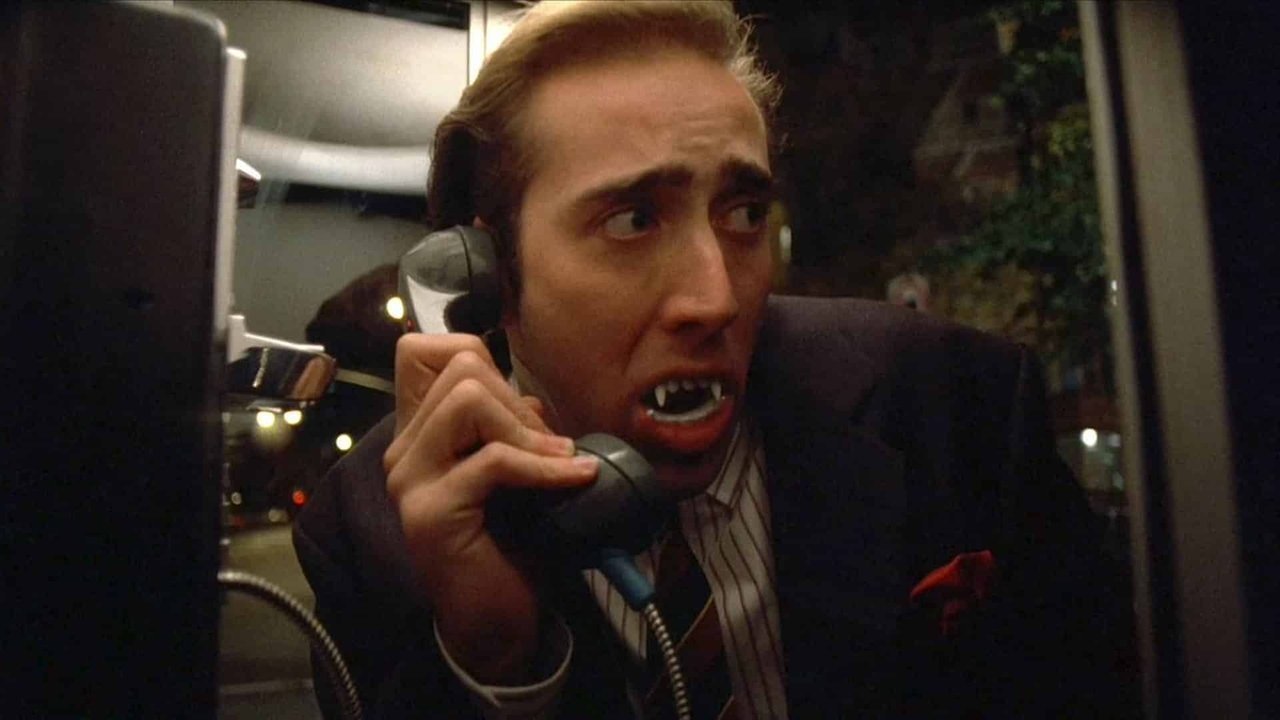
A publishing executive is visited and bitten by a vampire and starts exhibiting erratic behavior. He pushes his secretary to extremes as he tries to come to terms with his affliction.
About Vampire's Kiss
What Vampire's Kiss gets right
Peter Loew is the movie’s north star: a New York literary agent whose life is mostly work, short flings and regular trips to a therapist. That combination — ambition without much else to hold it — sets the tone for a film that prefers psychological calamity to neat scares.
The camera never forgets the genre it’s working in. Vampire's Kiss wears its comedy‑horror label on its sleeve: one minute a nightclub encounter feels like a cheeky late‑night hook‑up, the next a fanged bite upends the evening and leaves reality wobbling. It’s an odd balance, and the film leans into the discomfort of that wobble. Robert Bierman directs a tight 103 minutes of escalating unease. The cast around Peter — his put‑upon secretary Alva, the enigmatic Rachel, the spurned Jackie — are all small pivots that let the central premise do its work: watch a man’s life rattle apart and try to pretend nothing’s happened.
The idea that sets Vampire's Kiss in motion
At its simplest the film begins with a late‑night meeting: Peter meets a mysterious woman called Rachel at a club and brings her home. That single encounter — which may or may not have been what it seemed — is the sharp pebble dropped into Peter’s tidy life.
From that uncertain event springs the story’s engine: reality and imagination start to trade places. As Peter’s grip loosens he begins to misunderstand reflections and people, and small oddities become evidence for something larger and more catastrophic.
It’s a premise that works because it keeps the audience guessing whether the threat is supernatural, psychiatric, or simply the result of a man whose life has little to anchor it.
So the set‑up isn’t just about fangs and a bite. It’s about what a single night does to someone whose private world is already precarious.
Why Peter Loew matters
Peter Loew is written as a portrait of a certain kind of late‑decade professional: all confidence and little in the way of lasting attachments. Nicolas Cage plays him, yes, but the point here is the figure on the page — a man whose life is mostly a series of transactions and appointments.
That emptiness is why the vampire idea lands so effectively. If your social life is an assortment of one‑night stands and the nearest thing you have to intimacy is a therapy appointment, a dramatic interruption is more than theatrical — it’s existentially destabilising.
Peter’s behaviour toward the people around him — particularly his secretary, Alva — turns a personal unraveling into something that threatens others’ safety and comfort. The film uses those relationships to show how private collapse becomes public harm.
And there’s another, quieter point: Peter’s story is woven into the movie’s themes of family and loss. Even when he pursues escape, the film keeps drawing him back to ordinary human ties — sometimes with violent consequences.
Vampire's Kiss has more on its mind than the plot suggests
Underneath the horror‑comedy surface the film is quietly occupied with family. It doesn’t stage a conventional family drama, but the presence of siblings and confidants gives the story a human anchor when Peter’s world starts to tilt.
Home and safety are treated oddly here — the apartment that should be a refuge becomes a place of deterioration rather than rest. That inversion turns domestic spaces into psychological territory.
Memory is another recurrent idea: the film thrives on uncertainty about what actually happened versus what Peter remembers. That ambiguity is the engine of both tension and dark humour. And loss sits on the other side of everything. Whether it’s the loss of control, the loss of dignity or the loss of trust between characters, the movie keeps threading small defeats into a larger, fatal slide.
Vampire's Kiss could not belong to any other decade
Released in 1989, Vampire's Kiss sits at the tail end of the 1980s and feels of a piece with the decade’s fascination with self‑reinvention and professional identity. Peter Loew — the ambitious, image‑conscious agent — is a recognisable late‑80s type.
The movie’s blend of black comedy and urban paranoia lines up with several other films of the era that enjoyed twisting social anxieties into genre play. It uses that cultural moment to make its premise sharper: a man who should have status and control instead loses both.
That timing matters because the film reads differently coming from 1989 than it would from another decade. The background expectations — about success, therapy and public persona — are part of the machinery the story exploits.
In short: the film’s personality, for better or worse, is very much a product of its year and place.
What has aged — and what hasn't
A lot of the film’s basic machinery still works: the late‑night meet‑cute that might be a bite, the next‑day uncertainty, the gradual unmooring of reality. Those plot beats — meeting Rachel, the bed scene, the bandaged neck that won’t comfortably explain itself — retain an unsettling charge.
Other elements feel more peculiar to their moment. Peter’s descent into bizarre habits and self‑isolation — the weirdness he brings home, the way his apartment becomes a place he hides in — can still be persuasive, but they’re a rawer, less coded kind of storytelling than modern audiences often get.
Some beats are harder to watch now: the ways in which other characters are put in harm’s way or feel forced into uncomfortable positions are blunt and unvarnished. The story’s reliance on that escalating fear highlights how differently viewers respond to those dynamics today.
Still, the film’s willingness to let madness play out without tidy moral cover means it hasn’t gone cosy with time. It will unsettle you in places you might not expect, which is both why people remember it and why it remains a tricky watch.
Why Vampire's Kiss still matters
People keep talking about the film because it’s unusually uncompromising about a very particular collapse. Peter’s slide from confident professional to someone who can’t be trusted with his own reflection is a narrative that lodges in the mind.
The movie also endures because of the way it treats the people around him. Alva’s position — repeatedly humiliated and later frightened into staying away — and her brother’s involvement make the stakes feel immediate and personal rather than abstract.
There are memorable, grotesque images: Peter convincing himself he’s transformed, the small rituals he adopts, and the detritus of his smashed life. Those moments are why conversations about the film tend to focus on how far the comedy will go toward tragedy. Finally, the story’s refusal to tidy itself — from public outbursts to newspaper evidence that complicates the truth — leaves it lodged between tones. That uneasy holding pattern is what keeps viewers returning: the film is hard to classify, and that idiosyncrasy has a stubborn afterlife.
Does Vampire's Kiss still hold up?
Yes — but with a health warning. Vampire's Kiss remains a watchable, occasionally bracing piece of late‑80s oddness. It’s compact at 103 minutes and doesn’t try to smooth the edges of Peter Loew’s breakdown into comfort.
That said, parts of it are uncomfortable in ways that modern viewers will notice. The film straightforwardly stages behaviour that endangers other characters and forces them into painful positions; those beats feel blunt now rather than stylised.
If you can tolerate the film’s darker turns, there’s value in seeing a story that refuses to reassure. The themes it carries — family ties pulled taut, the collapse of home as refuge, memory’s slipperiness and the sense of loss that follows — are still resonant.
So watch it for its audacity rather than its gentleness. Vampire's Kiss isn’t a cosy nostalgia trip; it’s a small, sharp movie about what happens when a life with too little anchorage suddenly comes apart — and it leaves you staring at the wreckage.