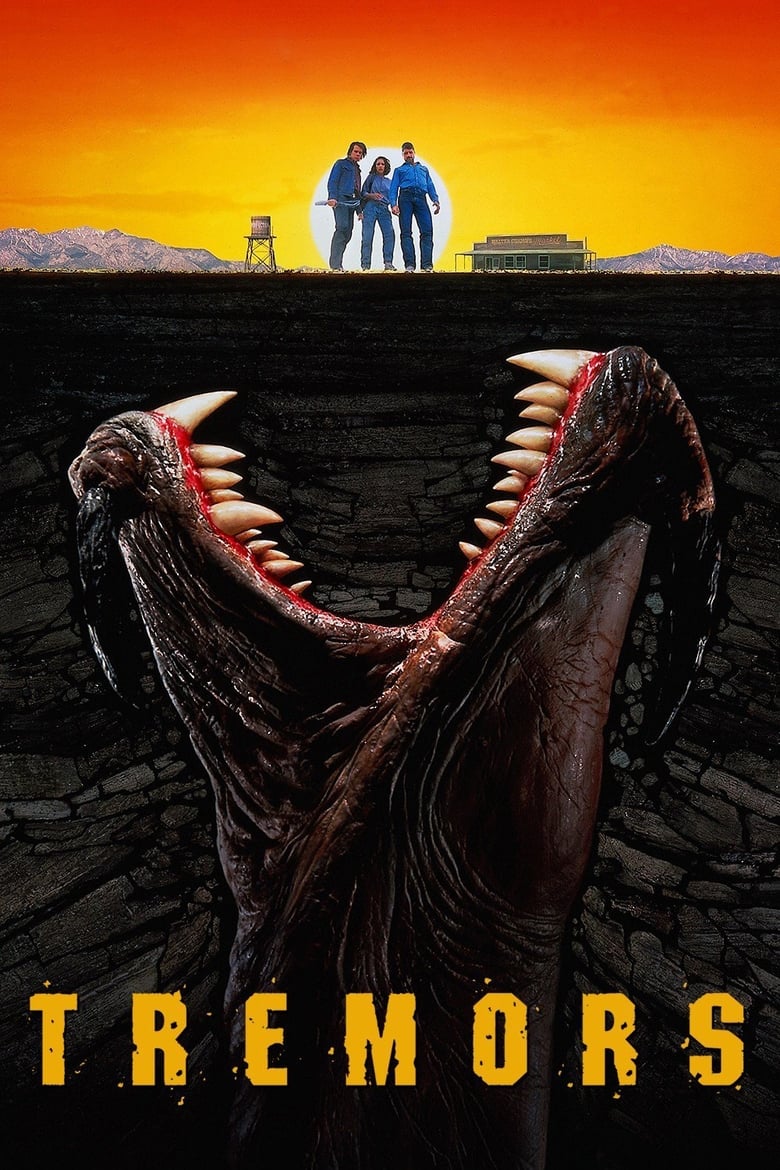
Tremors
“They say there's nothing new under the sun. But under the ground…”
Val McKee and Earl Bassett are in a fight for their lives when they discover that their desolate town has been infested with gigantic, man-eating creatures that live below the ground.
About Tremors
Why Tremors still works
There’s an immediately relatable set‑up: two handymen — Val and Earl — are so done with Perfection, Nevada, that they decide to leave town. It’s a small, human complaint, and it’s exactly the right place to plant a giant underground problem.
Ron Underwood keeps the engine tight. At 96 minutes, Tremors doesn’t linger on setup for the sake of atmosphere; it gets the people in place, then lets the trouble arrive and the personalities do the heavy lifting. The result is a genre stew — part science‑fiction comedy, part horror, part kaiju with an action streak — that never forgets to be entertaining. You remember the names because the film gives them room: Fred Ward’s Earl is the patient counterpart to Kevin Bacon’s Val, and the cast around them — Rhonda, Burt and even Heather Gummer — make the town feel like a community you wouldn’t mind being stranded with, provided the ground stays quiet.
The idea that sets Tremors in motion
At its simplest, Tremors is a small‑town story that suddenly has no way out. Val and Earl decide to leave Perfection, but before they can, strange deaths start to pile up — an electrician found dead on a tower, a shepherd and his flock mysteriously wiped out. Ordinary frustrations become urgent.
Those early discoveries flip the film’s tone from quiet domestic tiff to survival puzzle. The town’s attempts to get help are stymied — roads are blocked, phones go dead — which forces the characters to rely on themselves and on each other.
The reveal that the killers aren’t people but massive burrowing creatures reframes everything. When the townspeople learn the monsters hunt by sensing ground vibrations, the central problem becomes clear: how do you stay in motion without making the wrong kind of noise?
That premise — an isolated community, an unseen predator, and a handful of people improvising escape plans — sets up both the thrills and the jokes. It’s economical storytelling that gives the film room to breathe without becoming a laundry list of set pieces.
Why Earl Bassett matters
Earl Bassett is, in plain terms, the bloke who thinks in terms of plans. He’s one half of the pair who decide to leave Perfection, and that decision is what drags him into the mess — which matters because the film’s responses are character‑driven rather than purely plot‑driven.
He’s not the flashy hero. He’s the reliable one who, when trouble arrives, keeps his head and helps fashion a way through it. That steadiness gives the movie ballast: when danger escalates, you feel the weight of people trying to do the sensible thing under absurd conditions.
Earl’s presence also matters emotionally. After the crisis, he’s the kind of friend who tells Val to follow something more than restless feet — to go after Rhonda. It’s a small final nudge, but it reframes Earl as someone who values more than survival; he values life beyond the town’s grind.
In short: Earl matters because he anchors the film’s practical resourcefulness and, quietly, its belief that there’s something worth staying alive for.
Tremors has more on its mind than the plot suggests
Love shows up not as saccharine romance but as a practical reason to survive. The film keeps reminding us that people aren’t just trying to live; they’re trying to return to something worth living for.
Mortality is never far away. The early sequence of unexplained deaths makes the threat literal rather than abstract, and that immediacy keeps the stakes grounded even when the premise skews fantastical.
Freedom is a quieter theme: Val and Earl’s initial plan to leave town is about escaping routine, and the monsters force the characters to make choices about what freedom actually means — running away, making a stand, or building a new life. Those ideas — love, mortality, freedom — are the movie’s emotional ballast. They stop Tremors being only a set of creature encounters and make it a film about people deciding what they want to fight for.
Tremors could not belong to any other decade
Tremors arrived in 1990, right at the cusp of a decade that liked its genre blends neat and fast. It feels of that moment because it’s willing to hold comedy next to genuine peril without apologising for either.
The film’s mix — science‑fiction comedy, horror and even a touch of kaiju — mirrors a period when studios were open to modestly scaled, high‑concept fare that hinged more on a clever hook than on blockbuster trappings.
Its compact running time and economical storytelling are also very much of the era: a brisk 96 minutes that gets you in, gets you involved, and gets you out having had a proper adventure.
Put simply, Tremors wears its 1990 birthdate comfortably: it’s a film built for audience enjoyment, not spectacle for spectacle’s sake, and that sensibility felt particularly contemporary at the decade’s turn.
What has aged — and what hasn't
What still works is the film’s resourcefulness. The survivors’ plan — luring the creatures into swallowing homemade pipe bombs — feels satisfying because it’s clever and earned. It’s the kind of do‑it‑yourself solution that plays well on any screen size.
The quieter moments age better than you might expect. The film ends with a return to normality — survivors getting officials on the line and, importantly, characters nudging each other toward real life choices. That emotional closure doesn’t require effects to sell it.
Where viewers might be less forgiving now is in anything that trades subtlety for convenience. But the central mechanics — improvisation, ingenuity and personal stakes — remain effective because they’re human decisions rather than spectacle.
All told, Tremors still plays as a solid, character‑forward monster movie: the practical plans and human resolutions give modern audiences an accessible hook even when they’re used to louder, flashier fare.
Why Tremors still matters
People remember Tremors because it combines a very simple, human starting point — two blokes fed up with their lot — with a vividly strange threat. That contrast between the ordinary and the monstrous sticks in the memory.
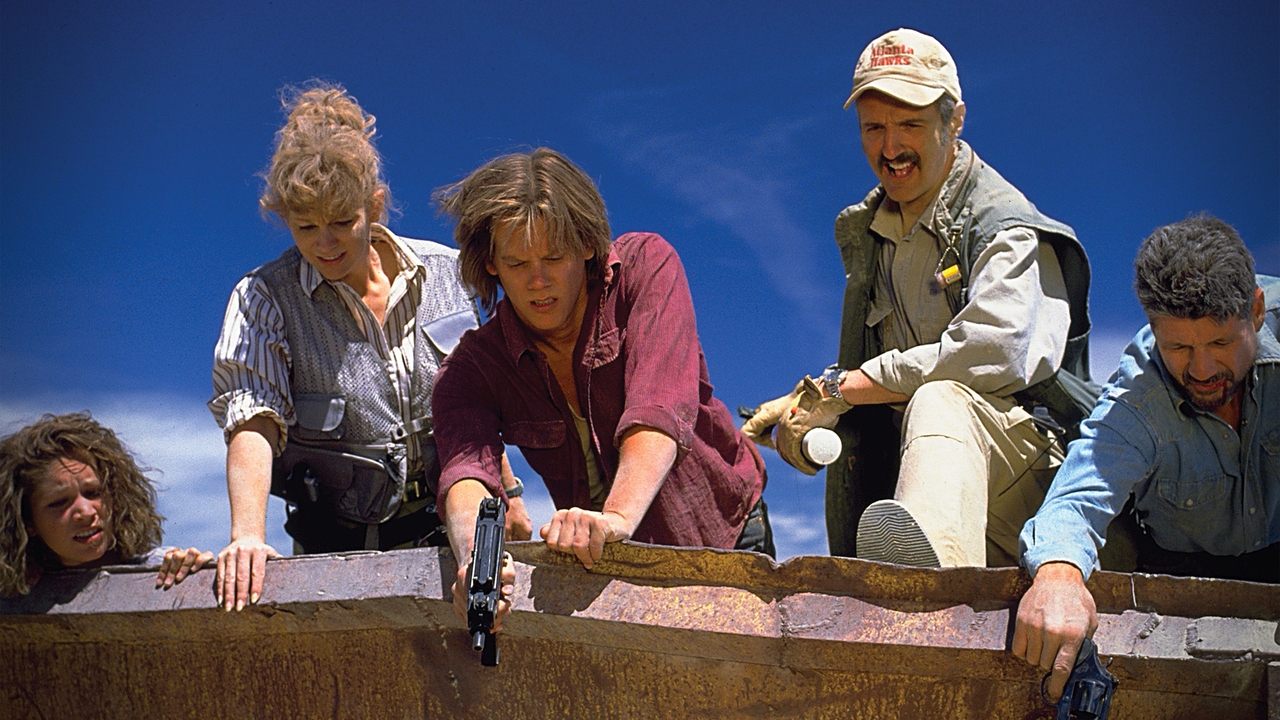
There are a handful of set pieces that linger: the subterranean reveal that transforms earlier incidents into something otherworldly, the rooftop scramble after the storekeeper names the creatures, and the way the monsters’ vibration‑based hunting forces the characters to invent new rules for survival.
The cast give the film its communal feel: the survivalist couple who turn up armed at the right moment, the graduate student who reads the monsters’ behaviour, and the handful of town residents whose fates remind you the threat is real. Those elements make the movie about people first and creatures second. And at the centre is a practical, satisfying finale: an improvised plan that takes the creatures out and leaves enough room for the characters to imagine life after the ordeal. That blend of threat, invention and small personal payoff is why the film still gets talked about.
Does Tremors still hold up?
Yes — if you’re after a lean, character‑led monster movie that balances laughs with genuine peril. Ron Underwood’s 1990 film runs a tidy 96 minutes and spends its time on people making smart, sometimes scrappy choices in a very bad situation.
If you enjoy genre mixtures — science‑fiction comedy, comedy horror, a bit of kaiju energy and plain action — Tremors delivers them without getting weighed down. The survivors’ plan to trap the creatures with homemade charges and the final push that drives the last creature over a cliff are the kind of endings that reward the film’s inventiveness.
It also holds up because it cares about what comes after the danger. The survivors don’t just survive; they return to town, call for help and start to think about lives beyond escape. That little insistence on personal outcomes — Earl nudging Val toward Rhonda — gives the film an unexpectedly warm aftertaste.
So yes: watch it for the monsters, stay for the people. Tremors remains a model of how economical storytelling, a clear premise and a few good ideas can make a film keep its bite.