
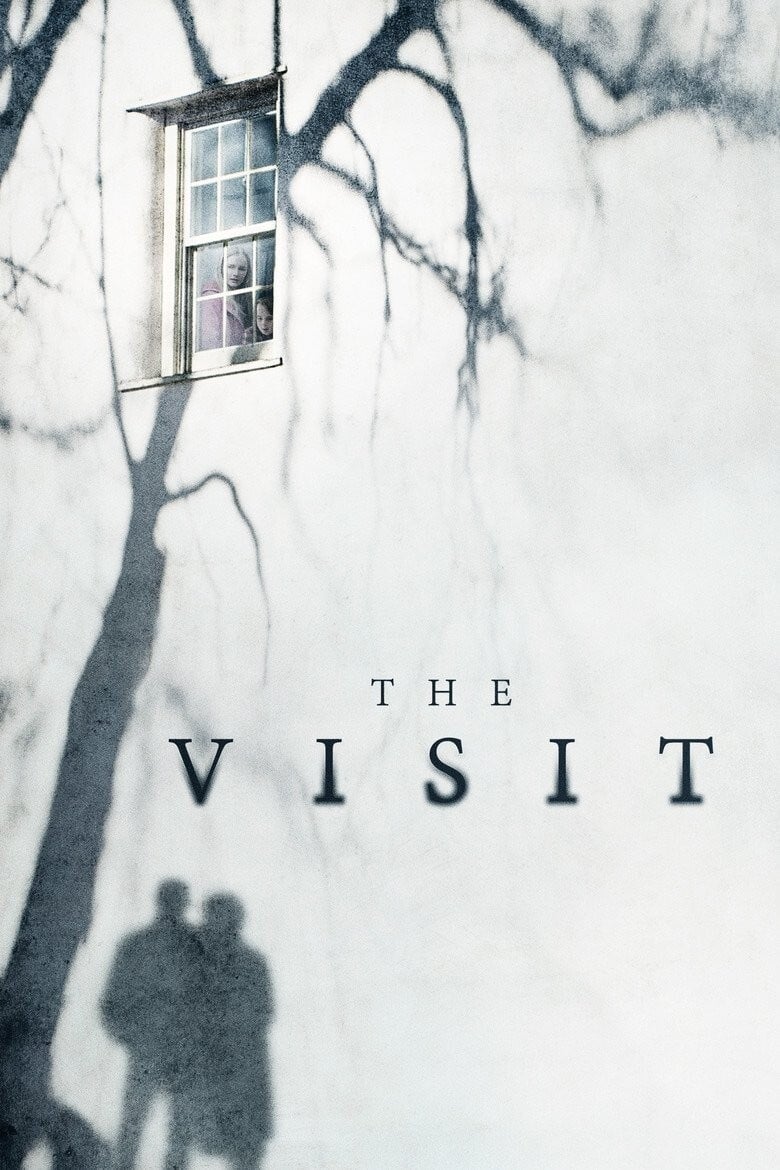
The Visit
“No one loves you like your grandparents.”
A brother and sister are sent to their grandparents' remote Pennsylvania farm for a week, where they discover that the elderly couple is involved in something deeply disturbing.
About The Visit
Why The Visit still works
The setup is disarmingly simple: Becca and Tyler are packed off to spend five days with grandparents while their divorced mother goes away. That ordinary family decision is the small shove that propels the whole film.
M. Night Shyamalan returned to the director’s chair in 2015 and keeps things tight — the film runs under one hundred minutes and wears its found-footage, teenage-documentary conceit like a comfortable jacket. It’s a small-scale horror about people you think you should be able to trust. That trust is what makes the film linger. The Visit trades big supernatural claims for the slow collapse of domestic certainties, so when the odd behaviour begins — projectile vomiting, a hide-and-seek chase, an attack in town — the atmosphere shifts from mildly strange to quietly menacing.
The idea that sets The Visit in motion
At the film’s hinge is one stubborn choice: Loretta hasn’t spoken to her parents for fifteen years, but rather than reconnecting herself she arranges for Becca and Tyler to visit them sight unseen. That awkward family history is the quiet tinder under the story.
The kids arrive with cameras and a plan — they intend to make a documentary about meeting grandparents they’ve never known. The camcorder framing gives the story a bootstrapped, DIY energy that keeps the perspective squarely with the siblings.
Rules that should be quaint start to feel ominous. The children are told to stay out of the basement and to be in their room by a set hour — small instructions that, in the context of increasingly odd behaviour, begin to feel like warnings.
What starts as a curious home-stay gradually becomes an evidence-gathering exercise. The kids stop hunting for charming anecdotes and begin looking for an explanation, and that shift from holiday footage to detective work is where the film gains its momentum.
Why Becca Jamison matters
Olivia DeJonge’s Becca is the sibling who wants the story. She arrives with a camera and a project, which gives the film its point of view: not merely terrified teenagers, but teenagers trying to make sense of what they’re seeing.
Her role is practical as well as emotional. Becca is the one who frames evidence, who chooses what to record and, crucially, who decides what the family story will include once they go home.
That decision matters because Becca’s choices mirror the film’s concerns about family history. At the end she opts to include footage of their father — a corrective moment to the way adult choices have shaped the children’s lives in the first place.
Becca’s pragmatism anchors the siblings when the household begins to unravel. The odd, increasingly alarming behaviour around the house gives her something to solve, and it’s her footage that ultimately tells the story back to the family.
The Visit has more on its mind than the plot suggests
On the surface it’s a home-invasion-style thriller told through kids’ footage. Underneath, it’s centrally about family: not the warm, nostalgic kind, but the messy inheritance of decisions parents make and the gaps those decisions leave behind.
Home and safety are constantly under negotiation here. The farmhouse is supposed to be sanctuary; instead it becomes the place where rules are enforced, trust is tested and boundaries are broken.
Parental protection — or the lack of it — is threaded through the whole film. The mum’s decision to send her children away, and the withheld truths about her past, are quietly responsible for the situation the kids find themselves in. Fear in The Visit doesn’t come from a single monster. It’s the slow unravelling of the idea that adults will keep you safe, and the uncomfortable fact that growing up sometimes means taking control of your own protection.
The Visit could not belong to any other decade
The Visit arrived in 2015, right in the middle of the 2010s. That placement matters because the film wears its decade lightly: it’s a tight, efficient piece of genre filmmaking aimed squarely at younger protagonists and their perspective.
Calling it a film of the 2010s isn’t just about the calendar. The decade saw a lot of horror willing to strip stories down to a few characters and a single location, and The Visit fits neatly into that economy — a compact, self-contained story.
It also benefits from the period’s appetite for blending formats: the idea of teenagers filming a project themselves feels of a piece with that decade’s curiosity about DIY storytelling and social media-era self-documentation.
Put simply: being from 2015 gives the film a headline — a mid-2010s horror that trusts a simple idea and a small cast to do heavy lifting.
What has aged — and what hasn't
The camcorder-documentary conceit still plays. Even if modern viewers are used to phones and livestreams, the choice to let the kids frame the action keeps the film intimate and immediate — it reads like two teenagers trying to tell the truth about a baffling situation.
As a piece of teen horror it still hits. The sibling dynamic, the combination of curiosity and bravado, and the way younger characters are forced to become investigators rather than passive victims holds up.
The themes of family and home remain persuasive. The Visit’s power comes from how quickly ordinary domestic rules twist into instruments of menace; that emotional pivot hasn’t dated.
Some of the film’s set-piece moments — strange behaviour that escalates into violence and the discovery that things are far worse than anyone suspected — retain their bite. The contrast between the banal and the grotesque is still effective.
Why The Visit still matters
There’s a simplicity to The Visit that guarantees it a shelf life. Two teens, a camera and an isolated farmhouse — that spare setup is the kind of idea that sticks in the head and is easy to explain at a party.
The film’s steady escalation from oddness to outright horror — the behavioural creep, the household rules that suddenly read like traps — is the part people remember. It’s the slow tightening of screws rather than a single big reveal.
The discovery that the house contains secrets meant to be hidden is a moment that reframes everything the audience has seen. That pivot from quirky to gruesome is the kind of beat that lives on in conversation. Finally, the film closes the loop: the children return to their mother and the family has to reckon with past choices. That sense of coming back to home, and the idea that adult decisions ripple down, is why the story lingers beyond its scares.
Does The Visit still hold up?
Yes — The Visit is worth watching now. It’s a concise ninety-four-minute film that does what it sets out to do: put two resourceful teenagers into a small house and make us worry that the people meant to protect them aren’t who they seem to be.
The camcorder framing and the kids’ documentary angle give the film a clear perspective, and the house rules — don’t go down, be back by a certain hour — are small details that pay off as the story tightens.
At heart it’s about family and home: how past choices echo, how protection can be misapplied, and how growing up sometimes means children having to look after themselves. Those ideas are delivered through a lean thriller that keeps the stakes immediate.
If you haven’t seen it, watch for the premise as much as the pay-offs. It’s not flashy; it’s a neat, focused piece of genre filmmaking that still makes a suburban visit feel unsettling.