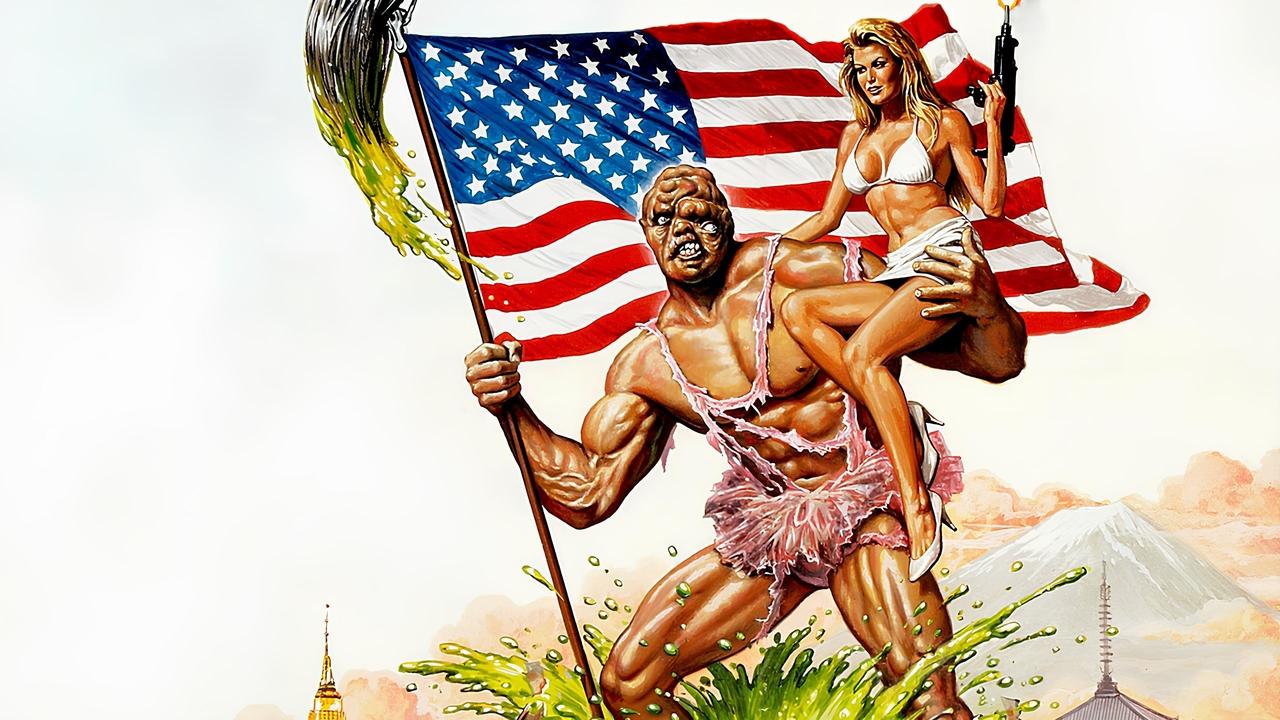
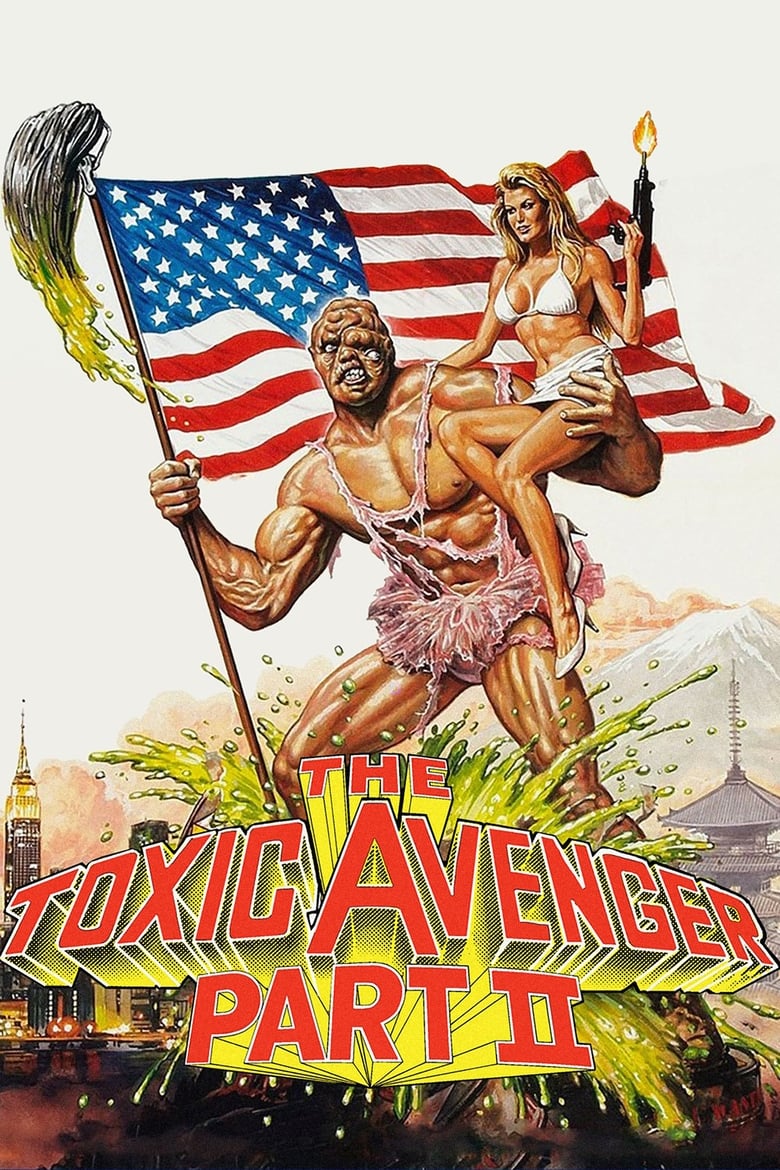
The Toxic Avenger Part II
“The first super-hero from New Jersey is back!”
Melvin Junko was a nerdy weakling until he fell into a vat of toxic waste, turning him into the first ever superhuman creature from New Jersey. This time, he takes on Tokyo.
About The Toxic Avenger Part II
Why The Toxic Avenger Part II still works
There’s a simple promise at the heart of The Toxic Avenger Part II: the grotesque figure who used to be Melvin Junko is still the town’s guardian. That alone gives the film a clear centre — Toxie isn’t an abstract idea, he’s the guy who made Tromaville safe again and who keeps showing up when the place needs him.
That clarity makes the movie a good companion piece for anyone who likes their weirdness with a purpose. It’s directed by Lloyd Kaufman and runs briskly, so the sillier detours — a trip to find Dad, a madcap chase, a string of battles abroad — never outstay their welcome.
And crucially, the film keeps folding personal stakes into its nonsense. Toxie isn’t wandering the world for kicks; his blind girlfriend Claire helps him find a job and then, when the town is threatened, those private ties become the reason he fights. It’s a nasty, noisy comedy‑horror that still believes in neighbours and loyalty.
The idea that sets The Toxic Avenger Part II in motion
The movie opens with a tidy trouble: Tromaville is safer because of Toxie, but a predatory corporation has other plans. That tension — protector versus takeover — is the engine that keeps things moving without demanding you follow every plot twist.
Rather than sit at home, Toxie is pulled into a very personal quest to find his father, which takes him overseas and into a string of absurd set pieces. Along the way he meets Masami, who becomes an ally after he rescues her from thugs, and that friendship redirects the hunt back towards home.
When the corporate menace exploits his absence and attacks the people Toxie cares for, personal stakes and town stakes collide. The film’s action choices — from chaotic chases to physical showdowns — exist to settle that single, stubborn problem: can this town stay safe now that its unlikely champion is away?
Why The Toxic Avenger / Melvin Junko matters
Melvin Junko’s accident made him into a guardian figure — a superhero with very domestic concerns. He’s not out for glory; he’s the creature who fixed Tromaville’s immediate problems and then kept checking on the people there.
That domestic anchor is what makes his journey to find his father feel less like a vanity quest and more like something tenderly selfish: he’s searching for roots at the same time as he’s trying to protect the home he already has. Claire, who helps him get a job at the Tromaville Centre for the Blind, is the human reminder that his battles have consequences.
He’s also a character who can be manipulated. When the villains use one of their ‘bad girls’ to persuade him to leave for Japan, it exposes how dependent Toxie is on the people who believe in him — and how dangerous it is when that protection is withdrawn.
Finally, his encounters in Japan — the discovery of a complicated father figure and the violent unraveling that follows — force him back towards Tromaville with a clearer sense of what, and who, he’s fighting for. That mix of monstrous appearance and stubbornly ordinary loyalties is what keeps him memorable.
Why John Altamura's performance matters
John Altamura is credited as playing Melvin Junko, the Toxic Avenger, and the film leans on that presence for several set pieces. One clear example is the moment when, after a bombing at the Centre for the Blind, Toxie returns from the rubble and deals violently with the intruders.
That sequence is built around the idea that the Toxie figure will reappear and change the shape of the scene — the film asks you to accept that this hulking, unwanted hero still has the power to stop immediate threats.
So rather than a showcase of subtlety, Altamura’s role functions as the physical proof that the narrative can pivot from tragedy back to protection in a single beat.
Put simply: the movie needs its Toxic Avenger to be a tangible force in moments like the rubble scene, and the casting supplies that functional presence.
The Toxic Avenger Part II has more on its mind than the plot suggests
Under the cartoon violence there are two steady concerns: family and the idea of home as something worth defending. Melvin’s search for his father is less about biography than about identity — about how much of ourselves we need to find elsewhere and how much we can protect in place.
Tromaville itself is treated as a household rather than a city. The film’s stakes are local and personal: when the town’s safety is compromised, the consequences hit family life directly.
Those twin themes keep the movie from becoming pure anarchic shock; they give every outrageous sequence a tether. Even the wildest set pieces are presented as responses to threats against the people Toxie loves.
So, beneath the slapstick cruelty, the movie’s concern with who belongs where and who looks after whom is what gives it an odd emotional through‑line.
The Toxic Avenger Part II could not belong to any other decade
Released in 1989, the film arrives at the tail end of the 1980s and wears the decade’s appetite for outrageous genre mash‑ups on its sleeve. It’s unmistakably an ‘80s picture in its willingness to mix comedy, horror and superhero tropes without batting an eye.
That late‑decade timing also helps explain the film’s appetite for big, frequently ridiculous beats: it’s stamped with a period confidence that a movie can be wildly uneven and still be worth the trouble.
The result is something that reads as a product of its moment — a slice of 1980s genre playfulness that prefers invention over polish.
Which is to say: it’s very much a 1989 film, and it leans into that identity rather than pretending to be anything more timeless on first glance.
What has aged — and what hasn't
Some elements hold up because they’re story choices rather than stylistic flourishes. The corporate takeover plot — a New York chemical company planting a bomb at a community centre — still reads as a clear, simple villainy that gives Toxie something honest to fight.
Likewise, the family threads remain persuasive: the film’s insistence that home and personal ties matter keeps its chaos anchored to feelings you can still recognise.
Where the film feels of its era is in how it stages action as a succession of escalating set pieces. Chases that end with a hovercraft pursuit and a home‑busting climax are thrilling in a throwback way; they demand you settle in for kinetic nonsense rather than modern slickness.
So while the movie’s manners and taste in spectacle belong to a specific time, its core — town under threat, a protector who refuses to leave — translates reasonably well.
Why The Toxic Avenger Part II still matters
People remember this film because it doubles down on things the first movie hinted at: a monstrous protector who still cares about neighbours, and a town that actually needs protecting. That simple, stubborn premise is everywhere here — from Melvin’s job at the Centre for the Blind to the way the community reacts when the chips are down.
The movie also refuses to play small. It sends Toxie to Japan, where wild discoveries — the unmasking of a criminal fish trade, a Yakuza leader posing as family and even a sequence that ends with sumo training — keep the plot lurching forward in memorable ways.
And when the corporate villains act, their plans are spectacularly awful: planting a bomb in a community centre, hiring a motorcycle killer with explosives strapped to him, then trying to sweep away the mess. Those outrageous choices turn the film into a string of moments people like to name‑check.
At the end, with Tromaville cheering and a surprise real‑father reunion, the movie folds its chaos back into a kind of homecoming. That’s the bit that lodges — it’s a messy, loud film that ultimately wants the same cosy finish as a family picture.
Does The Toxic Avenger Part II still hold up?
Yes — if you approach it on its own terms. This is a 1989 Lloyd Kaufman movie that knows what it is: a comedy‑horror romp about a transformed Melvin Junko who keeps turning up to protect Tromaville, even when the stakes get absurdly personal.
The personal parts — Claire getting him a job, the hunt for his father, the return to defend his town — give the film a beating heart beneath the nastiness. When the plot needs momentum, it deploys outrageous devices (a corporate bombing, hired killers, a nitroglycerin‑strapped rider) that force Toxie into action and keep the audience invested in whether the home will survive.
If you want slick spectacle or contemporary subtlety, this isn’t the place to look. But if you enjoy a movie that ties its silliness to simple loyalties — a protector who really does care about his neighbours, and a town that wants him back — it’s still worth the trip.
In short: it holds up as a noisy, affectionate oddity. It’s the sort of film that ends with the town cheering because, in its own gloriously grubby way, everyone got what they were fighting for.