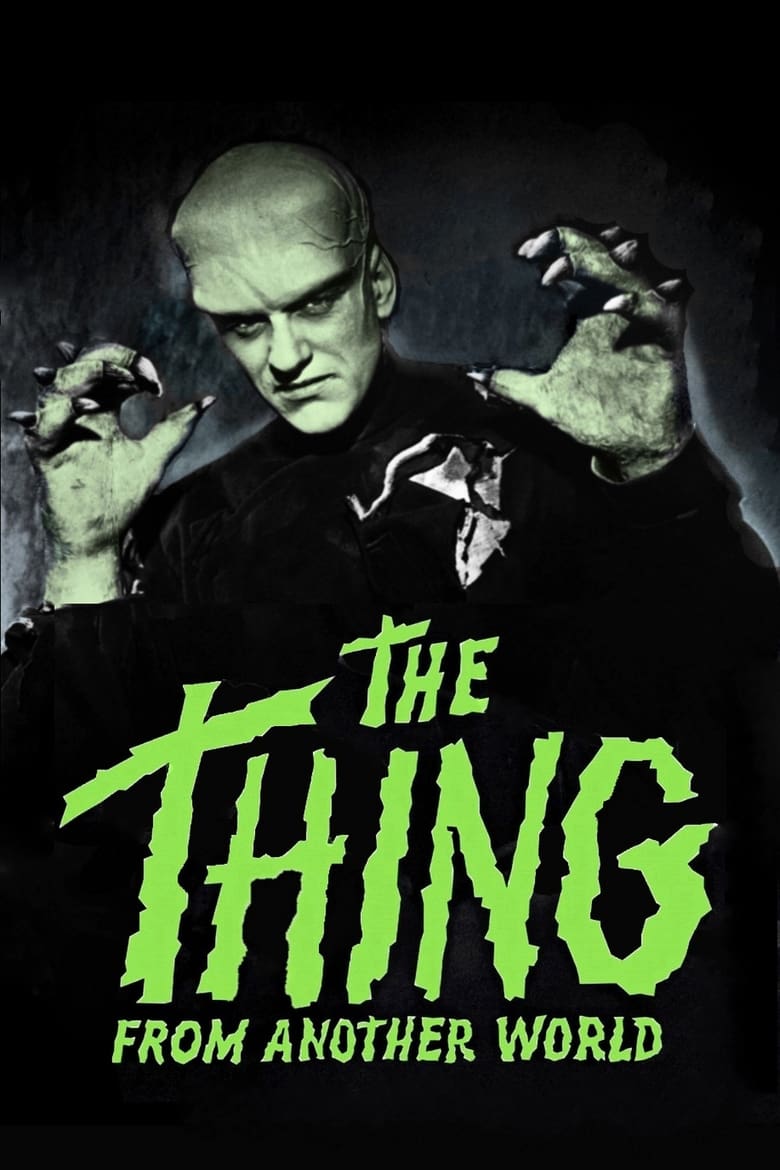
The Thing from Another World
“Natural or Supernatural?”
Scientists and US Air Force officials fend off a blood-thirsty alien organism while investigating at a remote arctic outpost.
About The Thing from Another World
Why The Thing from Another World still works
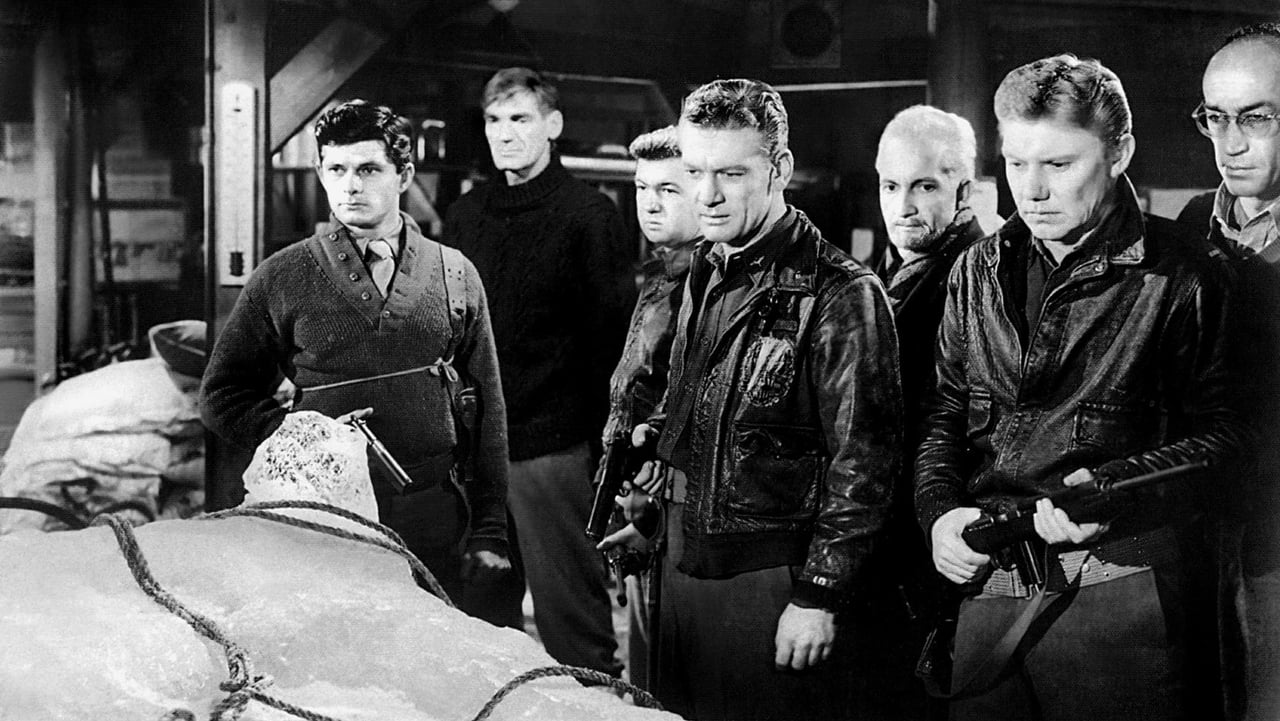
Picture the moment a cracked slab of ice stops being an exhibit and becomes a threat. The Thing from Another World starts with exactly that: a frozen body discovered near a crashed craft, dug out while a storm closes in. It's a propulsive opening that hands the movie its problem on a plate and lets the characters get to work.
Christian Nyby keeps the running time sharp — 87 minutes — which matters. There's no padding. The film moves from discovery to argument to action with the brisk confidence of a lean genre picture, and that economy gives the scenes of danger real bite. And the players make the machinery feel human. Margaret Sheridan's Nikki Nicholson, Kenneth Tobey's Captain Patrick Hendry and James Arness as the Thing are the visible poles around which the story spins: a secretary who knows more than she seems to, a captain forced to set limits, and a creature that refuses to stay frozen.
The idea that sets The Thing from Another World in motion
It begins like a straightforward assignment: journalist Ned Scott turns up at an air command club and meets Captain Hendry, the pilot in charge of a northern run. That meeting is the story's doorway — someone who wants answers arrives, and the answers they find complicate everything.
Hendry assumes command when the frozen body is brought back to the outpost, and he clamps down: no immediate examinations, no press. That choice — military caution against scientific curiosity — becomes the engine that keeps the drama turning.
The scientists do get a look eventually. Their tests on the creature's tissue lead to a surprising conclusion: this is not straightforward animal life but something closer to advanced plant life. That diagnosis trips the film into a different register; what looks alien begins to be argued over rather than simply fought.
And those arguments have consequences. Sabotage, plummeting temperatures and moral friction push the outpost toward extremes, and when the weather finally clears we're left with a story that began as an assignment and ended in a far louder, personal reckoning — even a radio warning sent home and a pair of characters headed toward marriage.
Why Nikki Nicholson matters
Nikki Nicholson isn't a passive accessory to the men in the room. As Carrington's secretary she has access to the scientist's world and to the centre of the argument about what the creature is and what to do with it.
Her connection to Captain Hendry is more than subplot filler; the rekindled romance gives Hendry something to lose and some personal stakes for the decisions he has to make. The prospect of a marriage at the end reframes the whole melodrama as more than just a monster-versus-base story.
Crucially, Nikki is present for the disturbing bits of scientific obsession. She's the witness when Carrington reveals he's been cultivating small alien plants from the creature's severed arm and feeding them with the base's blood plasma supply. That knowledge places her between two conflicting impulses: curiosity and common-sense caution.
So she matters because she carries information and moral weight. Nikki isn't just emotional ornament; she stands where the human costs of the scientists' curiosity are most visible.
The Thing from Another World has more on its mind than the plot suggests
On the surface it's a monster movie; underneath are a handful of familiar, honest things: fear, freedom, courage and love. The film treats those ideas plainly rather than dressing them up, and that directness is part of its appeal.
Fear is the obvious engine — the unknown in the ice, the violence against sled dogs, the creature stalking the base — but the movie doesn't only frighten for the sake of thrills. It uses fear to force choices: who protects the group, who takes risks, who thinks first and who feels compelled to act.
Freedom shows up in a quieter way: the tension between letting something live and keeping people safe. That argument about whether curiosity should be indulged or restrained runs through the film, and it means the monster is tied to a human debate, not merely a target to shoot at. Courage and love are the stabilisers. Characters make decisions not just out of principle but because relationships — romantic or communal — give them reason to fight or to stand firm. Those human motives stop the movie being all spectacle and make its confrontations feel earned.
The Thing from Another World could not belong to any other decade
This is a movie from 1951, and it wears that date like a stamp of purpose. It's very much a product of the early-1950s appetite for stories where science and the military bump up against each other in claustrophobic settings.
That mix — science-fiction speculation served through straightforward horror beats and a brisk runtime — is a recognisable pattern in 1950s movies. The Thing from Another World favours clarity and moral argument over ambiguity, which suits the era's storytelling instincts.
The film's concerns and set-up feel of their time precisely because they stage a debate about control, curiosity and communal safety — themes that were frequently dramatized in genre pictures of the decade.
Seen as a 1951 picture, it reads as an efficient example of mid-century genre cinema: sharp, purposeful and unembarrassed by the serious question marks it puts on the table.
What has aged — and what hasn't
Fear still travels. Specific moments — the discovery of a third sled dog bled dry, the idea of a vampire-like creature feeding on blood — land with actual unpleasantness even now. That particular image is blunt and effective: it doesn't rely on modern effects to unsettle you.
The film's plainspoken debates about science versus caution also feel comparatively fresh. The argument is framed in human terms rather than jargon, so the stakes remain intelligible to a modern viewer without a background in 1950s genre politics.
Where it may feel dated is in its delivery: the pace, the dialogue rhythms and the way arguments are staged can seem theatrical to contemporary eyes. But those are stylistic notes rather than failures of imagination.
Ultimately the central sensation — a contained outpost forced to decide whether to shelter a mysterious life or to destroy it — still plays. The gross, specific image of the bled sled dog is an example of the film's ability to unsettle directly; it doesn't need reworking to have an effect.
Why The Thing from Another World still matters
People who grew up with it remember that it packs a lot into a small shape: a crashed craft, a frozen body, a handful of characters who argue over what to do. Those elements make for a compact story that sticks in the memory — you can still see the ice block and the greenhouse in your head.
The moral friction is part of its afterlife. Dr. Carrington's conviction that the creature represents a superior form of life — and his decision to cultivate alien plants from the severed arm and feed them with the base's plasma — gives the film a troubling centre: curiosity that crosses a line.
That tension elevates the monster beyond a thing to be fought; it becomes a test of how men choose to respond when the unknown turns out to be not merely dangerous, but beguiling to the intellect. And the ending matters too: the story resolves with the creature destroyed and the human bonds reasserted, but not without warning — the surviving characters make clear there's a message to carry home. That mixture of small-scale human drama and larger caution gives the film a reason to be remembered.
Does The Thing from Another World still hold up?
Yes — with a caveat. The Thing from Another World is an economical 87-minute piece of 1951 genre craft: it tells a tight story, stages a recognisable and still-gripping conflict between military intervention and scientific curiosity, and gives its lead characters real decisions to make.
If you come for high production gloss or modern pacing, you might find it old-fashioned. But if you want a story that keeps its moral questions obvious and its shocks simple and effective, it delivers. The image of a bled sled dog and experiments grown from a severed arm are still the sorts of things that unsettle.
Nikki Nicholson and Captain Hendry are central to why the film matters: their relationship gives the captain stakes, and Nikki's proximity to Carrington's experiments ties the human cost directly into the scientific obsession on display.
So should you watch it? If you enjoy compact, idea-driven horror with a clear spine — and aren't expecting a modern effects showcase — this one is worth your time. It's a small, sharp film that remembers how to make a threat feel immediate, and it finishes by handing its survivors a message to take back with them.