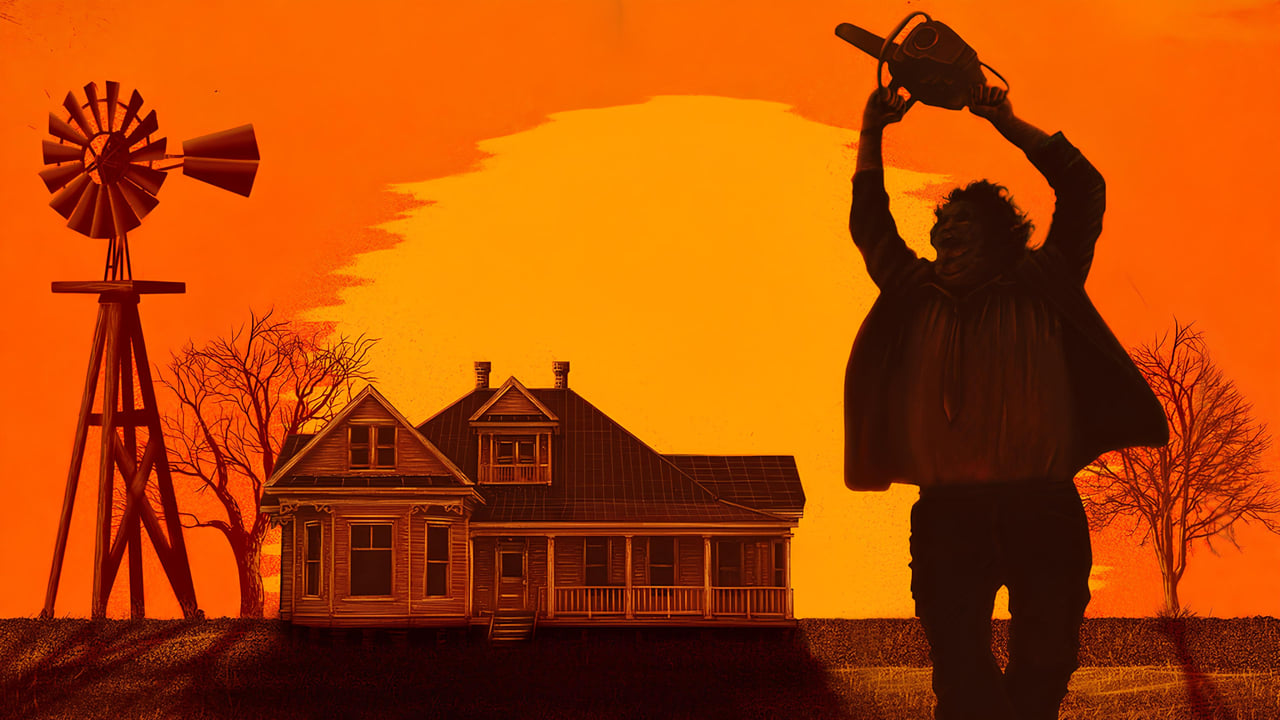

The Texas Chain Saw Massacre
“Who will survive and what will be left of them?”
Five friends head out to rural Texas to visit the grave of a grandfather. On the way, they stumble across what appears to be a deserted house, only to discover something sinister within. Something armed with a chainsaw.
About The Texas Chain Saw Massacre
What The Texas Chain Saw Massacre gets right
You open the film on a small, very specific piece of wrongness: somebody has been disrespectful to the dead, and the local world notices. That single grotesque tableau (found at first light) tells you everything you need to know about the movie’s appetite for unease.
Tobe Hooper keeps the run-time tight — 83 minutes — and refuses to let the story wander. The result feels less like a conventional horror marathon and more like a sustained, escalating emergency that centres on a group of young people led by Sally Hardesty. It’s not sentimental. It doesn’t apologise. Instead it turns familiar things — family, a roadside kindness, even a house that should be a refuge — into the engine of the dread, so you quickly stop asking how the film scares you and start asking why it insists on doing so.
The idea that sets The Texas Chain Saw Massacre in motion
At its simplest the picture is a road‑trip thriller: a small group of friends driving through the country. That everyday premise matters because it starts the story in neutral territory — ordinary people in an ordinary van — which makes the slide into violence feel sharper.
Hooper and co-writer Kim Henkel quicken that slide by dropping in details that twist normal life: for example, a conversation about the family trade as they pass a slaughterhouse. Moments like that quietly turn the open road into a landscape already littered with meaning.
The film also uses an older voice, literally — a storyteller credit — to frame the events. That choice gives the proceedings a storybook rhythm, as if the audience has been warned the world we’re about to see is a particular kind of danger.
And when the supposedly safe stop — help at a filling station — bends toward betrayal, the setup’s contract with the audience is sealed: the usual places you’d expect rescue from can’t be trusted here.
Why Sally Hardesty matters
Sally is the through-line. She’s one of five young people on the trip, and her ties to the place — checking her grandfather’s grave, sharing history with her brother — make the story personal rather than random.
That family link matters because the film keeps pulling the actors back toward domestic terms: this is their grandfather’s ground; this is the Hardesty house. When a familiar past and a present threat collide, Sally becomes the face of that collision.
She isn’t a passive victim who only reacts. When things go wrong she goes looking for her friends with Franklin, and later she endures and survives a grotesque humiliation that involves Grandpa and a cut finger. Those beats make her escape hard-won rather than accidental.
Crucially, the film closes on her running and then — strangely, terrifyingly — laughing as she finally gets away. Sally is the map the audience follows: from curious traveller to trapped target to someone who manages to tear free.
The Texas Chain Saw Massacre has more on its mind than the plot suggests
On the surface it’s a horror about violence. Underneath, it’s cramped with ideas about mortality — bodies, the dead displayed for shock — and how communities manage or fail the living.
Family runs through the picture in several registers: not only the Hardestys’ own history but the perverse, claustrophobic family the antagonists form. When the film keeps bringing the conversation back to the slaughterhouse and family labour, it suggests a link between domestic work and the tools of killing.
There’s also freedom versus enclosure. The young people arrive as travellers — free by definition — and the story steadily puts obstacles between them and the road. Home, which should be safe, becomes another kind of trap. Fear is the glue: the movie arranges ordinary items and everyday obligations so they become triggers. That’s why the film feels less like random gore and more like an argument about what we rely on to keep ourselves safe.
The Texas Chain Saw Massacre could not belong to any other decade
This is a 1974 film through and through: an independent picture that prefers pressure to polish and stakes its horror on discomfort rather than spectacle.
That slightly raw, almost documentary feel feeds the movie’s credibility. It refuses to dress the terror up as grand mythology; instead it insists the horror happens in specific, small places.
The grim anecdote that opens the film — a local corpse theft uncovered at dawn — anchors it to a rural, unsettled world that the decade’s cinema liked to visit: the cracks in American life where ordinary routines intersect with ugliness.
Put simply: release date and tone matter here because the film’s distrust of institutions and domestic normality sits neatly in the 1970s cinematic mood.
What has aged — and what hasn't
The basic engine — a bunch of teenagers on a doomed road trip — still reads. Teen travel as narrative set-up is simple and effective: it quickly creates isolation and vulnerability in a way modern viewers still understand.
The movie’s insistence that home and family can be threatening hasn’t become less unsettling with time. Seeing a house that should shelter people rearranged into a place of torment is a durable dramatic move.
Some of the film’s more extreme moments — the communal, almost ritualised behaviour of the hostile family, the humiliations visited on Sally — remain narratively potent because they’re tied to character choices and relationships rather than cheap shocks.
Where it can jar for a modern audience is the same place many older films do: the context and pacing expect you to sit with discomfort in a different way. But if you’re watching for a story about survival, family gone wrong and the dangers of small-town trust, those elements still land.
Why The Texas Chain Saw Massacre still matters
People remember specific, brutal images: a corpse displayed where a town can see it; a house full of grotesque domestic bricolage. Those moments are hard to shrug off because they turn the ordinary into the obscene.
The cast of characters — the teens, the hitchhiker who upsets the group, the masked, hulking presence who attacks with blunt instruments, and the family who treats violence as a form of ritual — gives the film a roster of threats that feel internally consistent rather than random.
There are structural beats that linger in the mind: a search for missing friends that goes badly, a gas-station offer of help that becomes a trap, a night that unravels into a morning scramble for survival. Those are story sequences that stick with you. Finally, the film’s last image — the survivor collapsing into a passing vehicle while the pursuer pounds the road — is a stubbornly ambivalent end. The escape is real, but it leaves you with something like a laugh that has been hollowed out by what came before.
Does The Texas Chain Saw Massacre still hold up?
Yes — if you’re prepared for a short, relentless piece of work that trades in atmosphere, discomfort and narrative pressure rather than modern horror’s CGI tricks or obvious jump-scares. At 83 minutes it’s compact and unrelenting.
It’s a film about vulnerable travellers, about the way family ties can be twisted into something imprisoning, and about the collapse of ordinary safety — a gas-station favour that turns into captivity is a good example. Those ideas don’t date easily.
If you want spectacle, this may not be the place. If you want a small, tightly wound study of fear and survival where the payoff is a desperate, ambiguous escape, it still has teeth.
So watch it for the setup — the road, the passing slaughterhouse chat, the strange houses — and for Sally’s story of getting away. The movie won’t let you forget the price of that escape.
Explore the Horror
The Texas Chainsaw Massacre franchise follows Leatherface and the terrifying families surrounding him across multiple continuities, remakes and reboots. Beginning with Tobe Hooper's landmark 1974 horror film, the series became one of the defining franchises of American slasher cinema.
EXPLORE FRANCHISE →