
The Stepford Wives
“Something is wrong with the women of Stepford.”
Joanna Eberhart comes to the town of Stepford, Connecticut with her family, but soon discovers there lies a sinister truth in the all too perfect behavior of the female residents.
About The Stepford Wives
Why The Stepford Wives still works
The first thing to know about The Stepford Wives is that it arrives with a very simple engine: a woman from the city moves to a perfect small town and doesn’t like what she finds. Joanna Eberhart brings a camera and two daughters with her when she and her husband relocate to Stepford, which sets up the film’s outsider gaze right away.
From that starting point, Bryan Forbes quietly steers a genre cocktail — science fiction leaning on horror and dystopia — and lets the unease do the heavy lifting. The women of Stepford are unsettling because they are too polished, too domesticated, and oddly uninterested in anything beyond housework. That contrast — a woman who carries ideas and an eye for a photograph placed against neighbours who seem unnaturally content with domestic ritual — is why the film still pulls you in. It’s a compact, unsettling premise played out in 110 minutes that keeps nudging the audience: what are we sacrificing in the name of comfort?
The idea that sets The Stepford Wives in motion
The film begins with Joanna’s relocation from Manhattan to Stepford with her husband and their two daughters. That move matters because it immediately puts Joanna in the role of an observer: she’s new, she notices, and she questions.
Stepford’s surface is calm and civil. Neighbours behave like neighbours. But the charm frays fast when Joanna sees small, peculiar things — for instance, a neighbour who behaves with a strange, submissive repetitiveness after what should have been a minor accident.
Those little oddities are how the premise grows teeth. The town isn’t frightening because it’s loud or violent; it’s frightening because it normalises a kind of flattened personality, where conversation and curiosity are smoothed out.
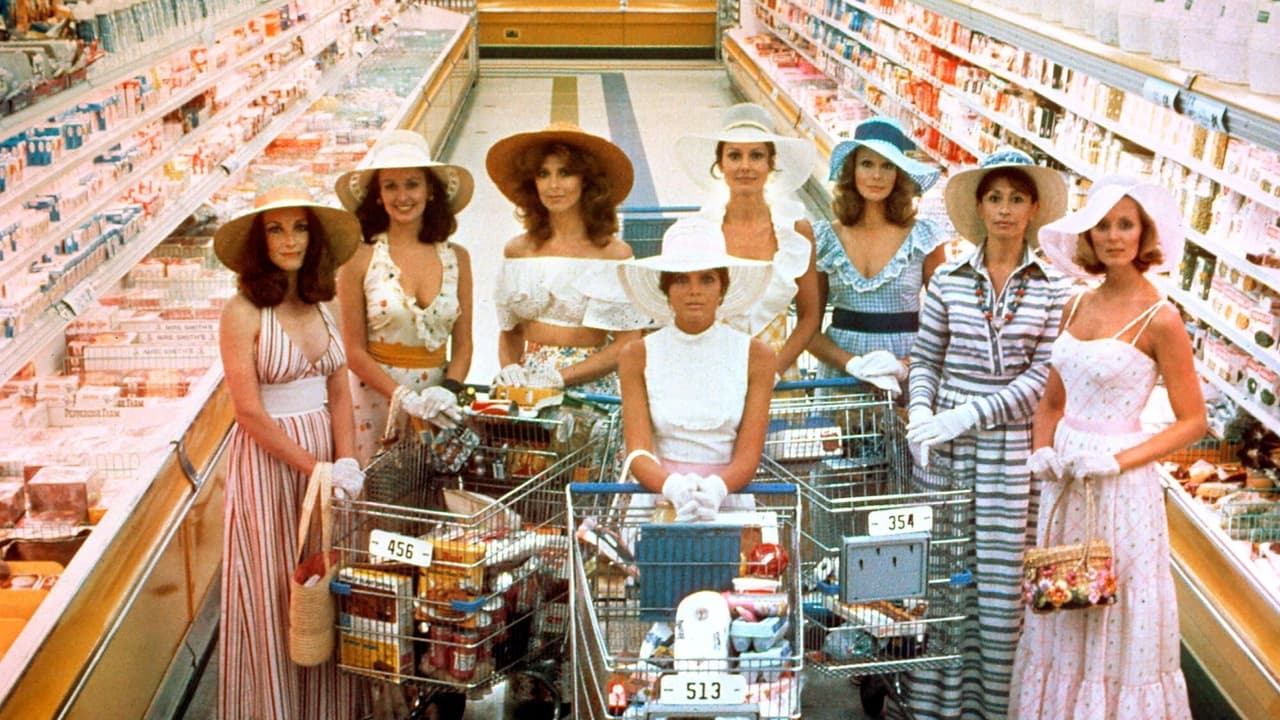
There’s even a public, everyday moment that underlines the effect: in the supermarket the wives offer each other vapid greetings while a new couple argues about having moved there. It’s ordinary and therefore more disturbing.
Why Joanna Eberhart matters
Joanna isn’t a ceremonial heroine. She’s a young wife who still carries work and interests — an aspiring photographer — when she moves to Stepford, and that makes her the natural sceptic in a town that rewards complacency.
Her family ties are important to the story. The film keeps returning to the idea of family and parental responsibility, so Joanna’s identity as a mother anchors the stakes: this isn’t only about autonomy, it’s about protecting children and the life you’ve chosen.
Crucially, Joanna finds an ally in Bobbie Markowe; their friendship gives Joanna someone to test ideas with, someone who shares her inclination to question rather than accept. That relationship sharpens the film’s sense of loss when the town begins to close ranks.
The closing images — photographs that show the family later presented as content and complete in Stepford terms — remind us why Joanna matters: she’s the standard by which that domestic perfection is measured and, ultimately, erased.
The Stepford Wives has more on its mind than the plot suggests
On the surface, the film reads as a domestic mystery about why the women of a town have become obsessively domestic and superficially flawless. Scratch that surface and the themes widen: it’s as much about home and safety as it is about what those words can demand of a person.
Family and parental protection thread through the film. Joanna’s concerns aren’t abstract; they’re practical and urgent. When the story pushes into menace, it does so through the lens of what a mother will do to safeguard her children and her household.
Technology — the mechanism that ultimately explains the wives’ change — sits uneasily beside those domestic themes. In the movie, mechanical means are used to achieve a human-looking tranquillity, which forces a question: what are we prepared to accept from progress if it gives us an ordered life? Layer all that together and you get a film that uses genre trappings to ask everyday questions about identity, control and what a community will sacrifice for the illusion of safety.
The Stepford Wives could not belong to any other decade
Released in 1975, The Stepford Wives sits neatly in a decade that was still wrestling loudly with social change. The film’s anxieties — about gender roles, progress and domestic life — map cleanly onto that moment.
It’s the mid-70s sensibility: stories that put ordinary life under a microscope, testing the limits of social comfort and asking whether the comforts we cherish come with hidden costs.
The movie’s casting and tone make it feel like a product of its time without needing costume clichés or nostalgic wink-winkery; the date is important because the questions it asks were very much in public circulation then.
Seen this way, Stepford is less a period piece and more a snapshot of a particular cultural conversation — one that film and fiction were having everywhere in the 1970s.
What has aged — and what hasn't
The parts that hold up best are the story’s basic human worries: parents terrified for their children, a woman who refuses to be silenced, and a town that trades freedom for predictability. Those concerns are still immediate.
There are moments that still land hard. Joanna’s frantic return home to find her children gone and a husband who won’t answer straightforward questions is an ugly, believable panic that keeps the film tense.
The film doesn’t shy away from physical confrontation either — Joanna’s desperate, violent attempt to force the truth out of her partner is shocking in a way that still rattles modern viewers because it’s rooted in protection, not revenge.
And the end — photographs showing a family reassembled into Stepford’s version of perfection — remains quietly unsettling. It’s a reminder that the film’s horror is not spectacle but erasure.
Why The Stepford Wives still matters
People talk about this film because it turned a suburban life into a thought experiment with teeth. The sight of women who are flawless but strangely hollow — obsessed with household chores and uninterested in ideas — is a vivid image that sticks.
The Men's Association and its exclusionary, controlling logic give the story a clear antagonist: it’s not a single villain so much as an organised idea about returning women to a particular role. That framing is what makes the conspiracy feel systemic rather than personal.
Joanna and Bobbie’s friendship matters to the film’s afterlife. Their attempt to hold a women’s meeting — only to find the conversation derailed into cleaning-product chatter — is both comic and tragic, and it underlines how the town’s influence works on everyday interactions. The revelations later in the film — the malfunctioning Bobbie that reveals a replacement, the discovery that formerly independent women have been changed, and the image of an android Joanna moving through a supermarket — are the hard, memorable payoffs that keep people returning to the movie.
Does The Stepford Wives still hold up?
Yes — but with a rider. The Stepford Wives remains worth watching because its central questions are stubbornly alive: what are we willing to trade for a settled home, and who gets to decide what ‘settled’ looks like?
Katharine Ross’s Joanna is the necessary troublemaker; the film needs her doubts and her maternal fear to make the town’s calm feel dangerous rather than quaint. The way the story escalates — from awkward neighbourliness to the discovery that the women have been replaced — still delivers real tension.
If you come for lurid spectacle, this isn’t that movie. If you come for a slow-burn, socially charged thriller that mixes science fiction with domestic dread, it holds up. Its 110 minutes are tightly used, with Bryan Forbes guiding a modest, focused scare.
Watch it for the uneasy idea and the final images of family life recast as perfection. It’s a film that still asks the right questions, and the best horror is the kind that makes you look at your own tidy life and wonder how tidy you want it to be.