
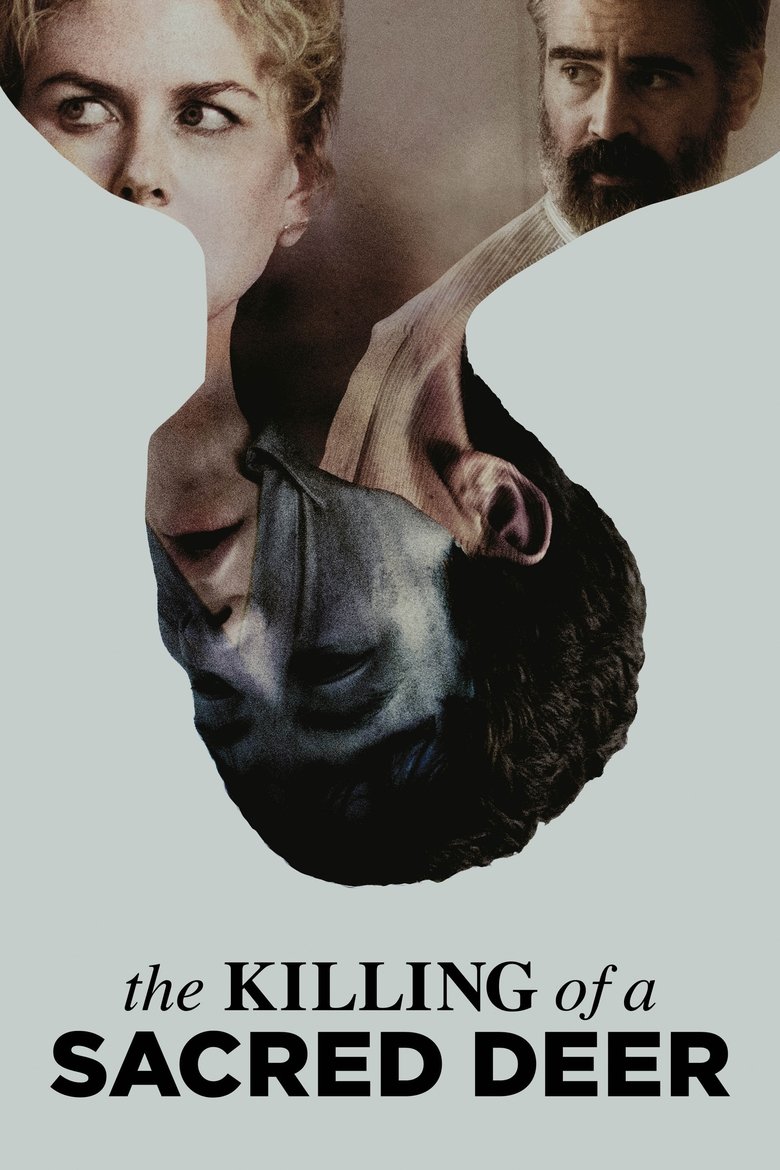
The Killing of a Sacred Deer
Dr. Steven Murphy is a renowned cardiovascular surgeon who presides over a spotless household with his wife and two children. Lurking at the margins of his idyllic suburban existence is Martin, a fatherless teen who insinuates himself into the doctor's life in gradually unsettling ways.
About The Killing of a Sacred Deer
Why The Killing of a Sacred Deer is still worth talking about
The film opens with a very simple, unnerving exchange: a surgeon who’s just finished an open‑heart operation meets a teenager at a diner. That quiet beginning — two strangers, an odd sympathy — is the tiny hinge everything later swings on.
It’s very much a 2010s picture in spirit. Lanthimos arrives with his particular brand of off‑kilter drama, and in just under two hours the film moves from polite civilities to a form of domestic terror that keeps the camera inside the house where the real trouble starts. And while the cast list reads like a who’s who — Nicole Kidman is in the centre as Anna Murphy, with Colin Farrell as her husband — what stays with you is the way family, protection and the idea of safety are quietly interrogated from the first scene to the last.
The idea that sets The Killing of a Sacred Deer in motion
At heart the film is built on an awkward but plausible first meeting: after an operation a respected surgeon encounters a 16‑year‑old whose life is coloured by a previous loss. The surgeon invites the boy into his life — into his home, even — and that invitation is the story’s fault line.
Things don’t stay small. The teenager’s family enters the picture in a way that immediately troubles the boundaries between adult and child, private and public. What begins as curiosity becomes a pattern of increasingly intrusive demands on the surgeon’s time and loyalties.
Then the domestic part of the plot starts to flicker: illness arrives in the house, tests offer no answers, and a parent’s worst anxieties catch hold. The real set‑up isn’t a mystery to be solved so much as a pressure cooker being slowly wound up.
What makes the set‑up work is its clarity. You can describe the inciting moments without inventing anything grand: a meeting after surgery, an invitation home, an escalation that forces two adults to admit mistakes they’d rather keep private — and then a desperate, physical response that shows how far they’ll go.
Why Anna Murphy matters
Anna is the domestic fulcrum. She is the person who anchors the family when the stranger is casually introduced into their lives, and she’s the one who has to reckon with what that breach means for the children.
Crucially, Anna is not a passive prop. The story gives her eyes on the situation: the husband confides in her about the past, and she is forced into the role every parent dreads — weighing imperfect facts against the instinct to keep her children safe.
She also becomes the family’s public defender: when the stranger’s motives are made explicit, Anna confronts that challenge head on. The film asks whether protecting a family can turn into something else — into accommodation, bargaining or even complicity.
Put simply, Anna matters because the film needs someone who will both refuse to look away and, at times, attempt to fight on the only field left open to her: the home itself.
The Killing of a Sacred Deer has more on its mind than the plot suggests
On the surface the film is a thriller‑ish morality tale: a wrong is identified and the demand for rectification is laid out in plain, brutal terms. But below that mechanism sits the real concern — what family means when every safety net unravels.
Parental protection is not sentimental here. It’s pragmatic, even transactional. The adults are faced with decisions that are awful and arithmetic‑like: choices about who stays, who goes, what a family is worth when put to an impossible test.
Home and safety are examined as fragile constructs. The house in the story is not a sanctuary that keeps horrors at bay; it’s where the moral calculus must be performed and where the characters’ loyalties are tested in daylight. That combination — intimate family stakes delivered through a cold, clinical moral puzzle — is what gives the film its emotional teeth. It’s less about a single act of vengeance and more about the way ordinary domestic life can be forced into extraordinary moral theatre.
The Killing of a Sacred Deer could not belong to any other decade
Released in 2017, this is a film that wears its decade plainly: the 2010s were a period where directors felt free to blur art‑house unease with thriller and horror ingredients, and Lanthimos pushes that mix to an uncomfortable place.
It sits squarely in that moment when audiences were open to moral experiments on screen — dramas that deliberately make you squirm rather than soothe. That willingness to discomfort was part of the decade’s cinematic vocabulary.
So while the story itself could be told at any time, the way it’s packaged — a clinical fable that treats family like a philosophical problem as much as an emotional one — feels very much of the 2010s.
What has aged — and what hasn't
The central domestic premise — a family pulled apart from the inside — has aged very well. The idea of a private home becoming a site of moral decision still hits hard because those are recognisable, modern fears: what happens when the people you love are held hostage by circumstances you can’t explain?
The film’s treatment of family and parental protection remains its strongest card. The choices the parents make, and the way the children are drawn into that decision, keeps the tension immediate and human rather than relying on gimmicks.
Some moments of escalation — the intrusions, the sudden illnesses with no medical answer — still feel sharply designed to unsettle. Scenes in which Anna tends to wounds or a child offers themselves up to save the rest of the family have a grim, fable‑like logic that hasn’t softened.
If anything, that fable quality has kept it watchable: it’s less tethered to a fleeting trend and more like a parable that still stings now as it did on first viewing.
Why The Killing of a Sacred Deer still matters
People remember the film because it takes a recognisable domestic unit and compels it to play out a moral ledger in full view. The spine of the picture — a surgeon who brings a grieving teenager home and the consequences that follow — is simple, and that simplicity makes the larger moments land harder.
The cast of characters remain vivid in the memory: the awkward intimacy with the teenager, the daughter who becomes entangled with him, the son who inexplicably falls ill. Those beats stick because they’re not cheap shocks; they feel like logical escalations of the premise.
The story’s deliberateness — the way it unfolds from a polite dinner to a sequence where the family must be physically bound and a choice is executed — is the image that lingers. It’s not a happy memory, but it’s a distinct one, and that distinctiveness is part of why the film stays in conversations. Put differently: it matters because it refuses to let the audience off the hook. The questions it asks about responsibility, error and protection are the sort that keep a film alive in memory long after the credits.
Does The Killing of a Sacred Deer still hold up?
Yes — if you are willing to be deliberately unsettled. Lanthimos’s 2017 piece is compact at 109 minutes, and it keeps its moral experiment tight: a respected surgeon introduces a stranger to his family and everything that follows forces a parent’s worst calculations into the open.
This is not comfortable entertainment. The film asks you to sit with choices that have no pleasant outcome: the escalating demands, the confession about a past mistake, the way illness and obedience are used as instruments. For viewers who want neat catharsis, it will be infuriating; for those who like their dramas to be morally abrasive, it’s a rare, discomfiting treat.
If the themes — family, parental protection, home as a battleground — appeal, you should watch it. If you want a film to soothe or reward you with easy answers, look elsewhere.
The Killing of a Sacred Deer still works because it doesn’t pretend to be anything other than an uncomfortable parable about the cost of safety. It’s a film that keeps its questions in the living room, and that’s why it keeps lingering in the mind.