
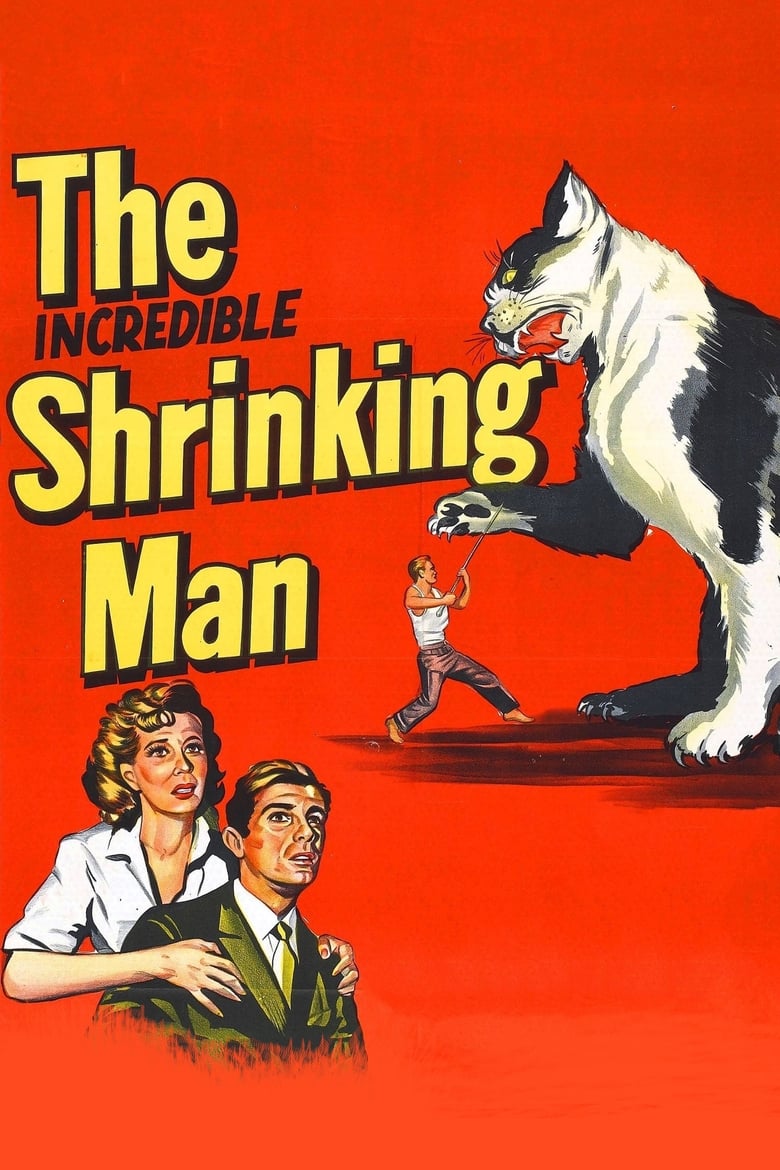
The Incredible Shrinking Man
“A fascinating adventure into the unknown!”
A dangerous combination of radiation and insecticide causes the unfortunate Scott Carey to shrink, slowly but surely, until he is only a few inches tall. His home becomes a wilderness where he must survive everything from spiders living in the cellar to his beloved cat.
About The Incredible Shrinking Man
What makes The Incredible Shrinking Man worth revisiting
The image that kicks everything off is disarmingly simple: a man on holiday, a strange mist, and the suspicion that something very small and very wrong has happened. That fog — the moment Robert Scott Carey is enveloped — turns ordinary life sideways and carries the whole picture with it.
Jack Arnold keeps things surprisingly tight. At 81 minutes, The Incredible Shrinking Man doesn’t waste a beat: Grant Williams’s Carey is the human centre, Randy Stuart is the wife who anchors him, and the story moves from domestic unease to full survival‑scale crisis with unfussy efficiency. Why come back to it? Because it’s one of those old genre films that treats its odd premise seriously. The shrinking is a gimmick, certainly — but it’s also an engine for the movie’s steady, human questions about safety, family and what freedom means when your world gets smaller.
The idea that sets The Incredible Shrinking Man in motion
It’s an economical premise: Carey’s life starts to slip away in small, everyday stages. He begins a journal — a practical, stubborn act of record‑keeping — to make sense of the absurd sequence of losses.
One of the film’s quieter moves is to find human mirrors for Carey’s misfortune. Clarice, a carnival worker who matches his size for a while, gives him company and a nudge back toward telling his story instead of hiding from it.
From being a public curiosity and the centre of headlines to being forced into seclusion at home, the set pieces chart a shift from spectacle to solitude. The film likes to trade on that contrast: the world gawps, the house closes.
And then the survival tone takes over. Carey’s shrinking becomes literal survival — small spaces, domestic hazards, the kind of danger you only notice once your scale changes — which keeps the story focused and immediate without spilling into endless complication.
Why Robert Scott Carey matters
Carey matters because he’s built as an ordinary man under extraordinary pressure. Grant Williams is the name in the casting, but what the script asks for is an everyman who can be fielding the small humiliations of shrinking and still make choices that feel human.
The moment that starts it all — the strange holiday mist — is worth stressing: it pushes Carey out of his normal life and into a new problem that’s bewilderingly physical and painfully personal at once.
As he gets tinier, his behaviour changes. There’s a strand to the story where shrinking isn’t only about scale but about character — Carey becomes controlling and even tyrannical when reduced to living in a dollhouse, which ties the spectacle to genuine human fragility.
Then there’s the close: having lost almost everything, including the easy certainties of a normal life and family, Carey reaches a quieter place. He ends by accepting his fate and finding a kind of meaning in the tiniest terms — it’s a human beat the film carries to the last frame.
The Incredible Shrinking Man has more on its mind than the plot suggests
If you strip the special‑effect premise away, the film is mainly a meditation on home and safety. Being forced into seclusion at home turns Carey’s living room and basement into theatres of peril — ordinary rooms become obstacle courses when you’re a fraction of their size.
Family is threaded through the whole thing. Carey’s relationship with Louise and his brother matters because it’s where the human cost of his condition is clearest: it’s not only about physical loss, it’s about the erosion of shared life.
Freedom is trickier here. The shrinking robs Carey of mobility and choice; at first he’s publicly visible and in control of his story, and by the end he’s making the most basic decisions about survival. The arc is less about escape than about measures of agency — how much you can keep when everything else is gone. The film uses small, domestic moments — a missing ring, a cat attack, the basement that becomes impossible to climb — to make those big ideas feel lived in rather than tacked on.
The Incredible Shrinking Man could not belong to any other decade
The film arrived in 1957, and that matters because it carries the tone of mid‑century anxieties without hammering them into propaganda. The opening — a holiday fog that sets everything off — has that neat 1950s pitch: ordinary life interrupted by an inexplicable intrusion.
It fits comfortably among 1950s movies that liked to imagine scientific or accidental catastrophes happening to everyday people. There’s a democratic quality to the premise: this is not about superheroes or mad geniuses, it’s about a man on holiday who has to make do.
That place in the decade also explains the film’s compact, no‑waste storytelling. It doesn’t bloat; it makes a single speculative idea play out in human terms, and it does so in a running time that keeps the tension taut.
So while it’s recognisably of its era, it’s not merely a period piece — it uses that 1950s sensibility to make its questions about family, safety and freedom feel immediate and unshowy.
What has aged — and what hasn't
A lot of the film’s concerns still land. The idea of becoming a media curiosity and retreating under the roof of your own home — effectively imprisoned by attention — reads as oddly modern. Being famous and invisible at the same time is a feeling people today will recognise.
Family strains also hold up. Louise preparing to move out with Carey’s brother is a blunt reminder that personal disaster rarely stays private; it ripples into the people who care for you, and that fallout is still persuasive to a modern viewer.
The survival episodes — the cat attack, the basement ordeal, the tiny‑scale fight with the spider — keep their tension because they’re about imagination and stakes, not visual spectacle alone. The physical risks translate across eras: danger on that scale feels immediate even now.
Some elements are of their time in tone, but the core — a man losing his footing, then deciding what matters — still speaks. The quieter, philosophical end‑point, where Carey accepts what’s left of his life, is still a respectable, hardheaded note to finish on.
Why The Incredible Shrinking Man still matters
There’s a straightforwardness to the story that keeps people interested: a mysterious mist, the baffling early signs (like clothes becoming too big), and then a medical explanation that treats the weirdness as something to be investigated. That mix of wonder and procedure gives the film a grounded spine.
Carey’s choice to document his life in a journal — to make sense of what’s happening by writing it down — is a neat narrative touch that turns private disaster into testimony. It’s the film’s way of insisting this small life is worth describing.
The movie also stages both public spectacle and intimate peril: Carey becomes a national curiosity, then is isolated at home; later, his tiny tests of survival — the battle with a spider, the desperate escape through a screen — give the premise memorable, tactile moments. And it ends on a genuinely human note: Carey reaches a form of acceptance. He decides that even if he shrinks down to microscopic scale, he still matters in the universe. For many viewers who grew up with the film, that modest, almost stubborn optimism is the part that sticks.
Does The Incredible Shrinking Man still hold up?
Yes — and not because of nostalgia. The film’s premise (that odd holiday mist and the medical explanation that follows) sets a clear problem and lets the human consequences play out honestly. That clarity is a strength: 81 minutes, a director with a sure hand, and a storyline that refuses to bloat.
If you worry about it feeling dated, what’s old‑fashioned is mostly tone, not substance. The emotional beats — the choice to let Louise go if she wishes, the slipping wedding ring, the media circus, the retreat into the house — still read as human dilemmas rather than period curiosities.
Practical scenes — the cat attack, the basement struggles, the fight for food and shelter — still create real suspense because they’re rooted in scale and consequence. And the film’s final turn toward acceptance gives the story an unexpected dignity: a tiny man who refuses to become irrelevant.
So, if you like compact, idea‑driven science fiction that trusts small, domestic details to make a big point, watch it. The Incredible Shrinking Man holds up because it keeps asking the same simple question after every loss: what do you hang on to when everything else has shrunk?