
The Hunger
“Nothing human loves forever.”
Five-thousand-year-old vampire Miriam promises her lovers the gift of eternal life. When John, her cellist companion for centuries, discovers that he has suddenly begun growing old, he attempts to seek out the help of Dr. Sarah Roberts, a researcher on the mechanisms of aging.
About The Hunger
Why The Hunger still works
Start with Miriam Blaylock. She’s introduced as an ancient predator — a vampire glimpsed drinking blood in far-off pasts — and she sells a neat, poisonous bargain: eternal life to the mortals she chooses. That promise is the engine of the picture.
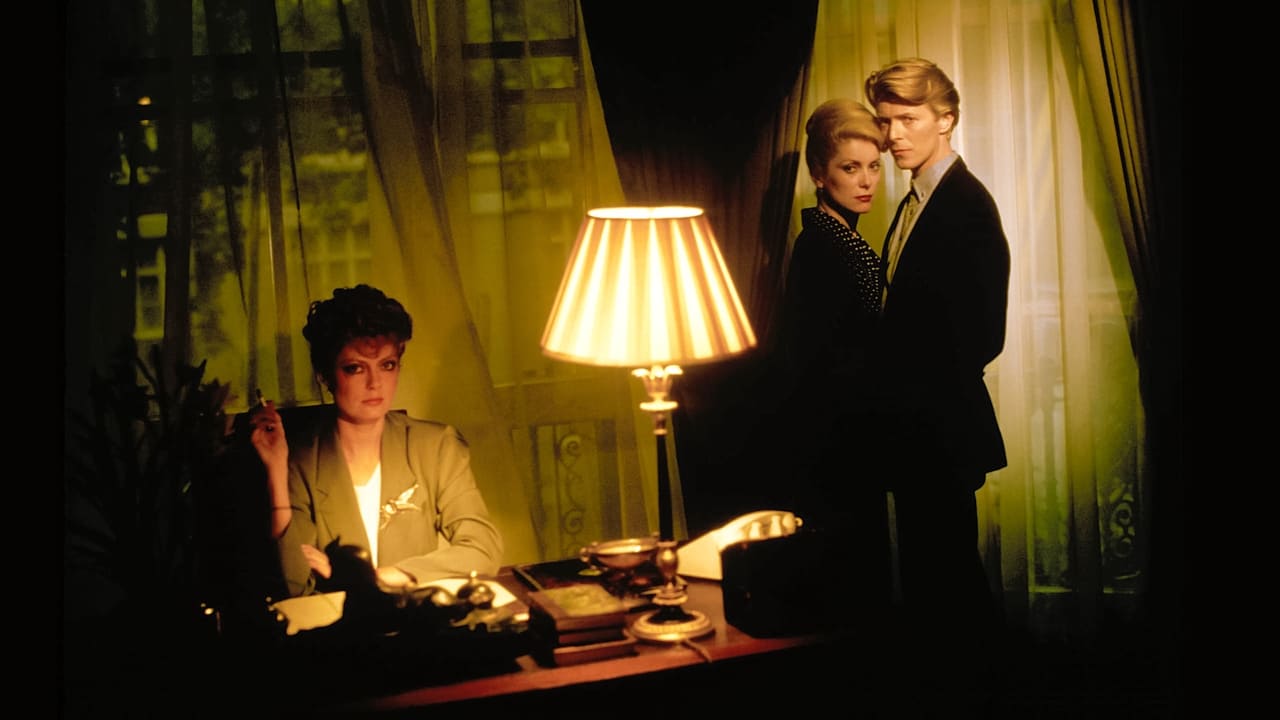
Tony Scott directs at a brisk, economical 93 minutes. The leads are simple, striking choices: Catherine Deneuve as Miriam, David Bowie as her long-time companion John, and Susan Sarandon as the researcher who becomes the film’s moral pivot. The cast and setup give the movie a personality — cool, intimate, and quietly unnerving. Genre-wise it’s where several things meet: horror, vampire story, erotic thriller and a touch of queer interest. But what keeps people talking is less a label and more the way Scott stages danger in domestic spaces and frames appetite as both a personal and a familial problem.
The idea that sets The Hunger in motion
The movie opens from a deceptively simple premise: John, who has been Miriam’s companion for centuries, starts ageing at a terrifying, accelerated rate. What begins as insomnia becomes a collapse into rapid decrepitude.
Rather than a hunt through the city, much of The Hunger’s pressure comes from what happens at home. When John finally fails, Miriam carries him to the attic — a room full of coffins — and places him among her other boxed lovers.
The plot then pulls a new character into that intimate orbit. Miriam initiates a sexual encounter with Sarah, and during it some of Miriam’s blood enters Sarah’s body. It is a private, invasive transfer that changes everything.
Sarah returns to her routine — to dinner with her boyfriend Tom — but the aftereffects follow her. The three-and-a-half-hour absence at Miriam’s house becomes a source of suspicion, and the private infection starts to spill into Sarah’s public life.
Why Miriam Blaylock matters
Miriam is the movie’s clean, cold centre: an ancient vampire who frames eternal life as an intimate offer. We first meet her as a predator with long reach — flashbacks place her feeding in ancient times — and that history gives every modern scene of seduction a long tail.
She’s not a horror cliché who lurks in the shadows; she operates in a household, posing with John as a cultivated couple who teach music. That decision matters — it collapses the line between hospitality and threat.
The film treats Miriam as someone who builds a kind of family out of lovers. Family here is less about children and more about possession and continuity: lovers who are promised a forever that turns out to be something else.
Because of that bargain — the promise of life without the promise of youth — Miriam’s presence forces the other characters into moral and emotional choices that are as domestic as they are deadly.
The Hunger has more on its mind than the plot suggests
On the surface it’s a vampire story. Underneath it’s a set of obsessions about what keeps you safe and what eats that safety away. Home and safety are recurring notes: the couple’s townhouse is a place of lessons and refinement that also hides an incinerator and an attic full of sleepers.
Family in The Hunger isn’t neat. Miriam assembles a household from lovers; John lives as both spouse and victim. The film treats those bonds as contractual and fragile rather than comforting.
Mortality and loss push through the erotic elements. John’s discovery — that immortality does not include eternal youth — makes ageing itself into the central horror. The promise of never dying becomes a form of slow suffering. There’s also a dark inversion of ‘growing up’. Miriam grooms successors; the film’s passages about initiation and replacement make human development feel like recruitment into a strange, unchosen family.
The effects work that gives The Hunger its physical personality
A big part of The Hunger’s physical mood comes from how the story insists on bodily change. The movie places ageing and biological decline at the story’s centre, framing them through Sarah’s contact with Miriam and the research world Sarah inhabits.
Sarah’s role as a gerontology researcher — someone who studies rapid ageing in primates — means the film leans into concrete symptoms and small, unsettling details rather than abstract dread.
There are also strong, intimate scenes where Miriam tends to Sarah as if caring for a sick guest. A sequence in which Sarah allows Miriam to put her to bed shows how the film stages transformation as something domestic and invasive at once.
The result is a film that makes physical change feel immediate and intimate, so the horror reads as a betrayal of ordinary life rather than a spectacle from far away.
The Hunger could not belong to any other decade
Released in 1983, The Hunger sits squarely in the early 80s — a period when genre films weren’t shy about mixing erotic tension with horror. The film’s blend of thriller and vampire elements feels of its moment without being defined by surface nostalgia.
There’s a compactness to its storytelling that also reflects the era: it’s efficient, genre-savvy and willing to be direct with adult themes in a way mainstream pictures would later tighten around.
The 1980s appetite for genre-mixing meant movies could be more ambiguous about morality and desire, and The Hunger takes advantage of that latitude: it refuses tidy resolutions and keeps its moral choices uncomfortable.
Put simply: the film belongs to 1983 because it takes the decade’s appetite for bold tonal blends and uses them to make domestic horror feel contemporary rather than antiquarian.
What has aged — and what hasn't
Many of the film’s themes feel intact: the fear of losing youth, the strange comforts of a household that’s also a trap, and the idea that promises about immortality might be bargains with terrible small print. Those concerns are still readable, even now.
The nightclub-to-home chain of events — meeting a young couple, bringing them home, and feeding on them — still strikes a clear, predatory note. It’s direct and unsettling in a way that doesn’t require modern tricks to feel threatening.
Where the movie can jar for modern viewers is in how it stages intimacy and initiation. The transformation scenes and the grooming of successors are framed in an erotic register that some viewers may find awkward today; the material is blunt about desire and possession. But the core horror — that immortality might be a life of slow, boxed suffering rather than freedom — still lands. John’s realization that he will not keep his youth remains a grim, clear idea that the movie carries to the end.
Why The Hunger still matters
People who remember The Hunger tend to remember its private horrors: an elegant townhouse that hides an incinerator, an attic of coffins, and the slow collapse of a companion who turns out to be trapped rather than liberated. Those images linger because they bend domesticity into menace.
The relationship at the film’s heart — Miriam and John, a centuries-old couple with very modern problems — gives the movie a memorable emotional through-line. John’s sudden decline reframes the vampire bargain as a moral and physical trap.
The film’s later passages, where Miriam brings new companions into her orbit, and where the consequences of initiation become gruesomely literal, keep the story from becoming merely stylish. The endings — with Sarah moved on to a new life and Miriam left calling her name from a draped coffin — make the emotional cost feel real.
For those who grew up with it, The Hunger matters because it mixed sex, science and domestic dread in a way that felt daring then and still has the power to unsettle now.
Does The Hunger still hold up?
Yes — if you want a sharp, compact vampire tale that treats intimacy as dangerous. At 93 minutes Tony Scott keeps things taut: the film moves from John’s crisis to Sarah’s reluctant involvement without padding, which keeps the central ideas—mortality, family, and how ‘home’ can betray you—front and centre.
The movie is strongest when it lets the premise do the work: a centuries-long relationship (John was turned centuries ago and remains Miriam’s companion) collapsing under the weight of ageing, and the consequent moral choices. Those beats still feel immediate and bitter.
It isn’t trying to be a contemporary morality play. It’s an erotic, gothic thriller that asks what you’re willing to trade for forever, and whether forever without youth is a mercy or a sentence. That question feels as sharp now as it did in 1983.
If you watch The Hunger today, expect a film that’s intimate and unsettling rather than loud. It’s a reminder that the most effective horrors often happen where we feel safest — and that’s a very specific, very welcome kind of fright.