
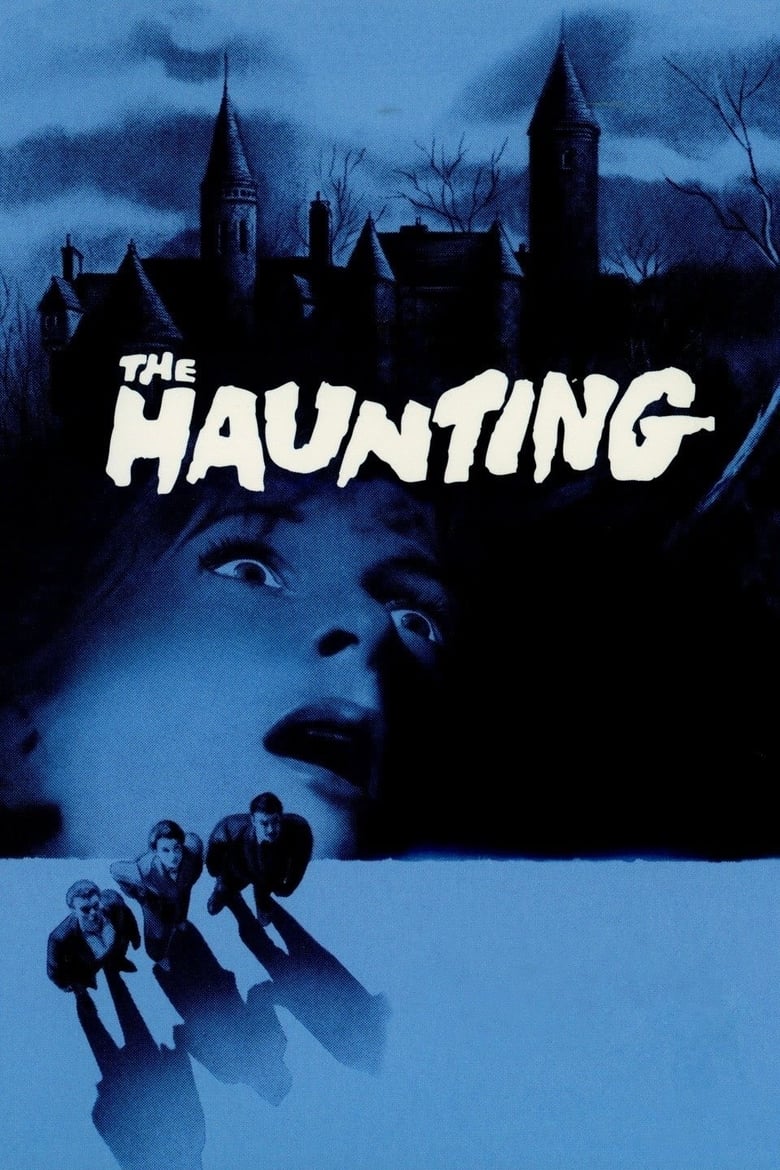
The Haunting
“You may not believe in ghosts but you cannot deny terror.”
Dr. John Markway recruits three strangers for a sleep-disorder study at the eerie and isolated Hill House. It soon becomes clear his real interest lies in the mansion itself and its sinister history, as they are forced to confront the nature of its horror…
About The Haunting
What The Haunting gets right
The Haunting begins with a short, unnerving history. Dr John Markway narrates how Hill House was raised by Hugh Crain for his wife — and how that wife died in a carriage crash as she approached it. You don't need a pentagram to sense that something has been wrong here from the start.
Robert Wise directs the whole thing with a tightness that keeps the attention where it should be: on people entering a place that seems to insist on knowing them. Julie Harris plays Eleanor Lance, the woman the house notices first, and the film makes that recognition feel like the engine of the story rather than an excuse for set-piece frights. What still registers is the film’s appetite for architectural unease. Hill House’s off-kilter geometry — walls built with angles that feel wrong and doors that move of their own accord — turns the idea of "home" on its head. As a film about safety, family and loss, it nails a simple, chilling truth: the house itself is the character that refuses to let go.
The idea that sets The Haunting in motion
The basic engine is simple and tidy: Dr John Markway gathers a small group to study the reported phenomena at Hill House. That framing — an investigator bringing people into a troubled house — keeps the plot compact and the stakes psychological rather than spectacular.
Markway’s narration anchors the film in Hill House’s long, unhappy past, which gives every creak and cold spot a context. It’s the sort of set-up that turns small, domestic scares into something bigger: a lineage of misfortune rather than random poltergeists.
Into that frame come two women who matter: Theodora, described as a psychic, and Eleanor Lance, who carries childhood experience of poltergeist activity. The choice to travel light (few guests, one house) lets the film concentrate on how the place interacts with people rather than on a chain of jump scares.
Once inside, ordinary moments turn strange. Theo moves into Eleanor’s room at Markway’s insistence; they fall asleep in twin beds pushed together, and later Theo wakes to find Eleanor on the couch and Eleanor realises the hand she held wasn’t Theo’s. Those intimate confusions are what the film trades in.
Why Eleanor Lance matters
Eleanor is the one the house picks out. Julie Harris plays her, and the screenplay makes clear why she is vulnerable: she grew up with poltergeist experiences and has spent her adult life as a carer for an invalid mother. That background gives her grief and guilt, and makes her more likely to hear a place calling.
Because she’s already been living in the shadow of someone else’s needs, Eleanor arrives with a practical emptiness — the space in her life that Hill House is almost able to fill. It’s not just plot convenience: her history with care and loss gives the supernatural material a personal angle.
The film stages moments that underline how easily Eleanor can be unmoored. When she leans over the veranda to peer at the library tower, she grows dizzy and needs catching; Markway briefly considers sending her home, and she stubbornly refuses. The push-and-pull there tells you everything you need to know about her predicament.
There’s also a curious echoing in the house: the group discovers a marble composite statue that seems to repeat the line of people who have lived — and suffered — at Hill House. Eleanor reads into that recurrence; she matters because the house has space for her among its long list of losses.
The Haunting has more on its mind than the plot suggests
On the surface it’s a ghost story. Underneath, the film keeps returning to questions of home, family and the long shadow of loss. Hill House is coded as a domestic space that has failed at the thing a home promises: safety.
That failure wears different faces. Family appears as obligation and as absence — Eleanor’s life of care has left her bereft when that role ends; the house, meanwhile, is packed with the residues of its own family tragedies and deaths.
Mortality and lifespan are threaded through the house’s history: a wife killed on arrival, a second wife dying on the stairs, a daughter who never left her nursery and a companion who took her own life. The house collects these endpoints and, in the film, seems to use them. Fear in The Haunting is intimate rather than cinematic. Eleanor wakes to voices, grabs at a hand that isn’t Theo’s, and later Markway finds Grace claiming she was kept lost by the house when she tried to find her husband. The terror is about not being able to trust the place that’s meant to keep you.
The Haunting could not belong to any other decade
Released in 1963, The Haunting sits in a moment when psychological steadiness in horror was a legitimate option. It prefers unnerving precision over gore or spectacle, which feels of a piece with a cinema that still favoured suggestion over brute force.
One way the film signals that seriousness is in the house itself. The production makes Hill House a set of architectural discomforts — walls and doors that read wrong, off-centre perspectives — and that kind of design choice gives the film a modern, almost clinical chill rather than an old-school melodrama.
Because it treats the house as a patient you examine rather than a monster you fight, the movie maps comfortably onto the 1960s taste for psychological interrogation. You’re invited to watch characters as much as you’re invited to watch scares.
That focus — character, architecture, and small, precise shocks — is what places the film firmly in its year. The Haunting feels like a 1963 picture in the best sense: restrained, a little austere, and intent on letting the audience do the work of feeling afraid.
What has aged — and what hasn't
What holds up is the film’s concentration on domestic terror. Themes about home, safety and the obligations of family remain recognisable and unsettling: when a place you think of as shelter begins to feel predatory, that idea still lands.
Scenes built on small invasions are still effective. The morning discovery of the words "Help Eleanor come home" scrawled on a wall carries a human chill; it is both a supernatural message and an emotional indictment of Eleanor’s vulnerability.
The movie’s use of the house’s history — the marble composite statue echoing the people who lived there — still gives the story an algebra of repetition that feels oddly modern. It’s a reminder that haunted houses in this film are repositories for lives, not just locations for effects.
Some set moments remain quietly unnerving: Eleanor’s dizziness on the veranda, the shared bed that becomes a site of confusion and the moment she squeezes a hand only to realise it wasn’t Theo’s. Those intimate breaches age much better than any attempt at spectacle would.
Why The Haunting still matters
People who grew up with The Haunting tend to remember a particular mixture: domestic tragedy plus a slow, personal dread. The house’s catalogue of losses — a wife who died approaching the home, another who fell down the stairs, a companion who hanged herself — gives the story a cumulative sorrow.
That accumulation matters because it makes Hill House more than a spooky set-piece. Markway’s decision to invite people and let them test the house turns the film into an experiment in how a place claws at strangers until some of them are made to belong.
There are concrete images that stick: the off-kilter architecture, the statue that seems to repeat past residents, and small but precise scares like the wall writing that pleads for Eleanor. Those things give the film memory hooks that audiences carry with them. And then there’s the ending image people keep discussing: Eleanor behind the wheel, the steering acting against her, a sudden figure and a crash. For many viewers that’s the moment when the film’s quiet psychological pressure becomes tragically, irrevocably physical — and that stickiness is why the film keeps being watched.
Does The Haunting still hold up?
Yes — if what you’re after is a character-first, architecture-aware ghost story that favours suggestion over spectacle. Robert Wise’s 1963 picture runs a neat 107 minutes and uses its tight running time to concentrate on a few people and one house, which is where it earns its chills.
Julie Harris’s Eleanor arrives with a history of care and guilt; the film repeatedly places her in situations where home has betrayed her trust. Those beats — the hand that isn’t Theo’s, the cold spot outside the nursery, the scrawled plea to come home — keep the emotional stakes immediate.
If you expect modern fright tactics, this is not the film for you. But if you want a slow, slightly clinical study of how loss and belonging can be weaponised by a place, The Haunting still works. The house doesn’t scream; it waits, and that patience can be more unnerving.
In the end, the film’s final cruelty is also its argument: Eleanor surrenders to whatever was in the car and, as Theo later says, she gets what she wanted — to remain with the house. It’s a hard, unmistakable finish, and a reminder that sometimes the most terrible hauntings are the ones that give people what they secretly yearn for.