
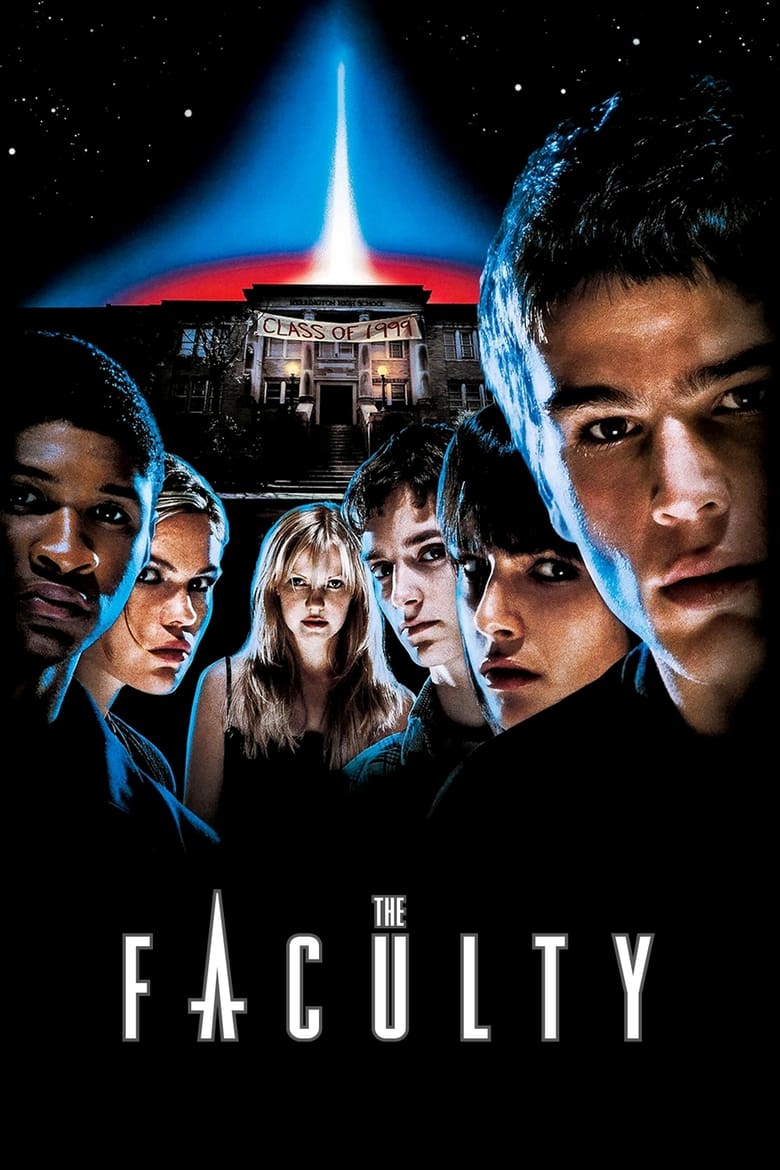
The Faculty
“These six students are about to discover their teachers really are from another planet.”
When creepy things start happening at Herrington High, the students begin to suspect that their faculty is being controlled by body-snatching aliens.
About The Faculty
What makes The Faculty worth revisiting
It begins like any small-town school cautionary tale: teachers and the principal leave after a budget meeting, only for one of those returns to end in violence. That immediate sense of a familiar, institutional routine snapping is the film’s opening trick — and it still lands.
Robert Rodriguez puts the whole thing on a tight 100-minute fuse. Within that runtime he assembles a recognisable late-90s teenage cast — from the unappreciated school photographer to the head cheerleader — and hands them a horror-mystery that’s equal parts adolescent power play and science-fiction panic. Part of the pleasure is the cast’s roster of roles: Delilah Profitt is the spiteful editor-in-chief who makes the photographer’s life miserable; the supporting players include teachers, a coach and even a school nurse, all of whom are folded into the movie’s horror machinery. It’s a neat set-up — a small world with lots of familiar grudges — which makes the alien premise feel dangerously intimate.
The idea that sets The Faculty in motion
A routine night at Herrington High — teachers talking budgets, lights going out — turns into something far stranger when a returning administrator is attacked. That tidy, schoolyard domesticity being broken is the engine of the whole film.
From there a small team of students gets drawn into sleuthing. Two of them hide in the teachers’ lounge hoping for gossip and instead find evidence that something is very wrong in the staffroom.
The threat isn’t abstract. A teacher makes a direct attempt to spread it to the students, and that attempt pushes the group from amateur rumour-chasing into real peril.
When one of their number confronts the football team and the coach, the stakes climb quickly — infection spreads, plans misfire, and the teenagers are forced to make adult decisions in a hurry.
Why Delilah Profitt matters
Delilah is the sort of school figure who makes a local authority happen: editor-in-chief of the paper, head cheerleader, the person who raises a corner of the social map and keeps an eye on who falls where.
Her spitefulness isn’t window-dressing. It frames how other characters relate to Casey, the photographer who has to endure being her assistant. That power imbalance gives the group a believable starting point — they’re not a cosy clique, they’re a set of alliances and resentments.
Her boyfriend’s dilemma — thinking about leaving the football team for academics — underlines that Delilah exists inside a network of choices and expectations. She isn’t just ‘mean for the sake of it’; she’s part of what the school is policing.
Because the students’ responses are driven by those ordinary hierarchies, Delilah’s presence keeps the stakes personal. The threat in the school isn’t only alien — it lands on a social system that already had winners and losers.
The Faculty has more on its mind than the plot suggests
At face value it’s an alien-invasion whodunnit. Underneath, the film is busy with questions about freedom — who gets to move, speak or make choices in a small social world — and what it costs when that freedom is taken away.
Authority is constantly on trial: the adults are both protectors and potential threats, and the students must decide when to trust or oppose them. The set-up of a school makes that argument immediate and recognisable.
There’s also a nagging sense of lifespan in the way the invasion is framed: the idea that something external could abruptly shorten familiar lives, forcing teenagers to confront mortality earlier than they expect. Those three ideas — freedom, authority and mortality — give the film a surprising emotional bite beneath its genre thrills. The horror matters because it interferes with ordinary adolescence.
The Faculty could not belong to any other decade
Released in 1998, The Faculty sits at the tail-end of the 1990s — a moment when teen genres were happy to mix high-school melodrama with horror and sci‑fi. That timing gives it a particular energy: it’s breezy but invested in characters.
The movie’s blend of genres — horror, science fiction, mystery and teen drama — feels very of its period in the way it treats adolescent social worlds as the primary battleground.
Because it uses a compact school setting, it captures a late-90s appetite for stories where ordinary places contain extraordinary threats. The decade’s taste for mixing register — the everyday with the fantastical — is built into the film’s bones.
In short: its release date is not an incidental detail. The Faculty reads like a 1998 movie because it pairs teen concerns with genre mechanics in that particular late-90s idiom.
What has aged — and what hasn't
The film’s teen focus is one of the things that still works: its concerns are recognisable, compact and clear, which helps it move briskly for modern viewers.
Not every beat is cosy. One of the more brutal moments — when a homemade drug is used directly on a teacher, with fatal consequences — still has the capacity to shock. That sequence keeps the movie from ever feeling light or throwaway.
Because it never pretends the stakes are only social, the film maintains tension across its runtime. The combination of adolescent grudges and genuinely dangerous moments gives it a sturdy forward push.
Seen now, The Faculty is short and sharp enough to be a tidy genre ride; its willingness to get dark in places prevents it from settling into nostalgic banality.
Why The Faculty still matters
There are a handful of images people tend to remember: a principal attacked after fetching her keys, a drama teacher who stabs an administrator without expression, a student photographer finding a strange specimen and realising the staff aren’t themselves. Those are the anchors of the film’s memory.
The way ordinary school rituals — staffrooms, paper deadlines, sports matches — are turned into alien theatre gives the film a lasting appeal. Scenes where teachers force a parasite into a nurse and where bodies are discovered make it feel dangerous in a tangible, everyday way.
Then there are the inventive beats that stick: a teenager using a homemade drug to stop an infected teacher and the revelation of the true antagonist at the heart of the student group. The story closes in a familiar, tidy way — people returning to normal, couples pairing up and life moving on — which leaves the audience with a satisfying tidy ending. For those who grew up with it, The Faculty matters because it folded adolescent politics into a genre story that took the stakes seriously. It rewarded group loyalty and smarts, and finished by restoring a sense of ordinary life — with the odd relationship and reputation changed for good.
Does The Faculty still hold up?
Yes — as a compact, genre-mixing high-school movie, it mostly does. The opening violence that follows a budget meeting, the teacher attacks and the discovery by the school photographer all set a clean engine in motion that the film sustains for its roughly 100-minute runtime.
What helps is the simplicity of its concerns: it’s about freedom being snatched away, about authority that can’t be trusted, and about adolescents forced into adult choices. Those ideas still translate: whether you call it horror, mystery or science fiction, the film treats those pressures seriously.
There are moments that still sting — the sequence where a homemade drug is used with lethal effect, or the reveal of who’s been pulling the strings — and there’s pleasure in the neat reset at the end, when the school returns to normal but the characters have changed.
If you’re deciding whether to watch it now, think of it as a brisk, late-90s genre snack with some surprisingly dark teeth. It’s not sentimental about teenage life, and it ends on a clear, decisive note — which, after an alien infestation in a high school, feels like an achievement.