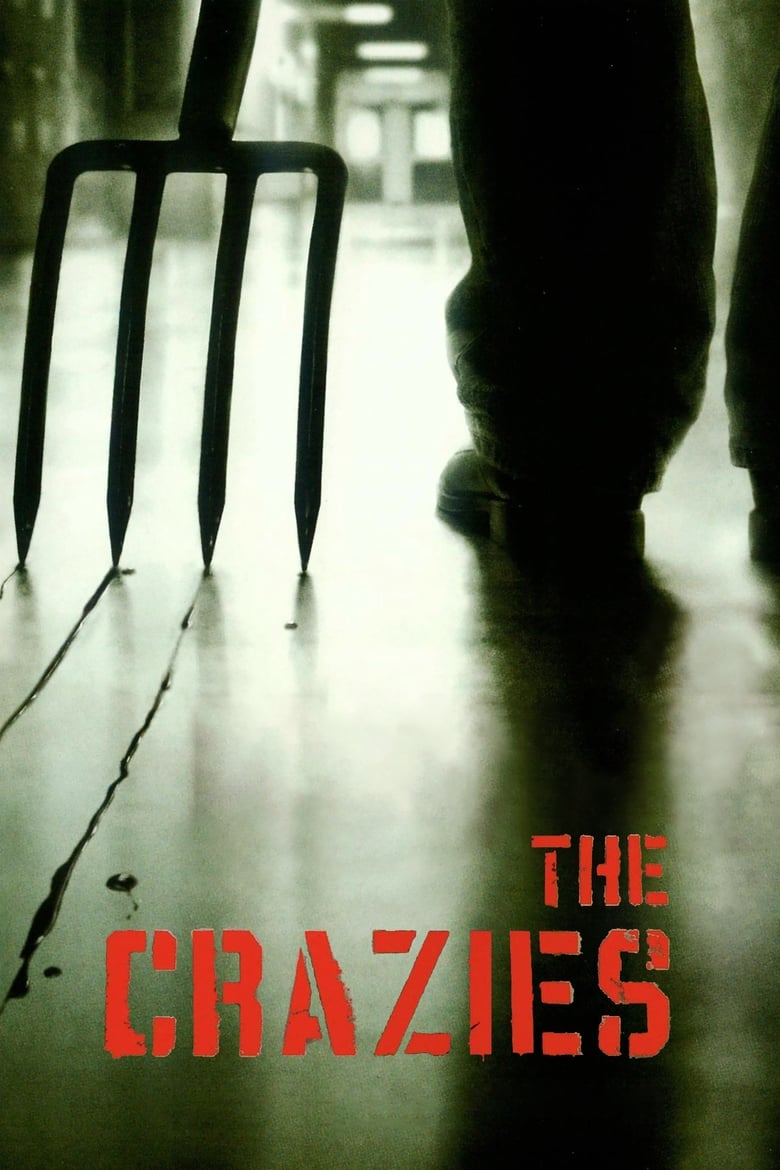
The Crazies
“Fear thy neighbor.”
Four friends find themselves trapped in their small hometown after they discover their friends and neighbors going quickly and horrifically insane.
About The Crazies
Why The Crazies is still worth talking about
Anyone who’s seen The Crazies remembers where they were at the baseball game. Rory walks onto the outfield with a shotgun and a sleepy town becomes risk and reaction in one tight, awful second. That moment does two things at once: it gives the film a proper jolt, and it introduces David, the sheriff who will have to live with the consequence of taking a life to save others.
This is a film that gets straight to business — Breck Eisner directed it, it runs for a sharp 101 minutes, and it doesn’t linger on exposition. The Crazies dresses its scares in genre clothes (horror, action and sci‑fi all elbowing for space) but the engine is simple: panic meets authority, and ordinary relationships get stretched until they snap. It’s also a story about families under stress. Judy’s medical alarm bells, David’s choices as sheriff and the way neighbours turn on one another all fold into themes the film keeps returning to: freedom, parental protection, authority and fear. That combination is what keeps the movie from being just another outbreak picture.
The idea that sets The Crazies in motion
The film compresses the collapse of a small town into a few relentless beats. Suddenly all communications die and soldiers show up to quarantine residents at the local high school — the ordinary civic scaffolding is removed and replaced with checkpoints and examinations.
That quarantine is the pressure cooker: neighbours are tested, separated and exposed to the worst of what institutional power offers in a crisis. It’s not a detective story so much as a series of reactions — people trying to find one another and figure out who is still themselves.
What keeps the setup working is its clarity. The situation is straightforward and the rules of the world are quickly established: the town is sealed, people are checked for infection, and those who don’t pass are treated as a threat.
And when the film moves from containment to escape, it keeps the stakes immediate — at one point the central survivors kill two infected hunters and make a break in a semi-truck, which turns the survival effort into a grim, kinetic road out of the town.
Why David matters
David matters because he is the film’s practical centre — the one who has to make decisions on other people’s timelines. Early on he faces Rory on the baseball field and is forced into a terrible choice: dissuade, or shoot. He shoots. That single, tragic moment sets his story in motion.
He’s not an abstract moral stance; he’s a man trying to protect a place and the people in it. When he suspects contaminated water, he pushes the mayor to act and, finding the town’s official channels blocked, makes a difficult, unilateral call to cut the supply himself. That instinct — to take responsibility when authority stalls — tells you everything you need to know about him.
The personal stakes are concrete. Judy’s medical alarms complicate his job: she’s flagged as infected at one point, separated from him because of pregnancy-related symptoms, and the film keeps returning to the idea that this isn’t just civic duty, it’s about family.
When the quarantine unravels David keeps acting in the small, urgent ways that matter — rescuing people at the school, subduing a soldier to find out what’s actually happening, and trying to get his family out. He’s the lens through which the audience experiences the collapse of order and the brutal choices that follow.
The Crazies has more on its mind than the plot suggests
On the surface it’s a contagion film. Beneath that it’s a movie about what people will do when they can’t trust institutions or their neighbours — and what they will do for their families.
Freedom shows up as more than a slogan: you feel it in the tension between desperate private choices and heavy-handed public policy. The film sets up a clash between individual agency and command-and-control reactions.
Family and parental protection are the emotional linchpins. The plot repeatedly reminds us that decisions aren’t abstract; they have mouths to feed, lives to save and children to shelter. Authority and fear are the twin forces pushing the story forward. The military’s arrival, the quarantine and the decision to treat civilians as expendable all turn the film into a study of panic administered from the top down.
The Crazies could not belong to any other decade
This is a 2010 film by date and temperament: it landed at the start of the decade and shares the period’s appetite for hybrid genre films that mix horror, action and sci‑fi elements.
Coming out in 2010, it sits where audiences were ready for sharper, leaner thrillers that didn’t waste time getting to the ruin. The Crazies is compact and purposeful — a product of a moment when high-concept premises were being turned into efficient, crowd-pleasing sets of problems to solve.
It also reflects the decade’s interest in small communities under systemic pressure: local people against institutional responses, a theme that resonated in several 2010s stories about trust and control.
Put plainly: being a 2010 film isn’t just a date stamped on the canister. The Crazies’ speed, hybrid-genre leanings and focus on civic breakdown are properly of its moment.
What has aged — and what hasn't
Family as the film’s emotional core has aged well. When the smoke clears, what lingers isn’t the precise mechanics of the outbreak but the couple trying to keep each other and their loved ones safe. That keeps the stakes human rather than merely procedural.
Fear, likewise, remains effective. The movie doesn’t rely on cheap jump scares as a substitute for tension; it builds dread through a steady accumulation of bad options and shrinking choices, and that approach still feels satisfying.
What doesn’t require nostalgia is the moral friction: choices made to protect the many or the few still read as meaningful now. The basic argument the film stages — whose life do you prioritise when the system collapses — still lands.
Viewed today, The Crazies holds up best when you watch it as a compact crisis drama with horror flavours rather than as a sprawling disaster epic. Its focus on family and fear keeps it honest and watchable.
Why The Crazies still matters
People who remember The Crazies tend to remember images more than ideas: the baseball-field confrontation, the shock of a neighbour mutating into a danger, and the grotesque scene of a town being quarantined at a high school. Those set-pieces stick because they are simple and sinister.
The film’s cruelty is particular rather than abstract. Bill Farnum’s breakdown — locking his family in and burning their farmhouse — and scenes of people strapped to gurneys make the threat feel immediate and personal. That’s why the story’s betrayals by official forces cut so deep: the military arrives to ‘help’ and ends up being an executioner.
There are quieter moments, too: the discovery of a crashed military aircraft and the revelation about the cargo (a prototype biological agent) change the problem from local mystery to catastrophic mess. That escalation — from neighbour-on-neighbour violence to institutional annihilation — gives the film narrative teeth. Finally, the ending beats linger: the survivors who scrape out of the town witness a massive explosion that levels their home, and a satellite view tells the audience the containment protocol has been initiated. It leaves the film ringing with the cost of trying to survive when the decisions are made far above you.
Does The Crazies still hold up?
Yes — if what you want is a lean, mean outbreak thriller that keeps its eye on people more than spectacle. The Crazies runs a tight 101 minutes and never forgets its basic dramatic promise: a town collapses, ordinary relationships are tested, and a sheriff called David is forced to make ugly, necessary choices.
It’s of its time (released in 2010 and stamped with that decade’s appetite for hybrid-genre churn) but it doesn’t feel quaint. The themes — freedom, family, parental protection and authority — are blunt and immediate, and the story respects those tensions by steering its characters into situations where the answers are never easy.
If you’re put off by bleakness, fair enough — there are scenes designed to unsettle, from gurneys in a school to soldiers ordered to shoot civilians, and the film ends with the town’s destruction. But those choices are in service of the movie’s idea: that terrifying, bureaucratic decisions can be more dangerous than the contagion itself.
So should you watch it? If you like horror that still cares about who the horror happens to — and if you don’t need your endings neat — The Crazies is worth a rewatch. It’s not a sunrise movie; it’s the one that makes you light the lantern and check the door twice.