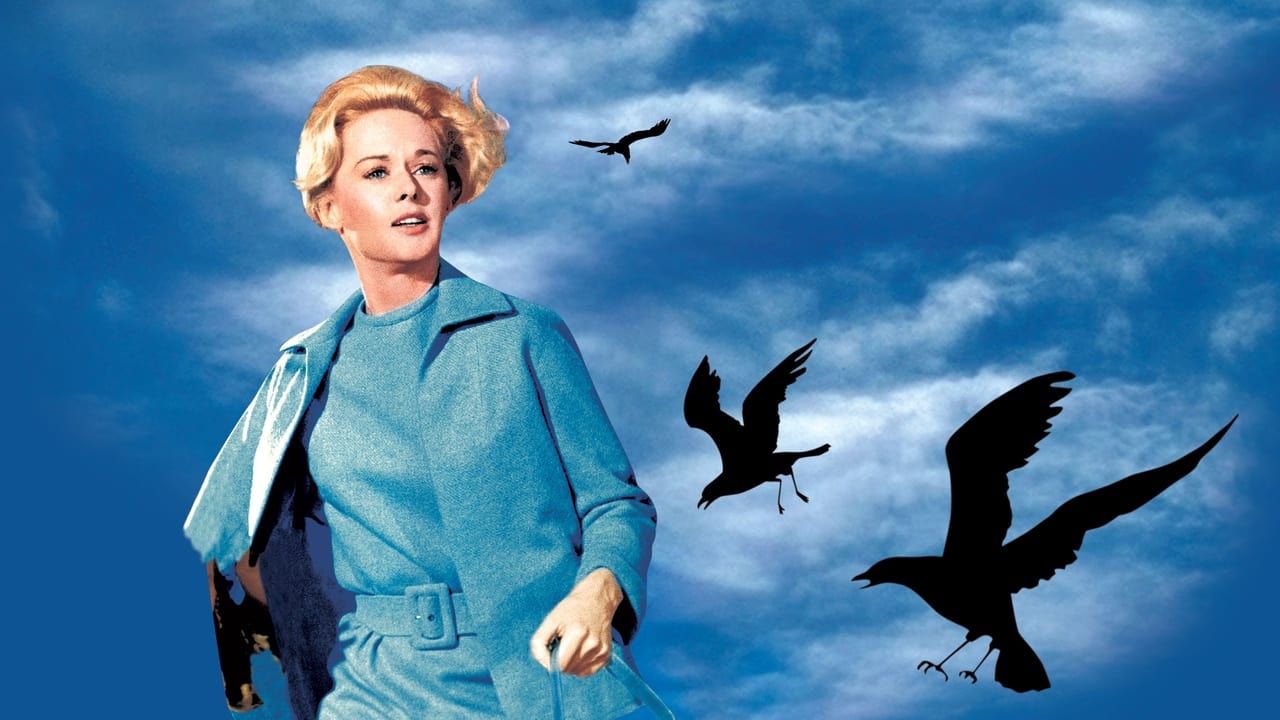
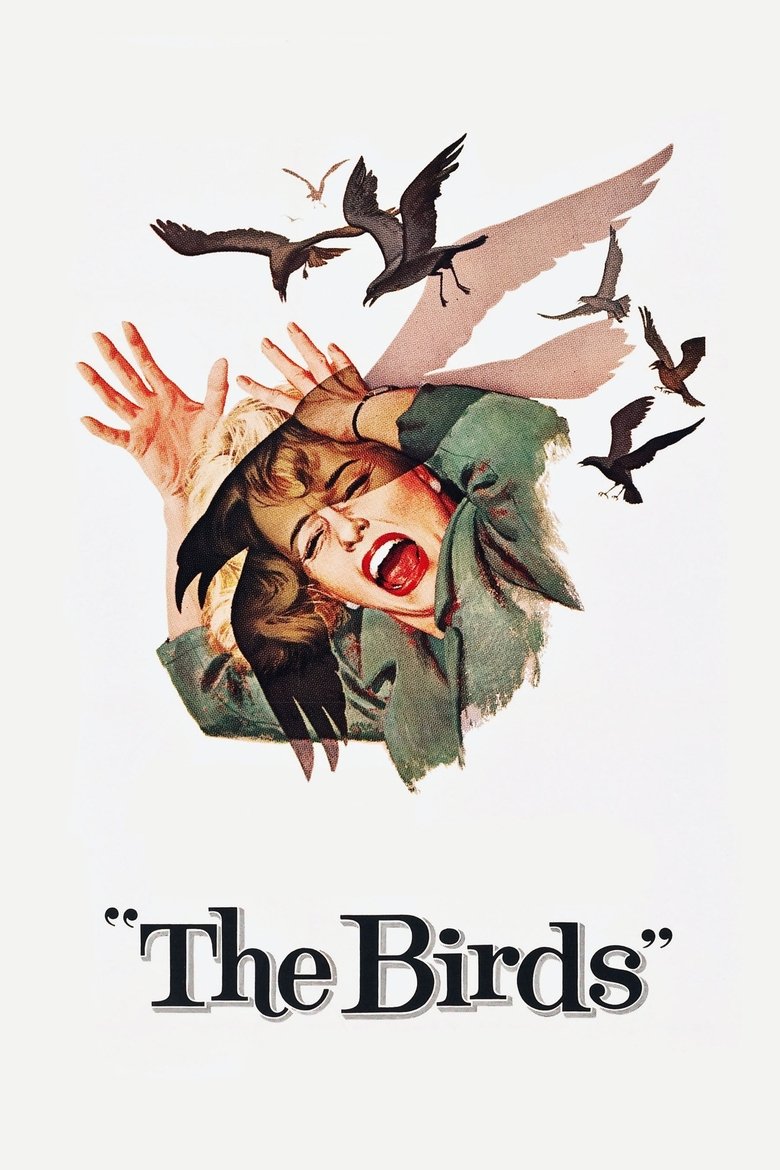
The Birds
“...and remember, the next scream you hear may be your own!”
Thousands of birds flock into a seaside town and terrorize the residents in a series of deadly attacks.
About The Birds
What The Birds gets right
It opens like a little comedy: a San Francisco pet shop, a socialite buying lovebirds as a birthday present and a man who recognises her from an earlier scrape. That small, slightly awkward moment puts the human connections front and centre before anything feathered starts behaving badly.
This is a film about ordinary people — about family and the idea of home being worth protecting — shot through a relentless, bare-knuckled sense of fear. Hitchcock spends 119 minutes nudging the audience from polite curiosity into genuine unease, and he never lets the subject slip out of view.
Rod Taylor is the Brenner who ties the story to a family, Tippi Hedren plays the stranger who arrives with the birds, and Hitchcock himself keeps the camera (and the mood) steady enough for the menace to feel inevitable rather than staged.
The idea that sets The Birds in motion
The premise is disarmingly simple. A chance meeting over lovebirds in a pet store sends Melanie Daniels out to a coastal town where the ordinary rules will start to break down.
She follows a thread — curiosity, attraction, or mischief — and quietly drops the birds at the Brenner farm. That small, almost intimate trespass is Hitchcock’s starter pistol.
From there, the film keeps tightening its grip: the attacks move from the unexpected to the personal. At one point, the house itself is invaded and Melanie is trapped after the birds peck their way through the roof — only to be pulled free by Mitch.
That mix of the casual and the catastrophic is what makes the setup work. The movie treats an everyday errand as the opening move in something much stranger.
Why Mitch Brenner matters
Mitch isn't a hero in some textbook sense; he's the way the film keeps returning the chaos to a domestic centre. The fact that Rod Taylor plays him is less important than how the story uses Mitch as the family’s hinge.
We first meet him arranging a birthday present for his sister, and from that small, familial gesture the movie stakes its claim: this is about people who protect a home and one another.
Mitch’s relationships are a practical engine for the drama. An old romance with Annie collapsed under the weight of an overbearing mother, Lydia, and the film keeps threading the past into the present — the deceased father’s absence, sibling duties, and the tense, watchful love that circles Cathy.
When the birds turn the house into a battleground and the family literally barricades themselves inside, Mitch is the link between the outside threat and the intimate work of keeping his family together.
The Birds has more on its mind than the plot suggests
On the surface it's a string of escalating attacks. Underneath, it’s a film obsessed with family: who we shelter, who we trust to protect us, and how fragile the idea of safety can be.
Home is treated as a place that should be safe by default — and that assumed safety is what makes the attacks so unsettling. When Lydia is worrying about Cathy and Melanie offers to collect her from school, the movie keeps circling parental responsibility and guardianship.
Fear in The Birds is not an abstract emotion; it’s practical and immediate. People are wounded, children are threatened, and adults must make decisions that matter — evacuate the school, light a match at a petrol pump, sit in a diner and argue about whether something is real.
That linkage between private lives and public menace — family life caught in the crossfire — is the idea the film keeps returning to, even when the birds themselves are doing most of the screaming.
The effects work that gives The Birds its physical personality
Right from the pet shop exchange — when Mitch recognises Melanie from an earlier court incident and sets up a teasing test about birds — the film favours physical, believable interactions over spectacle.
Those grounded moments make the later bird incidents feel anchored: when something ordinary is interrupted by violence, the disruption lands harder.
So the practical nature of the film’s encounters — people in real places having to scramble, bandage wounds, and barricade doors — is what gives the story a solid, touchable personality.
It’s less about a special-effects flourish and more about keeping the action tactile and human, which is why the bird attacks never feel like mere set pieces.
The Birds could not belong to any other decade
Released in 1963, the film sits at a moment when movies were comfortable blending genres: thriller, drama, and outright horror rubbing shoulders in the same picture.
That early-60s timing gives Hitchcock room to be both theatrical and domestic — he can stage a public panic and still keep the story rooted in a family household.
It’s a product of 1960s filmmaking sensibilities in the sense that it trusts the audience to feel unease from ordinary details rather than just spectacle.
Put simply: The Birds makes the decade’s appetite for narrative risk feel personal rather than merely stylish.
What has aged — and what hasn't
A lot of The Birds endures because the film’s stakes are human: a woman drives out to a provincial farm with a pair of lovebirds, a sister’s birthday is planned, and parents fret about their child. Those simple, family moments still read cleanly today.
The scenes where adults make decisions about children — evacuating the school, rushing to fetch Cathy, taking a traumatised child home — still carry weight because those concerns are universal and immediate.
The idea of home being violated — Melanie and the Brenners barricading themselves as the house is attacked — remains effective. Physical danger to a household is a straightforward and enduring source of dread.
What feels more specific to its time is some social texture around reputations and gossip; Lydia’s dislike of Melanie, partly driven by columns and social talk, ties the film to an era when public image could shift private lives in particular ways.
Why The Birds still matters
People keep coming back to this film because its scares are built from relationships and small, recognisable moments: the pet-shop meet-cute that sends Melanie to Bodega Bay, the quiet rental of a boat, the gull’s sudden strike at the wharf.
There are scenes that lodge in the mind — a children's party interrupted by attack, a diner debate where a grown-up refuses to accept the danger, and an ornithologist who won’t take the events at face value. Those collisions of denial and panic feel human and immediate.
The grief and protection that run through the film — Annie’s death while trying to shield Cathy, the family’s scramble to save their own — give the bird assaults a human cost.
And the ending — the family guiding a catatonic Melanie past a vast gathering of birds and into a car that drives away under their watch — leaves you with a quiet, unresolved image that sticks.
Does The Birds still hold up?
Yes — if you're after a picture that turns ordinary domestic friction into sustained unease. The film is anchored by a small human story (a pet-shop meeting, a sister’s birthday, a woman taking a boat to a farm) and keeps its emotional interest in the family at the centre.
There are elements that feel crisply of 1963 — the way reputation and gossip complicate Lydia’s welcome, for instance — but the core business of fearing for children and a house under siege doesn’t date.
Hitchcock made a movie that runs for a little under two hours and spends most of that time convincing you that the personal and the public can collapse into each other. That collapse is exactly what still sits well with modern viewers.
So watch it for the slow tightening of domestic screws, for the way ordinary gestures become meaningful, and for an ending that leaves you thinking about the cost of safety long after the car drives away.