
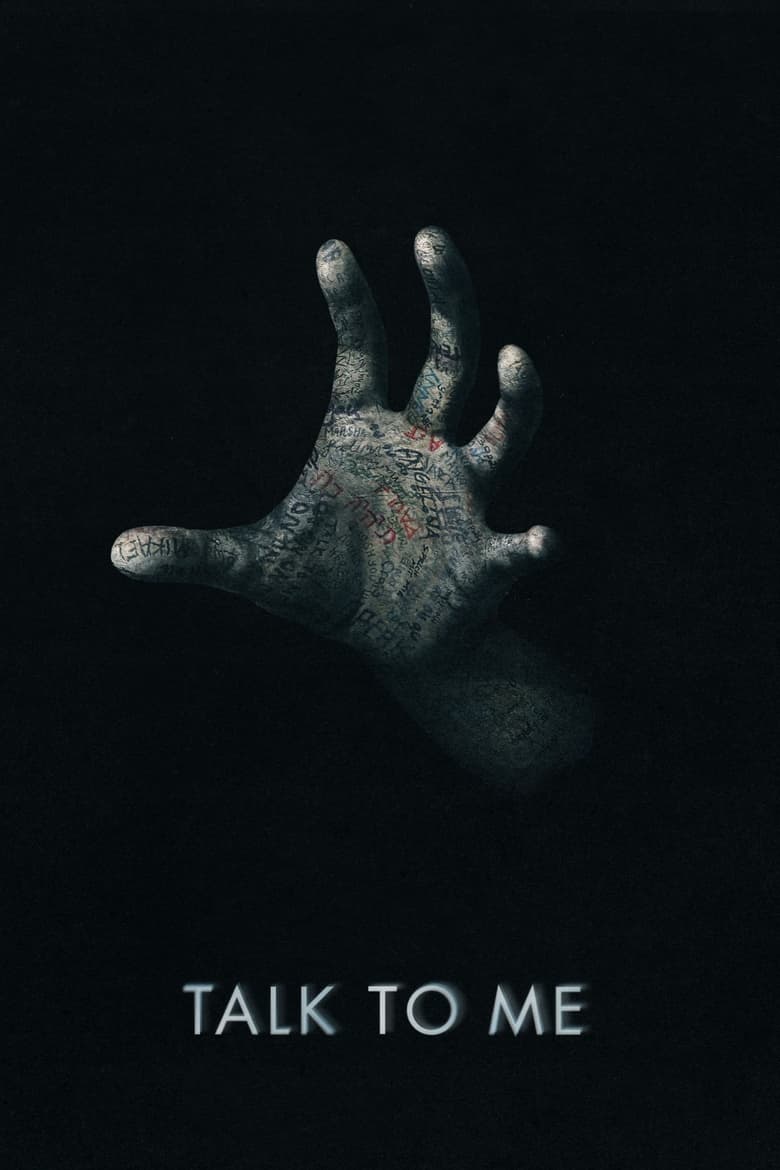
Talk to Me
“You call. They'll answer.”
When a group of friends discover how to conjure spirits using an embalmed hand, they become hooked on the new thrill, until one of them goes too far and unleashes terrifying supernatural forces.
About Talk to Me
Why Talk to Me still works
The movie opens where you expect trouble to start: a house party. Cole is running around looking for his brother, and the mood that's supposed to be loose and stupid snaps into something ugly in a handful of beats. That quick escalation — from frivolity to a very physical, very final kind of violence — tells you everything you need to know about what this film will do to a room.
At the centre of it is a single, simple ritual. Hold a preserved hand, say “Talk to me” and a stray spirit appears; say “I let you in” and the spirit can move through you. There’s a rule, too — someone else has to break the link before ninety seconds are up — and the film treats that rule like a ticking promise you keep breaking. Mia volunteers first, and what begins as curiosity becomes a fixation when she describes the possession as euphoric and a spirit shows a worrying interest in Riley. Danny Philippou keeps it compact — under an hour-and-a-half — and keeps the cast close: Sophie Wilde’s Mia is the line the audience follows into the dark, with friends like Jade and Riley orbiting her choices. Family, home and mortality are threaded through the scares, so the film never feels like it’s only aiming for jump-scares. It wants you to care about the people who make the mistake of trusting a hand.
The idea that sets Talk to Me in motion
The film hangs off a single clean concept: an embalmed hand summons the dead when someone clutches it and asks to be spoken to. Say the wrong thing at the wrong time and the spirit can move through you.
That piece of party occultism comes with a safety catch — a companion action that must interrupt the ritual within a strict time window — which the characters treat like a joke until the timing slips. The rule is simple and mechanical, which makes it satisfyingly easy to understand and terrifying when it’s ignored.
Because the supernatural is introduced as a dare among friends rather than a creeping cosmic mystery, the consequences land in domestic places: rooms, cars, hospital beds. The premise lets the film collapse social thrill-seeking into very private harm.
And when the lights go out or the world narrows for Mia, the movie leaves the party and follows her to the places grief reaches: the empty chairs at home, the hospital corridors, and the moments you would give anything to rewind.
Why Mia matters
Sophie Wilde plays Mia, a seventeen-year-old carrying the anniversary of her mother's death and a father she's drifting away from. She's not simply the person who takes the dare; she's the friend who keeps reaching for something that feels like repair.
Mia's curiosity quickly hardens into compulsion. After volunteering first and describing the possession as euphoric, she keeps returning to the hand — even when the ritual stops being a party trick and starts hurting people. Her choices matter because they come from wanting a conversation with her mother more than from any love of danger.
When the consequences escalate — Riley ends up in hospital and Mia becomes the focus of blame — she takes control of the problem in the only way she knows how. She hides the hand, brings people into her home, tries to contact her mother directly and even goes to extremes to ‘help’ Riley when the spirits make it clear he’s suffering.
By the end of the story we see that Mia's grief can make her both vulnerable and dangerous: misled by a spirit that tells her lies about Max, pushed into acts that wreck her life and those around her. Her final fate — separated from the living, unable to be seen, reaching for the same hand that started everything — turns her arc into a grim sort of tragic loop.
Talk to Me has more on its mind than the plot suggests
On the surface it’s a possession picture. Beneath the surface it’s constantly asking what family means when grief is involved. Mia’s choices are driven by loss and by a desire to repair the damaged domestic world she’s been left inside.
Home and safety are tested in the smallest ways — people who should keep each other safe are the ones pushing the game along — and that makes the film feel claustrophobic rather than cosmic. The threat doesn’t come from far away; it comes from the people you see every day.
Mortality and lifespan are threaded through the ritual itself: the dead are summoned into the living, and the film makes you watch how that swap rips ordinary life apart. Friendship is a double-edged thing here — the group dynamic that makes the ritual possible is the same thing that allows tragedy to spread. Fear in Talk to Me is intimate. The movie is less interested in arguing whether spirits exist than in showing what belief — and the refusal to let go — can do to people who are already fragile. When Mia sees Riley tortured in a vision, the supernatural becomes shorthand for a grief that won’t be pacified.
Talk to Me could not belong to any other decade
Talk to Me arrived in 2023, which places it neatly in the 2020s moment when short, sharp horror films are the obvious way to make a point and keep attention taut. Its runtime and shape suit modern viewing habits — compact, immediate, and designed to leave a lingering chill.
What ties it to the decade isn't a fashion choice or a prop; it's the way the film traffics in quick social rituals among young people and then follows those rituals back into private places where real damage is done. That blend of the social and the domestic feels very of-the-moment.
Being a 2020s movie here means being economical. The story is tight and direct, and the film trusts the audience to fill in the emotional gaps without padding. It’s a horror breed that favours focus over breathless spectacle.
Put simply: the film’s shape — a 2023 release, short and concentrated — helps it speak to the era’s appetite for horror that arrives, bites and leaves you thinking about the people it hurt.
What has aged — and what hasn't
The party-to-violence opening still lands. The sequence where Cole is searching for Duckett and finds an outcome none of the characters expected remains a punch to the stomach; the film doesn’t waste time getting dangerous and that bluntness still feels effective.
The domestic betrayals — Max finally telling Mia his version of what happened to her mother, Rhea’s death being revealed as suicide, the reading of a letter — have held up in a way that cheaper scares rarely do. Those scenes give the supernatural stakes that feel rooted in real pain, and that keeps the movie’s tension human instead of abstract.
Some of the choices the characters make are deliberately ugly: trusting the hand, prolonging possessions to chase a personal comfort. That nastiness ages like a dare you’d remember — it still stings, because the movie makes clear how friendship and curiosity can enable harm.
Finally, the moments of pure psychological terror — Mia’s hospital vision of Riley being tortured, the collapse of her relationship with those around her — still read as unsettling. The film wants you to feel how grief distorts judgement, and that remains an oddly modern fear.
Why Talk to Me still matters
People remember the hand. It’s a strange, very physical prop that turns a party game into a moral test. The ritual’s rules — speak to summon, speak to let in, and someone else yank the hand away before the clock runs out — make for memorable, repeatable beats that anchor the film.
Beyond the gimmick, the movie sticks in the mind because of the choices it forces on characters. Mia keeps prolonging contact with her mother’s spirit; when she refuses to end a possession in order to keep talking, the consequence is immediate and painful — Riley’s body is taken over and he ends up in hospital.
There are images you don’t easily forget, from the strange intimacy of the possession scenes to the unsettling, almost comical detail of a spirit-focused moment that ends in the waking world with someone convinced they saw something impossible. Those jags of weirdness sit beside the hurt: families split, friendships broken and the question of how far you’d go to speak to someone who’s gone. And the ending — Mia finding she can’t be seen, grabbing for the same kind of hand and being pulled into another party — turns the whole story into a grim loop. It’s not a neat lesson, and it’s not a comfort song; it’s a reminder that the film kept its focus on people, and on how the living respond when the dead become a temptation.
Does Talk to Me still hold up?
Yes. Talk to Me remains a tight, effective horror because it keeps its horrors domestic and personal. It’s a 2023 film that knows what it is: short, sharp and stubbornly centred on a grief that refuses to behave.
The ritual is the hook and the engine, but the film’s real energy comes from watching a young woman chase consolation and, in doing so, damage the people around her. Mia’s decisions — refusing to end possessions, stealing the hand, trying to use it on Riley in the hospital — create a tragic escalation that rewards the viewer’s attention.
If you’re visiting it now you’ll still feel the squeeze: the ninety-second rule, the cheap party dare turned dangerous, the intimate betrayals at home. It isn’t interested in explaining everything; it wants to make you live inside the consequences.
So watch it for the premise, yes — but stay for the way it turns a simple object into a machine that reveals character. In Talk to Me the scariest thing isn’t the spirit; it’s the person who won’t let go.