
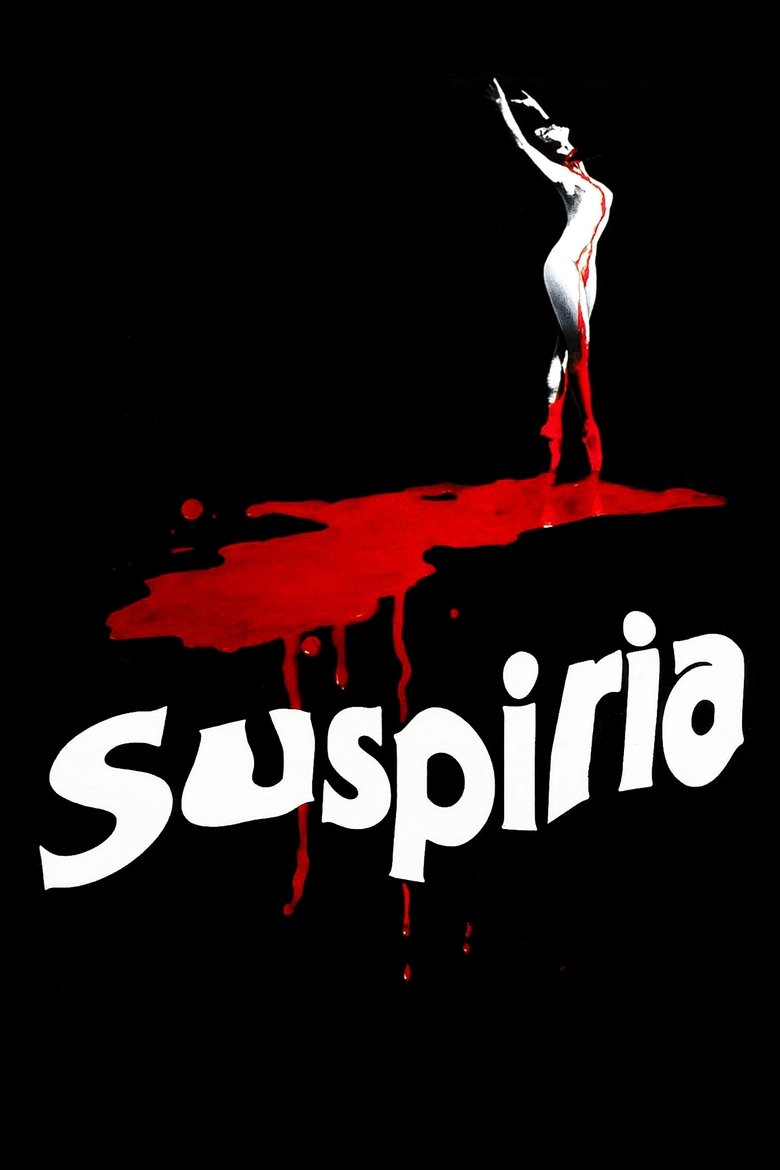
Suspiria
“Do You Know Anything About Witches?”
An American newcomer to a prestigious German ballet academy comes to realize that the school is a front for something sinister amid a series of grisly murders.
About Suspiria
Why Suspiria still works
Suspiria welcomes you in the middle of movement. We meet Suzy Bannion, an American ballet student who has come to Freiburg to study at the Tanz Akademie — and almost immediately the place stops feeling purely academic.
There’s no slow build to the strangeness: a panicked student flees the school in terror, Suzy is turned away and forced to spend the night in town, and the surface normality of a dance academy begins to fray. That urgency gives the film a tautness that keeps you watching rather than wondering when the next shock will arrive. Dario Argento directs with a lean sense of purpose: Suspiria runs for 94 minutes and uses that economy to move from mystery to menace without dawdling. Jessica Harper’s Suzy is the lens through which we discover a place where friendship and fear collide, and where every polite introduction might be the first step toward something much worse.
The idea that sets Suspiria in motion
The simplest way into Suspiria is this: a prestigious dance school, a newcomer with nowhere to turn and a violent, unexplained rupture that refuses to be explained away. Suzy arrives, meets the school’s instructors — Miss Tanner and Madame Blanc — and finds herself dropped into an environment that is oddly closed-off and strangely formal.
She also meets classmates who are potential allies: Sara and Olga, and a routine of classes and rules that should be comforting but instead feels tightly managed. The movie’s engine is curiosity: Suzy moves from polite student to someone asking the wrong questions at exactly the wrong time.
That insistence on following a clue — footsteps in a corridor, a strange refusal at an intercom — is what keeps the plot moving. Those small, precise choices lead her into Madame Blanc’s office, and then into a discovery that reframes everything she thought she understood about the school.
It’s not a whodunnit so much as a how-bad-is-this-really puzzle. When Suzy finds the instructors gathered and plotting a human sacrifice, the set-up flips from private unease to full-blown conspiracy — and the stakes become properly personal.
Why Suzy Bannion matters
Suzy Bannion is the most sensible choice of protagonist for this story: an outsider who arrives with a single-minded purpose — to study — and then is forced to adapt when that purpose becomes complicated by violence and secrecy. Jessica Harper plays her, and the film makes a clear decision to let Suzy’s curiosity do the heavy lifting.
She’s not a detective in any formal sense. She’s a novice who keeps showing up, asking questions and following small clues that others dismiss. That quiet persistence is how the movie turns ordinary student behaviour into something heroic: asking to see a teacher’s office or chasing down a sound can lead straight to survival.
Friendship is threaded through her actions. Pat runs to a friend and confesses terror; Sara becomes someone Suzy trusts enough to follow a lead. Those connections make the losses sharper — Suzy’s investigation isn’t an abstract mystery, it’s about people she’s already begun to care about.
When she doubts the official explanations and even calls on Sara’s former psychiatrist, Suzy becomes the pivot between a school that wants its secrets and the messy, human world outside. That position — between institutional calm and frightened individuals — is why she matters: she’s the audience’s reasonable, stubborn eyes.
Suspiria has more on its mind than the plot suggests
On the surface Suspiria is a supernatural thriller about a corrupt academy. Underneath, it keeps returning to a few human things: freedom, loss, friendship and mortality. The movie uses the school as a pressure cooker where those ideas are tested — especially the possibility of escaping the rules that govern you.
Power is a constant. The revelation that the school traces back to Helena Markos and that a coven draws its strength from a single leader reframes the entire institution as a hierarchy that lives or dies by one person’s authority. That’s a tidy narrative device, but it also lets the film ask what happens when a system depends on a single figurehead.
Loss arrives repeatedly: students disappear, friends are murdered, and loyalty becomes dangerous. Those losses are not just plot points; they are the emotional currency that makes Suzy’s choices feel necessary. Friendship supplies what the school lacks — a reason to act rather than to hide. Mortality and lifespan are quietly present too. If the coven’s power is tied to a leader’s life, then death is not just an ending but a structural threat. The idea that an organisation might collapse without its head gives the final moments a logical, almost merciless pressure: remove the centre, and the rest must follow.
Suspiria could not belong to any other decade
Suspiria was released in 1977, and that date is not incidental. It arrives at a moment when filmmakers were willing to be blunt and brave with genre, and the movie’s choices — to be concise, strange and unflinching — read like a product of its time.
Calling it a 1970s movie isn’t nostalgia; it’s an observation about a film that sits comfortably in that decade’s appetite for boundary-pushing horror. Being made in 1977 means it carries the decade’s tendency to mix mood, shock and mystery without necessarily explaining every seam.
The decision to tell a tight, ninety-four-minute story — to move swiftly from arrival to confrontation — is itself a 70s sort of confidence: don’t over-explain, let the audience feel the oddness and follow where it leads.
Put simply: Suspiria’s 1977 birthdate matters because the film shares the decade’s impatience for slow exposition and its willingness to let unease sit on screen until it becomes unbearable.
Why Suspiria still matters
People remember Suspiria because it doesn’t skimp on memorable, unsettling beats. A student bolts from the school in terror; Pat is brutally attacked and later found hanged; maggots fall from a spoiled shipment and ruin the students’ night. Those moments stick because they are decisive and unromantic — they don’t hint, they land.
The film’s roster of characters — Miss Tanner, Madame Blanc, the blind pianist Daniel, and students like Sara, Olga and Patricia — gives the academy texture. When those figures are removed or revealed to be hostile, the losses feel personal rather than schematic. Finding Sara’s disfigured corpse in a hiding place reframes the threat as intimate and horrific.
There’s also the structural reveal that supplies a satisfying, ominous answer: the school traces back to Helena Markos, and the instructors are not merely strict, they are part of a coven that depends on a central leader. The discovery of the instructors plotting a human sacrifice makes the whole enterprise feel inevitable and monstrous at once.
Finally, the bookend of escape and collapse — Suzy forced into Helena Markos’s private space, the leader’s death, and the school’s destruction — gives the story a clean, terrible logic. When the centre is removed, the rest falls apart; that tidy cruelty is part of what keeps the movie lodged in the memory of those who first saw it.
Does Suspiria still hold up?
Yes — if your taste runs to compact, uncompromising horror that is driven by curiosity and dread rather than by explanation. In 94 minutes, Dario Argento gives us Suzy Bannion’s trip to a Freiburg academy, a violent unraveling and a revelation that the school’s power rests on a single, dangerous centre.
The film’s commitment to friendship and loss — the way small acts of trust become the reasons to push against secrecy — still lands. When the coven’s dependence on its leader is revealed, the narrative stakes make sense: remove the head and the body cannot keep pretending to be whole.
That logic gives the ending weight: Tanner, Pavlos and the rest of the coven perish once the leader is gone, and Suzy escapes into the night as the academy burns. It’s not a neat happy ending, but it rewards the film’s earlier insistence on following the cracks until they shatter. If you’re drawn to movies that make institutions feel dangerous and personal ties feel necessary, Suspiria is still worth your time. It’s brief, bold and certain of its own strange rules — and it asks you, quietly but insistently, to keep watching until the truth is forced into the open.