
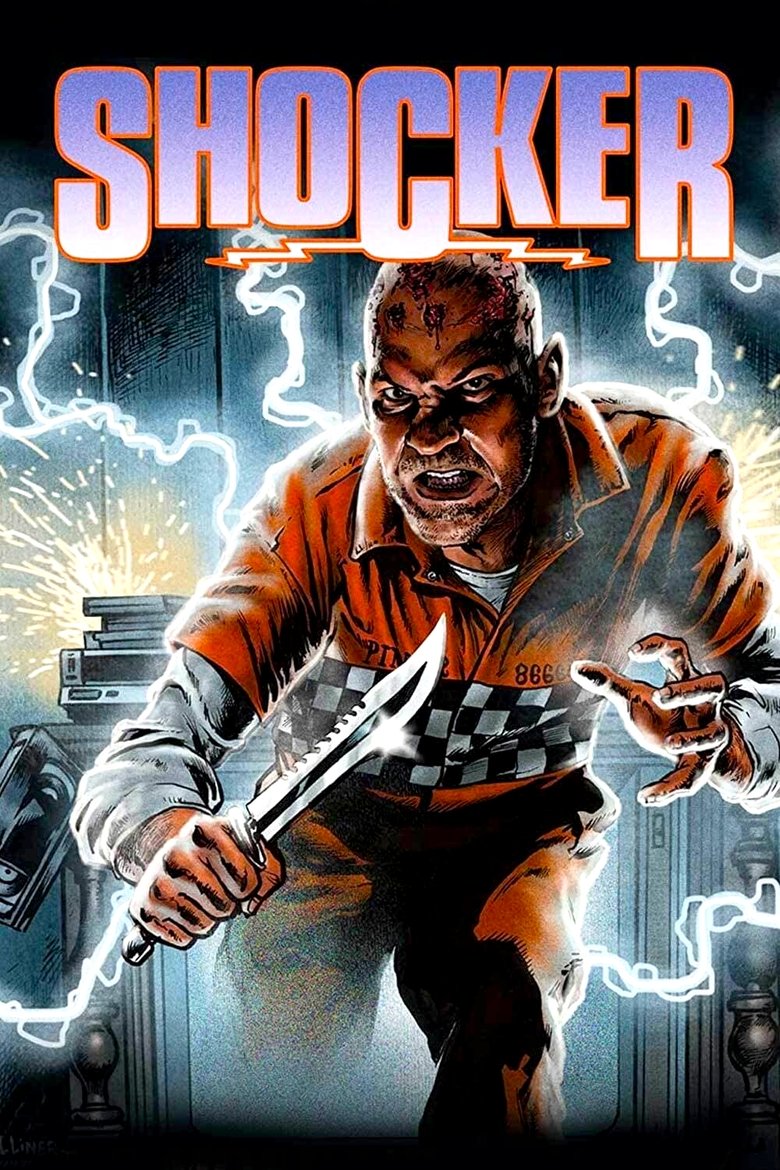
Shocker
“No More Mr. Nice Guy”
About to be electrocuted for a catalog of heinous crimes, the unrepentant Horace Pinker transforms into a terrifying energy source. Only young athlete Jonathan Parker, with an uncanny connection to him through bizarre dreams, can fight the powerful demon.
About Shocker
What makes Shocker worth revisiting
You start with a news image: a victim being pulled away on a stretcher. That instant sets the movie’s tone — a suburban bleeding into the broadcast, ordinary life interrupted by something gruesome on the other side of the screen.
Wes Craven made Shocker at the end of the 1980s, a compact 101‑minute ride that knows it’s a horror‑comedy hybrid. It plants its flag immediately by introducing a serial killer at large in a Los Angeles suburb and then refusing to keep him ordinary: this is Horace Pinker, a television repairman with very particular talents. What keeps the film moving past the gimmick is the way those talents collide with family. Lt. Don Parker is the cop who follows the case up close, and when his household is ripped apart the story becomes about protection, the bonds between an adoptive father and son, and the small group of friends who get dragged into turning off the lights to stop the threat.
Why Lt. Don Parker matters
Lt. Don Parker is not a detective-for-hire with a cool jacket — he’s a father. Michael Murphy’s character is the officer whose investigation becomes painfully personal when Pinker’s violence takes aim at his family.
The film turns procedural duty into parental duty: when Parker’s wife, foster daughter and foster son are murdered he is forced to treat the case as a rescue mission rather than a routine investigation. That shift gives the movie its ache; the detective’s choices come from protecting the people around him, not from career ambition.
Parker’s adopted son, Jonathan, becomes central to that protection. Jonathan’s link to the killer — a strange connection through dreams that points the police to Pinker — means Parker is not working alone; his paternal role includes following his son’s leads and watching over him as danger escalates.
Even the more physical moments underline Parker’s purpose. He ends up grappling with the killer in a way that is as much about stopping the threat as it is about keeping whatever’s left of his family safe, and those desperate, hands‑on confrontations remind you why parental protection is the film’s beating heart.
Shocker has more on its mind than the plot suggests
Beneath the shocks and the black comedy there’s a steady interest in how people cope when technology steps in where it shouldn’t. The film treats technological menace as a kind of force that upends ordinary life, not merely a backdrop for screams.
Family threads tie directly into that menace. The movie makes clear that the stakes are emotional as well as physical: the chase isn’t about catching a headline, it’s about saving the unit of people who call themselves family and the limits they’ll push to keep one another safe.
Friendship is the film’s other civilian resource. A group of mates — the sort who’ll do ridiculous things for one another — end up carrying out the blunt, civic side of the plot: they head to the power station to disable the supply and, in doing so, become active participants rather than passive victims.
All of these ideas orbit questions of power and lifespan: who can control energy, who can be made immortal, and what freedom looks like once those elements are in play. The movie’s choices keep the focus on relationships rather than just the novelty of the threat.
Shocker could not belong to any other decade
Shocker arrived in 1989, which places it right at the tail end of the 1980s and ties it to a particular era of mainstream horror that liked its ideas bold and uncomplicated.
Being an '80s picture matters because it gives the film permission to be a bit brazen — to take a strange premise and run with it for the sake of a good set piece and a punchy closing image.
That timing also helps explain why the movie mixes comedy, black humour and outright horror in short, confident bursts; it behaves like a film that knows its place in the decade’s cinema without having to over‑explain itself. If you think of Shocker as an 1989 creature, it reads as a final, rather unrepentant example of that decade’s appetite for high‑concept premises married to low‑tolerance storytelling. Which is to say: it’s very much of its time, and that time is part of the point.
What has aged — and what hasn't
On a modern watch, the clearest things that hold up are the human bits: the family ties and the loyalties among friends. Those relationships are simple but honest, and simplicity here is an advantage rather than a flaw.
The film makes choices that keep the action legible: people are acting to protect one another, and that motive translates regardless of when you first see it. The adoptive father/son dynamic and the mates who take decisive, physical action remain emotionally persuasive.
Where Shocker can feel dated is in the mechanics of its set pieces and how it wears its high‑concept idea on its sleeve — but because the movie keeps returning to who cares for whom, those moments sit inside an emotional frame that modern viewers can still recognise.
If you watch it now, treat it like an oddball fairy tale about community and protection rather than as a cutting‑edge tech thriller. The core human commitments are what make it watchable today.
Why Shocker still matters
There are images in the film that stick: a news report showing a stretcher, the mounting tally of a serial killer on the loose, and the small‑town dread that follows when the murderer turns out to be a familiar trade — a television repairman. Those details make the danger feel both public and domestic.
The story’s personal hits are what people remember. Pinker’s violence impacts Lt. Don Parker’s home directly — the murder of Parker’s wife, foster daughter and foster son turns the procedural into a private war, and that kind of personal cost lingers in the memory.
The film also leans on striking conceits: a convicted killer sentenced to the electric chair who does not simply die, a revelation about parentage that rewires the relationships, and the bizarre aftermath that leaves the killer as something other than human. Those beats give the film an oddball longevity.
Finally, the communal response — Jonathan’s friends heading to the power station, the blackout that traps the threat and Alison’s voice guiding Jonathan — turns the climax into a neighbourhood affair rather than an isolated showdown. That sense of group involvement is a reason the movie still feels personal to those who grew up with it.
Does Shocker still hold up?
Yes — if you’re looking for a film that pairs a daft, audacious premise with real domestic feeling. Wes Craven’s 1989 picture runs a tight 101 minutes and knows when to stop and let the family stuff breathe, which matters more than you might expect in a movie about a killer who isn’t content to die.
Watch it for the idea itself — a television‑repairman murderer who becomes something else after the electric chair — and for how those threats are rooted in a father’s attempt to shield his adopted son. The personal stakes carry the film through the moments where the concept is doing most of the heavy lifting.
It’s not subtle, and it isn’t trying to be. That bluntness is part of the charm: the film sits squarely inComedy‑Horror and Black Comedy territory, so expect shocks and jokes served without apology and a plot that keeps nudging the theme of parental protection. If you enjoy an oddball late‑’80s horror that cares about human bonds as much as inventive nastiness, Shocker is worth a look — a neighbourhood blackout, a family that won’t let go, and a final image that asks you to step outside and look up at the stars.