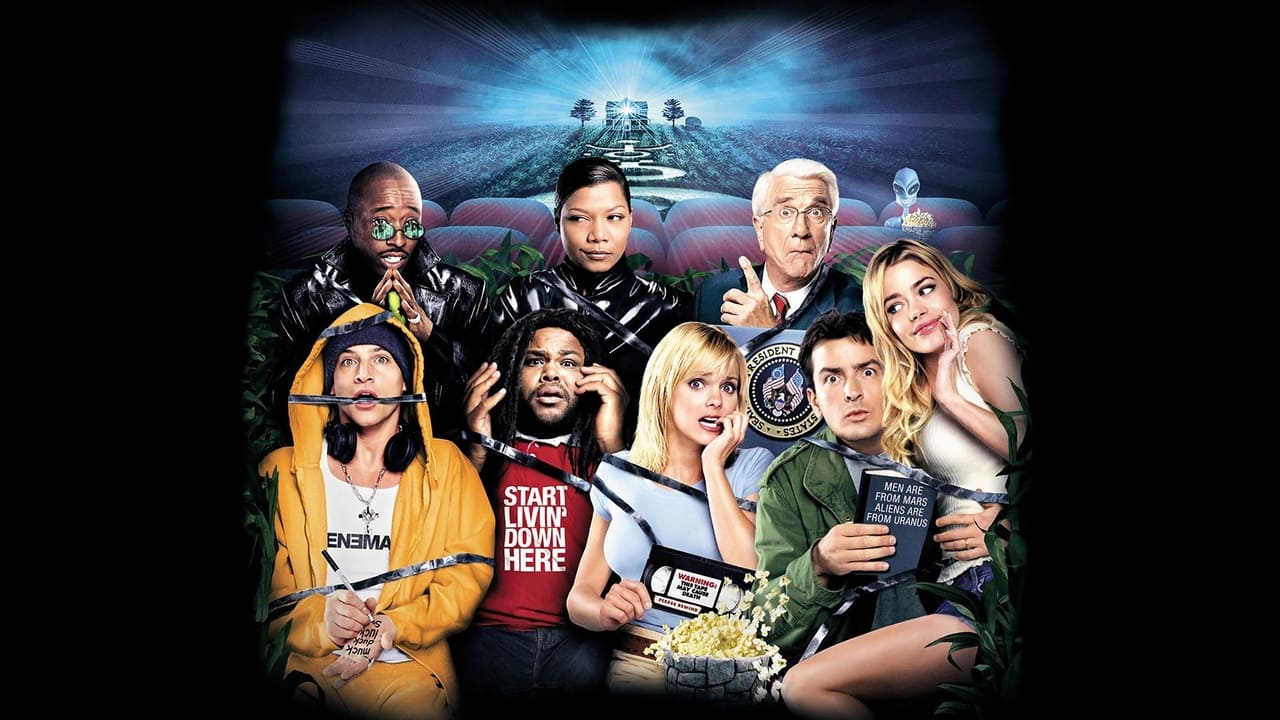
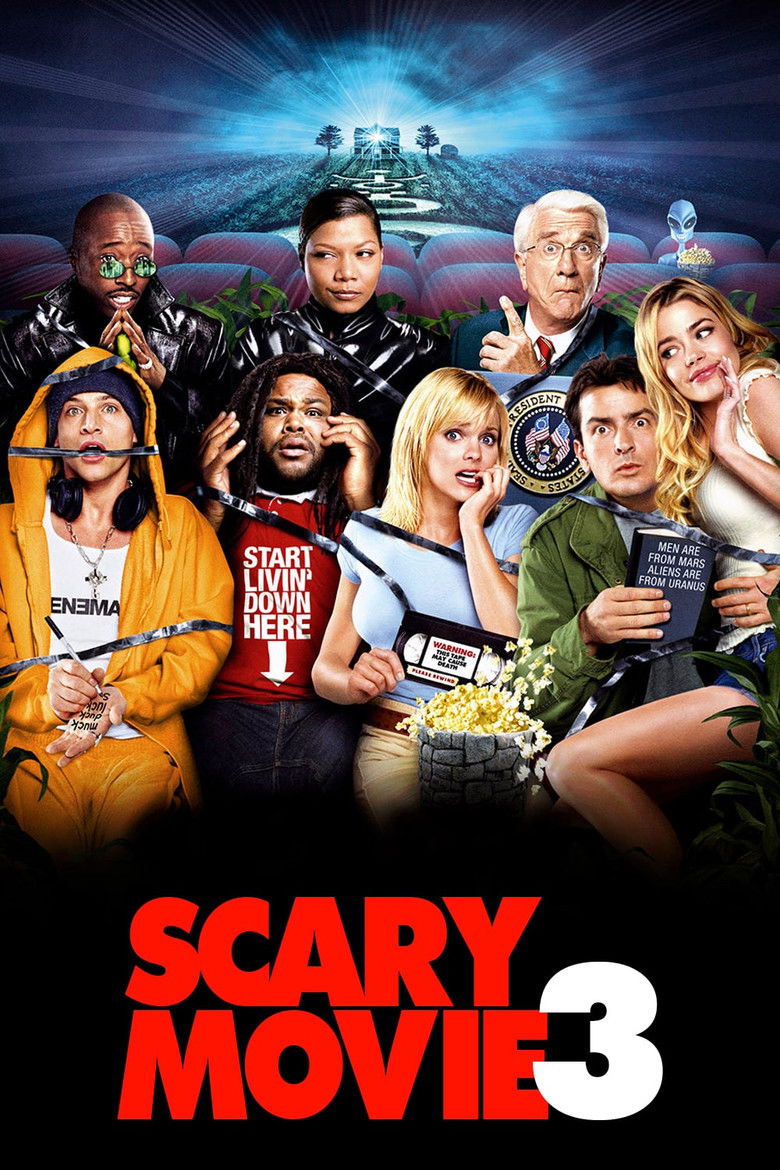
Scary Movie 3
“Great trilogies come in threes.”
News anchorwoman Cindy Campbell has to investigate mysterious crop circles and killing video tapes, and help the President stop an alien invasion in the process.
About Scary Movie 3
What makes Scary Movie 3 worth revisiting
If you remember one image from Scary Movie 3, it’s probably a cursed videotape that brings doom to anyone who watches it. That gag—borrowing the central idea from turn-of-the-century horror—is the film’s engine: take a familiar fear, then run it through a blender of daft sight gags and pop-culture detours.
David Zucker directs at sprint speed; the film wastes no time. It was released in 2003 and, in its brisk 84 minutes, hops between haunted wells, crop circles on a Washington, D.C. farm and an alien mistaken for a pop star. That breathless pace is part of its personality—it wants you laughing before you’ve finished noticing the reference. At the film’s centre is Cindy Campbell, the local reporter who covers the crop-circle story and, crucially, keeps an eye on her precocious nephew. She’s the thread that holds the mess together as the movie swings between full-on parody and something that, beneath the jokes, nods at family and loss.
The idea that sets Scary Movie 3 in motion
The film leans on a single, simple horror premise: people watch a videotape and an unseen force kills them afterward. That familiar, pulpy threat gives sugar to a series of sketches—some obvious, some surprisingly inventive.
Our connective tissue is Cindy Campbell. While she’s trying to report on crop circles, she bumps into George at a rap battle, where the movie deliberately mixes low-stakes comedy with mock-danger. It’s the sort of sequence that says: we’ll do both small, human jokes and big, silly set-pieces, often in the same breath.
From there the stakes shift quickly. One of Cindy’s friends confesses she’s seen the tape and asks for shelter; after a string of pranks, the supernatural force exacts its price. That setup—friends trying to protect one another from an inexorable, ridiculous threat—keeps the movie’s momentum honest.
Parallel to Cindy’s small-circle problem is the Logan farm: a widowed pastor and his brother find crop circles and a terrified child in the middle. The film ties those odd occurrences to an explanation found at a lighthouse, where an architect reveals a drowned girl whose evil was trapped in a VHS cassette. It’s ridiculous and tidy, and it’s the reason the tape’s menace has to be confronted before it spreads.
Why Cindy Campbell matters
Cindy isn’t the manic centre of the madness so much as the person you want to follow through it. Anna Faris plays her; she’s a local reporter at 8 News who’s trying to get attention for genuinely odd events while keeping her life together.
That combination—someone serious about a silly job—gives the film its balance. Cindy is the one who has to be practical: she finds the cursed tape, she broadcasts warnings that go awry, and she’s the adult figure for a child who can see things before they happen.
Crucially, Cindy isn’t just a plot device. When the supernatural threat escalates, she and George even try to talk the ghost into belonging somewhere—offering her a place in their family. That moment converts a gag into an emotional gesture: the film is prepared, now and then, to treat people like people.
Putting a reporter in the middle of haunted nonsense also makes the jokes land. She’s a bridge between the ordinary world and all the lunatic elements the script throws at her, which keeps the film anchored even when the next gag is airborne.
Scary Movie 3 has more on its mind than the plot suggests
On the surface it’s parody: a grab-bag of horror and sci-fi jokes. Underneath, the film keeps circling family. From the widowed pastor and his daughter on the farm to Cindy’s role as guardian for her nephew, relationships matter more than the one-liners.
Loss is threaded through the set-up. A drowned child becomes the origin of the tape’s evil and that origin story pushes characters into actions that are as protective as they are panicked. The joke scaffolding sits atop a recognisable fear—of harm, and of not being able to stop it.
Mortality and lifespan get their comic treatment too. The cursed tape’s countdown is an absurd version of real dread: a fixed deadline that forces characters to make choices and to think about what they’ll do to keep the people they care about safe. Even when the film is being daft—aliens turn up, mistakes are made—the big emotional beats are about adults trying to look after the children around them. That parental-protection impulse gives the absurdity a pulse.
Scary Movie 3 could not belong to any other decade
Released in 2003, Scary Movie 3 feels stamped by the early 2000s. There’s a rapid-fire sketch sensibility—short, recognisable pop-culture hits stitched together for immediate laughs—that suits the era’s appetite for fast parody.
That period loved mash-ups: genre-mixing and referential jokes that assumed an audience fluent in movies and TV. The film’s willingness to swing from haunted tapes to extraterrestrials and celebrity cameos is exactly the decade’s kind of jokework.
So while the gags are very much of their time, the basic mechanics—quick set-ups, a low tolerance for lingering—are what make the film feel like a product of that particular moment in commercial comedy.
What has aged — and what hasn't
Some of the film’s broad comedic instincts still work: the central mystery of crop circles on a farm outside Washington, D.C., and the jump from small-town panic to national spectacle is an effective comic through-line. It gives the jokes somewhere to land.
The movie’s interest in family also reads crisply today. Cindy trying to protect a child who sees the future, and adults scrambling to keep children safe, is a simple, human concern that outlives any dated reference.
Other things feel less comfortable now. The gag economy depends on quick punches and celebrity detours; when the tape is carelessly broadcast to a much wider audience, the movie is asking us to laugh at panic on a bigger scale, which lands unevenly depending on sensibilities.
Still, certain comic beats—like attempting to reason with a ghost and offering it a place in your family—have a peculiar charm. They mix cruelty and tenderness in a way that keeps parts of the film surprisingly watchable.
Why Scary Movie 3 still matters
People who grew up with it remember specific images: the cursed tape, the crop circles and the rap-battle detour where a character’s white hoodie goes disastrously wrong. Those moments stick because they’re sharp, silly ideas executed without hesitation.
The film also assembled a familiar gag roster—a reporter trying to be taken seriously, a kid with precognition and a community reacting to the bizarre—which made it easy to quote and to return to at parties or late-night chats. The beats are memorable because they’re immediate and plain.
There are darker, more surprising threads in its memory too. The drowned girl whose malice inhabits a VHS cassette and the attempts by characters to offer the ghost a family slot gives the film an odd emotional punctuation that people recall with a mixture of affection and bewilderment. Finally, the mixture of small-scale domestic worry and big, absurd spectacle—aliens who misidentify a human film and intervene—means it’s the kind of film people either enjoy as an aggressive joke machine or revisit because its weird tonal shifts make it interesting to dissect with friends.
Does Scary Movie 3 still hold up?
Yes — but with a caveat. If you want razor-sharp satire or a slow-burn story, this isn’t it. Scary Movie 3 is an 84-minute sprint directed by David Zucker from 2003: frantic, referential and unapologetically broad. It does one thing well—throwing crowd-pleasing gags at familiar horror beats—and if that’s what you’re after, it still delivers.
Where it earns a little more respect today is in its heart. Anna Faris’s Cindy is the film’s anchor: a reporter at 8 News trying to make people listen while protecting a child who sees trouble coming. That family impulse—adults trying to keep kids safe—gives the film unexpected emotional texture.
There are misfires. Some jokes are blunt and a few set-pieces feel scattershot. But the movie’s commitment to absurdity means it rarely lingers where it shouldn’t; the pace hides weaknesses and accentuates the pleasures. Characters such as Mahalik and George are there to land the broad strokes, and mostly they do.
So should you watch it? If you want something that will make you laugh, make you cringe and sometimes make you feel oddly tender about a haunted VHS, then yes. Consider it a noisy, affectionate time capsule from the early 00s—flawed, funny and, when it wants to be, surprisingly human.