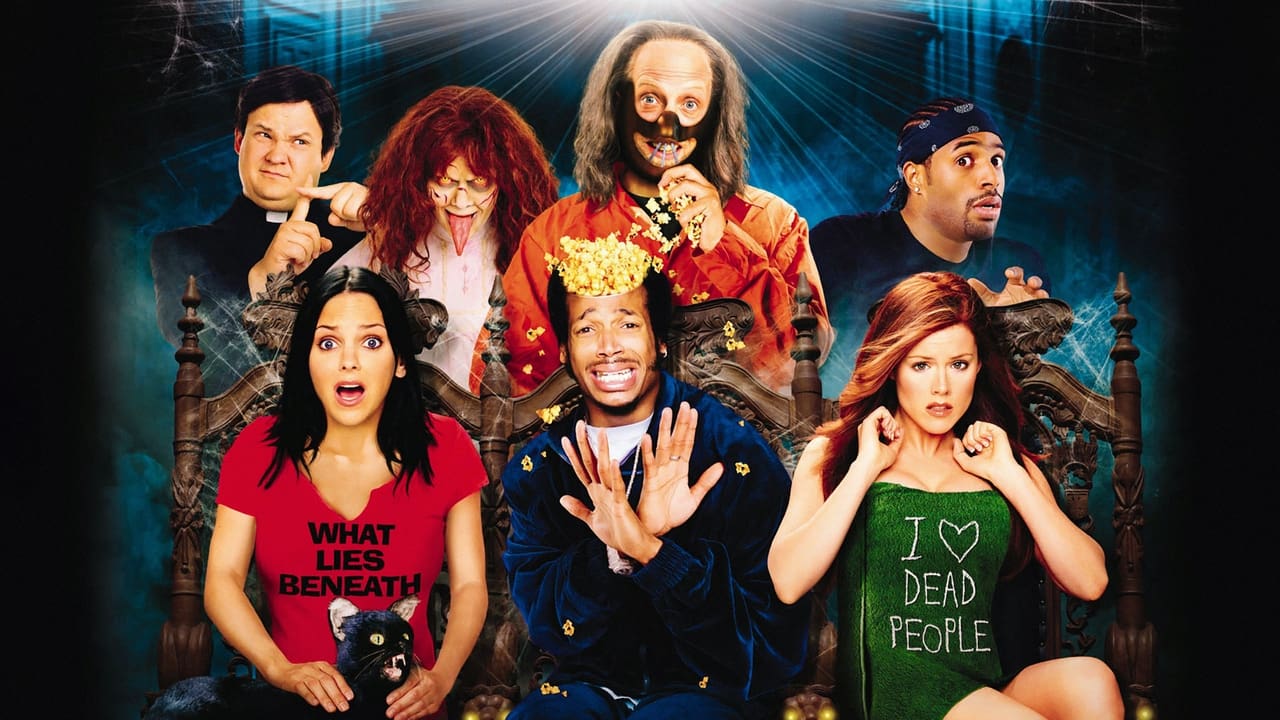
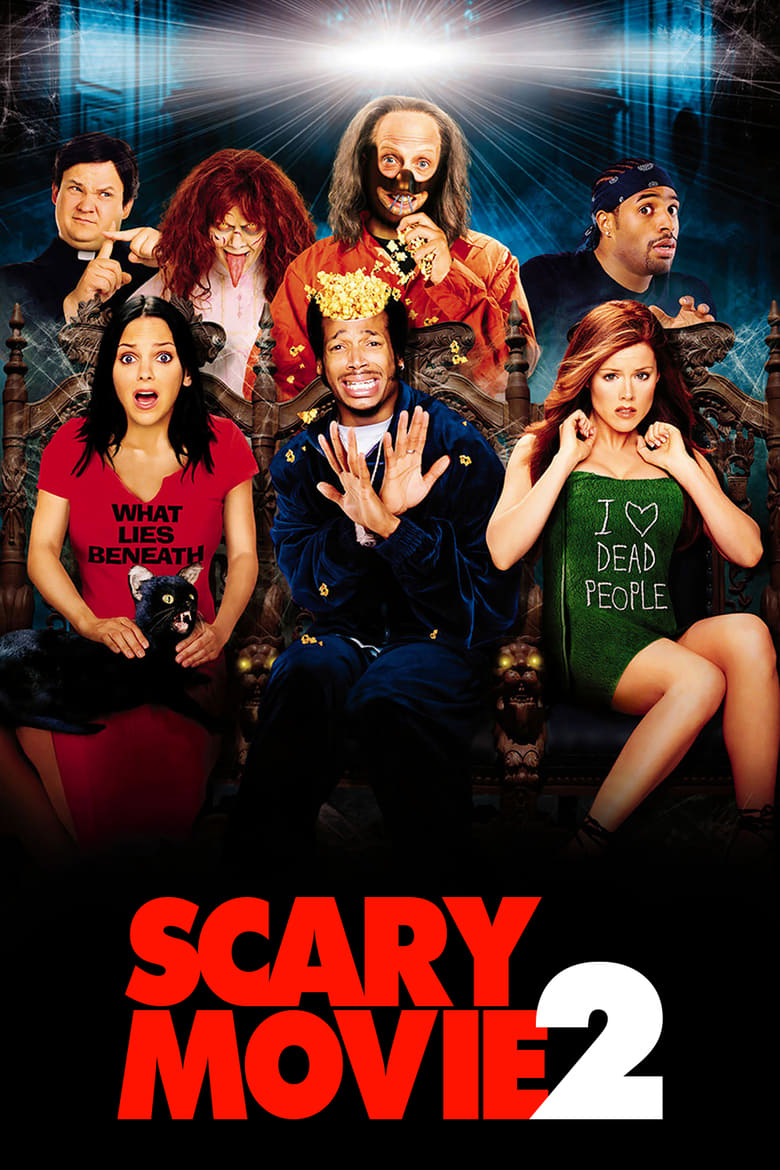
Scary Movie 2
“No more mercy. No more shame. No more sequels - honest! - We lied.”
A group of students visit a mansion called "Hell House," and murderous high jinks ensue.
About Scary Movie 2
Why Scary Movie 2 still works
Start with the image that sticks: a haunted place called Hell House, a teenager possessed by a spiteful old owner and a priest who, when all else fails, pulls a gun. That opening shove plants the film’s tone — spooky business handled with blink-and-you’ll-miss-it absurdity.
Keenen Ivory Wayans keeps the whole thing tight and fast: 82 minutes of wide gags and theatrical set pieces that rarely linger. It’s a movie that prefers the quick joke to the slow burn, which explains why so many of its moments are immediately memorable. And at the middle of the chaos is Cindy Campbell. Anna Faris’s character is the point the film returns to — the sensible(ish) centre as friends, possessions and a foul-mouthed parrot collide. It’s that mix of spooky set dressing and a core group dynamic that makes Scary Movie 2 worth a second look.
The idea that sets Scary Movie 2 in motion
The film opens with a proper haunted-house hit: Megan Voorhees becomes possessed by Hugh Kane, the mansion’s nasty former owner, and an exorcism attempt goes so wrong that a priest resorts to a gun. It’s a blunt reminder that this house does not play by polite rules.
A year on, Cindy Campbell and her circle — Ray, Brenda and Shorty — are at college, trying to move on from what happened. The story’s engine is simple: survivors of one horror are drawn back into another, and they’re not arriving as blank slates.
Ray’s personal confusion and his new friendships — including Buddy’s romantic interest in Cindy — supply the interpersonal noise that keeps the plot from being only jump scares. There’s a low-key romantic thread, but mostly the characters are a team: friends caught up in something they didn’t choose.
When the investigators arm the teens with tools that can hurt the house’s spectral threat, the resulting chase feels like the whole movie’s point — a sequence of escapes, possessions and set-piece payoffs that keeps momentum high and stakes oddly domestic.
Why Cindy Campbell matters
Cindy is the thread the movie pulls on. Anna Faris plays her, but more importantly Cindy is the survivor who keeps being asked to sign up for another round of nonsense. One year after the first film’s trauma she’s in college, still trying to make ordinary life stick.
That ongoing attempt at normality — being a friend, dodging awkward romantic interest, agreeing to be part of a supposed sleep‑paralysis study — is what grounds the ridiculous set pieces. Cindy isn’t just the plot’s report; she’s its moral anchor in the loosest sense: the person who notices things and tries to act.
Her relationship with Buddy is telling. He’s interested in more than friendship; she says no but stays close. It’s a small, human note amid the chalet-sized gags and possessions, and it gives the film a quieter payoff down the line.
And when the house finally turns violent — when Hanson is taken over and Shorty is kidnapped — it’s Cindy who volunteers for the bait job that helps end the curse. That willingness to step forward is what makes her a memorable centre: not immune to the absurdity, but willing to face it with her friends.
Scary Movie 2 has more on its mind than the plot suggests
On the surface it’s a collection of parodies and gross-out payoffs. Underneath, the movie keeps circling a few steady ideas: belief in the supernatural, the slipperiness of what makes a house feel like home, and how fear alters ordinary relationships.
The Hell House isn’t just a location for jokes; it’s an inversion of safety. A house should be private, familiar, a place to rebuild after trauma. Here, every familiar object turns traitorous, which lets the film riff on what happens when the place you rely on becomes the threat.
Friendship is the answer the movie offers. The characters are not lone heroes; they operate as a unit. That’s why Cindy’s choices and the group’s willingness to help Shorty matter — the laughs land because there’s something genuinely shared at stake. And love — in its various guises — complicates things. Alex’s desperate bid for Kane’s affection ends in an explicitly fatal way, which is a blunt reminder that this film, even while jokey, treats desire and fear as forces that can collide disastrously.
Scary Movie 2 could not belong to any other decade
Released in 2001, Scary Movie 2 arrives at the very start of the 2000s — an era when cinema loved bold, immediate comedy and quick cultural payoffs.
That timing explains the film’s appetite for fast, unconcerned gag construction: it doesn’t spend long explaining itself and it expects the audience to keep pace with the jokes.
In other words, the movie carries a decade’s impatience and energy. Being from 2001 is part of its personality: noisy, brisk and unembarrassed by its own excesses.
What has aged — and what hasn't
Some of the shock-style jokes will land differently now; tastes have shifted. But the film’s core — the house as threat, the friends rallying together, and the way fear interrupts ordinary life — still reads clearly. Those story beats are simple and durable.
Sequences built around the teens being armed and chased through the mansion still produce a kind of breathless, comic tension. When the group have to act together, the stakes feel immediate because the danger is domestic: it threatens their friendship and safety.
Cindy’s choice to volunteer as bait and the plan that follows give the movie an old-fashioned payoff: the group works, the device is used, and the curse is broken. That tidy conclusion rewards the audience’s patience and keeps the emotional order restored.
Finally, the postscript — Cindy and Buddy as a couple two months later, followed by the film’s final, ridiculous gag — underlines what aged best: a willingness to finish on a human note before the film leans back into daftness. The friendship and small attachments keep the silliness from feeling hollow.
Why Scary Movie 2 still matters
What people remember are the scenes that refuse to be boring: the foul-mouthed parrot and Hanson the creepy caretaker, a weed that literally rolls Shorty into a joint, and the absurd escape in which Cindy cobbles together a caterpillar tractor. Those bits are precisely the kind that lodge in the head.
The film’s appetite for mixing gross-out set pieces with affectionate group stuff — survivors returning to college, old friendships tested — gives it a particular rhythm. It’s not all stunts; the movie keeps coming back to the idea that these characters have a shared history worth protecting.
There are darker comic beats too: a dinner interrupted by repulsive behaviour, an investigator who shows himself to be lecherous, and a scene where a character’s attempt to win love ends catastrophically. Those moments give the laughs a sharp edge. And then there’s the closing image: two months after the events the group has moved on, only for the movie to pull a last obscene gag. It’s the kind of finish that reminds you what kind of film you just watched — affectionate for its characters, relentless for its jokes.
Does Scary Movie 2 still hold up?
Yes — if you know what you’re walking into. Scary Movie 2 is 82 minutes of deliberately loud, silly parody assembled by Keenen Ivory Wayans and anchored around a group of characters who matter to each other. That compactness is a strength: it rarely outstays its welcome.
Some individual jokes will feel of their moment, and a few gags are deliberately crude. But the film’s themes — belief in the supernatural, the idea that a home can become unsafe, and friendship holding through chaos — still give the comedy some ballast. Cindy’s choices, the group’s teamwork and the tidy resolution are evidence the movie cares about its people beneath the pratfalls.
If you want slick satire, this isn’t it. If you want a frantic, affectionate parody that favors pace and gag payoff over subtlety, it’s still worth a watch. It’s a 2001 movie through and through: brisk, unapologetic and wired for laughs.
So yes: watch it for the silly scenes, stay for the group stuff — and don’t be surprised if you leave remembering a parrot and a caterpillar tractor more than any single line of dialogue.