
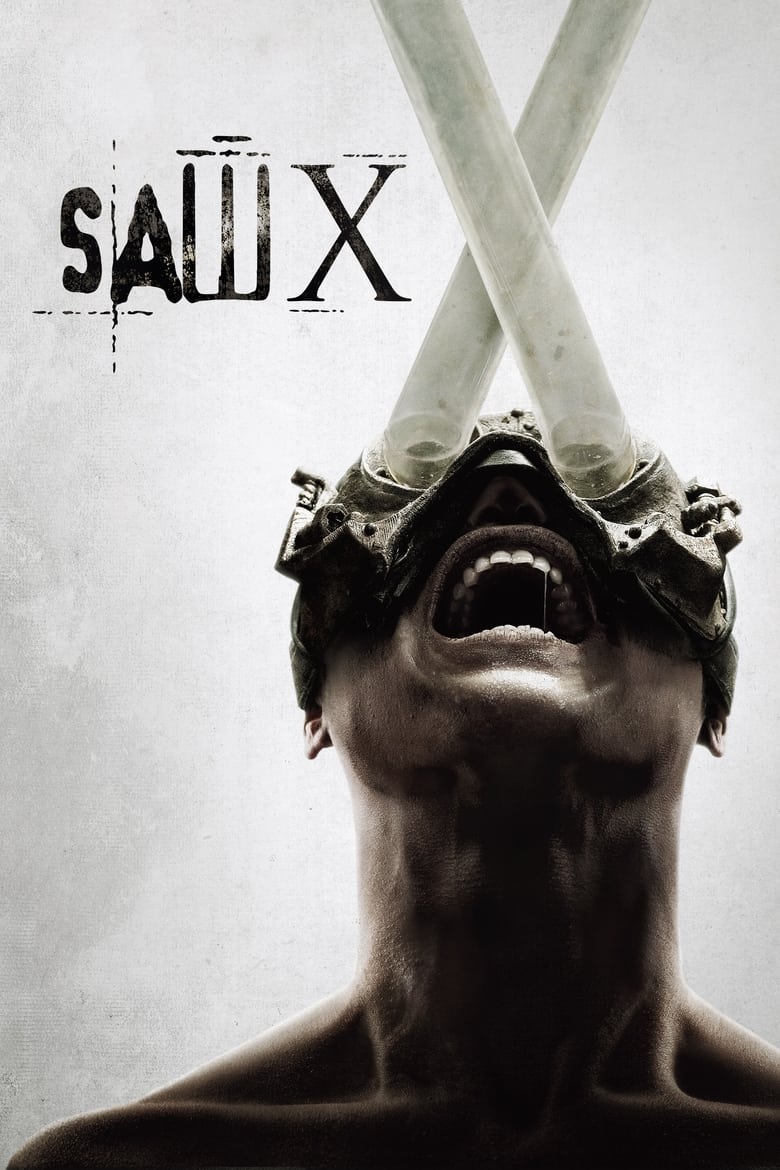
Saw X
“Witness the return of Jigsaw.”
Between the events of 'Saw' and 'Saw II', a sick and desperate John Kramer travels to Mexico for a risky and experimental medical procedure in hopes of a miracle cure for his cancer, only to discover the entire operation is a scam to defraud the most vulnerable. Armed with a newfound purpose, the infamous serial killer returns to his work, turning the tables on the con artists in his signature visceral way through devious, deranged, and ingenious traps.
About Saw X
What makes Saw X worth revisiting
There’s a flat, heartbreaking urgency to this one. John Kramer is already running out of time when the film begins, and that desperation steers everything: the travel, the bargains, the trust he places in strangers offering a cure. It’s a simple setup, but one that gives the film a distinct pulse.
Kevin Greutert directs with a clear aim: keep the story focused on people whose lives are being bought and sold, not just on the traps. That human centre — John’s search for a cure, his friendships in the clinic, the small kindnesses that matter — is what stops Saw X from feeling like a string of set pieces. It runs just under two hours, and it uses that time to knuckle down on motive as much as method.
And then there’s Amanda Young. Played by Shawnee Smith, she’s not a decorative sidekick; she’s hands-on in the abductions and the hard choices that follow. Her presence means this is as much about loyalty and family as it is about punishment — which makes the film feel oddly intimate for a picture that loves its gore.
The idea that sets Saw X in motion
The engine of the film is straightforward: John discovers the cure he believed in was a con. Instead of a scar, there’s the sting of betrayal — and a film that proceeds from that single, furious discovery.
He follows the trail of the deception, identifies who was involved and forces confessions in ways that leave no room for comfortable moral distance. One of the early payoffs is a brutal compelled-choice sequence in which a driver, unmasked as a scam participant, has to cut through flesh to save himself. It’s ugly, and the movie wants it to be.
Things escalate when Amanda Young joins the operation. The people responsible for the scam become subjects instead of suspects: they wake up inside the clinic and quickly realise they are in Jigsaw’s world now.
That neat swap — victims turned into participants — is why the setup works. The film doesn’t have to invent complicated backstories; it simply asks what someone on the edge will do when everything they hoped for is revealed as a lie, and then measures the answers in traps.
Why Amanda Young matters
Amanda Young is not a cameo; she’s an active force in the story. Shawnee Smith returns to the role and, crucially for the film, Amanda is shown doing the hard, hands-on work of abduction and enforcement. That changes the tone: this isn’t a distant puppeteer pulling strings, it’s someone who has signed up for the dirty work.
Her presence ties into the film’s focus on family. Amanda is part of John’s orbit and that membership explains why she’s there — loyalty, shared belief and an acceptance of the brutal logic they both live by. The result is a partner who makes the punishments feel personal rather than procedural.
Because she helps carry out the kidnappings and the supervision of the games, Amanda turns what could be a one-man vendetta into a small, grim family affair. That keeps the camera on relationships and choices, not just the mechanics of traps.
Put simply: Amanda matters because she makes Saw X less like a puzzle-box exercise and more like a story about people who have committed themselves to a cause — for better or worse.
Saw X has more on its mind than the plot suggests
At face value the film is about revenge and retribution, but underneath it’s organised around a few recurring impulses: parental protection, family ties, courage and an odd version of heroism. Those are not thrown in as ornaments — they determine who lives, who dies and why.
The parental-protection angle is especially telling. Many of the tense moments hinge on what a parent would or wouldn’t do to shield a child, and the script repeatedly returns to that moral knot until the choices feel inevitable, however uncomfortable.
Family in Saw X isn’t always blood. It’s also the small group that shares the burden of a belief. That sense of membership hardens characters’ loyalties and explains the willingness to carry out extreme acts on one another’s behalf.
Courage and heroism in the film are uneven — sometimes admirable, often twisted. The movie keeps asking whether courage is the same thing as stubbornness, and whether heroism can be defined by harm as much as salvation.
Saw X could not belong to any other decade
Released in 2023, Saw X sits squarely in a decade that has seen genre pictures doubling down on character as much as spectacle. This is not a film that treats its mechanics as an end in themselves; it leans on motive and consequence.
That 2020s tendency to blend thriller, crime and horror suits the film. Saw X is comfortable switching registers — from intimate drama to hair-raising trap sequences — and that hybrid identity is very much of this moment.
Being a 2023 movie also means the story feels deliberately economical: the runtime is used to set up stakes, deliver shocks and follow through on consequences without lingering for the sake of style.
In short, Saw X feels of the 20s because it insists that a horror picture can also be a tight moral melodrama, not merely an effects showcase.
Why Saw X still matters
What keeps people talking about Saw X is less the traps themselves and more the choices that surround them. The film begins with a sick man’s hope and a very human need for a cure; when that hope is shown to be a scam, the revenge that follows feels, for better or worse, comprehensible.
Amanda’s involvement and the way the clinic’s staff and patients are dragged into games give the film a communal texture — victims become players, and the moral lines blur. Scenes such as a desperate amputee struggle and a doomed attempt to extract a key from a piece of brain tissue are gruesome, yes, but they’re also woven into the story’s idea of rough justice.
The film also refuses neat closure. Cecilia’s betrayal, the moment a child becomes the fulcrum for a trap, and the claustrophobic fight forced by a single ventilation hole are the kinds of choices that leave a knot in the viewer’s stomach. Even the epilogue — a familiar face overseeing another trap — reminds you the story’s moral logic keeps turning.
All of this means Saw X matters because it treats its violence as an argument about protection, loyalty and consequence. It’s a nasty, stubborn little sermon that makes you squirm — and sometimes that squirming is the point.
Does Saw X still hold up?
Yes — if you want a Saw that remembers why John Kramer does what he does. The film opens with a man told he has only months left, sends him chasing a supposed cure, and then makes him respond when that cure turns out to be a lie. That emotional throughline gives the film a moral spine most entries in the series only flirt with.
It’s also a return to the small, personal scale: Kevin Greutert keeps the runtime focused on motive and consequence rather than set-piece virtuosity. Amanda Young is central to that choice — she turns vengeance into a collective project, which lifts the movie out of pure spectacle territory.
If you’re unsettled by gore and moral ambiguity, this won’t convert you. But if you appreciate a horror-thriller that ties its shocks to genuine grievances — a scam, a child used as leverage, the bitter arithmetic of who survives — Saw X delivers with conviction.
So should you watch it today? If you care about a Saw that doubles as a grim family drama with a clear, if brutal, logic, then yes. It’s a nasty film, but one that still believes in the human sparks at the centre of its cruelty.