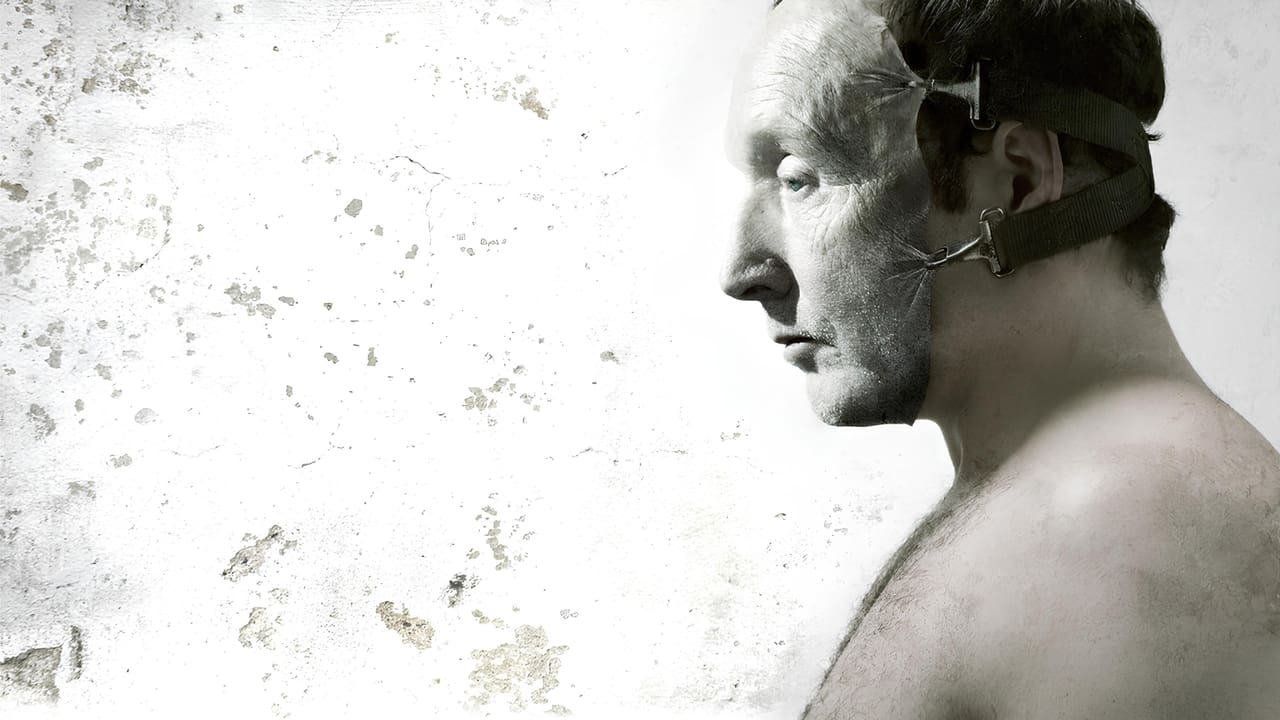
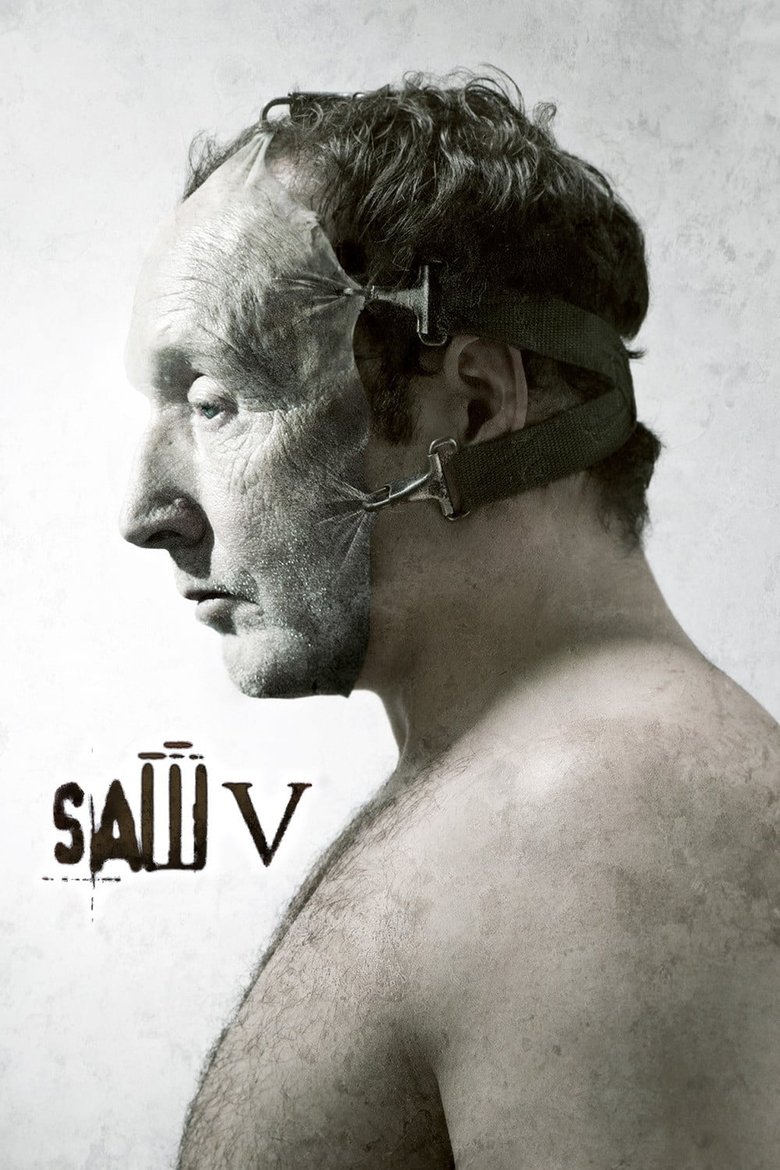
Saw V
“You won't believe how it ends.”
Following Jigsaw's grisly demise, Detective Mark Hoffman is commended as a hero, but Agent Strahm is suspicious, and delves into Hoffman's past. Meanwhile, another group of people are put through a series of gruesome tests.
About Saw V
Jigsaw is still the reason this movie works
Right up front, Saw V reminds you why the franchise stuck around: a convicted killer wakes under a pendulum blade and is forced to make a grotesque choice to escape. It’s the sort of immediate, horrible proposition that lets the film do what it does best — put life on a balance and make you watch which way it tips.
David Hackl directs with a clear short-hand: this is a 92-minute splatter picture that doesn’t linger on small talk. It’s lean, mean and designed to keep the pressure on while Tobin Bell’s presence as Jigsaw hangs over everything like a quiet verdict. Beyond the traps themselves, the film is interested in what those traps do to people — how authority claims closure, how grief asks for protection, and how the countdown is the most democratic thing in the room. That mixture is why Saw V still demands attention from anyone who remembers the series’ particular brand of nastiness.
The idea that sets Saw V in motion
Saw V runs on suspicion. Agent Peter Strahm, pushed to the sidelines by his superiors, refuses to accept the neat closure his colleagues hand him and starts digging through old case files to see whether Mark Hoffman belongs inside or outside the circle of blame.
Hoffman, meanwhile, bears a darker backstory: John Kramer once abducted him and forced him into complicity, pulling him into the business of making people pay for their lives. That history reframes Hoffman from simple cop to something nearer an heir — or a cover story.
The movie then threads two strands together: an investigator who won’t let a case rest, and a set of brutal tests in which people wake up wired to each other and told they must act against instinct to survive. It’s a tidy engine for tension: personal doubt on one side, immediate physical peril on the other.
Because the film keeps its staircase of revelations compact, that collision — the procedural stubbornness of Strahm against Hoffman’s muddy loyalties, and the victims who must learn cooperation under threat — is what drives the picture rather than any single lengthy scene.
Why Jigsaw matters
Jigsaw isn’t just a monster wearing a machine; in Saw V he’s more of a continuing legal brief. Tobin Bell’s role is the moral corkscrew that keeps being turned: his philosophy supplies motive, even when he’s not the one hiring the henchmen or pushing the buttons.
The film underlines that legacy by showing how Hoffman's reputation — being credited with closing the case and rising in the ranks — rests on Jigsaw’s prior work. That relationship matters because it makes the investigation personal: it’s no longer just about traps, it’s about whose name ends up on the file.
Strahm’s obsession with proof and his decision to comb through victims’ records is in direct conversation with Jigsaw’s aftermath. The man may be physically absent for much of the film, but his rules and bargains keep the plot moving and keep the other characters answering to him.
And when the narrative reaches its last cruel turn — the tape that forces a choice about entering a box or being framed — it proves how Jigsaw’s ethical grammar can outlive him, shaping other people’s fates long after he’s gone.
Saw V has more on its mind than the plot suggests
On the surface Saw V is a series of contests in which bodies are counted and blood tallied. Underneath, the film keeps returning to mortality: how long a life lasts, what people will do to preserve it, and the ledger-style way the story measures sacrifice.
Authority is another quiet obsession. The movie explores who gets to declare an end to a case, who claims credit and who enforces punishment. When a detective is promoted for closing the Jigsaw file, it raises the question: is justice a job to be finished or a story to be owned?
Parental protection and home safety flicker through the proceedings too. Characters make desperate moves to keep loved ones intact or to assert control over the places they thought were safe. Those instincts — to guard, to blame, to shelter — show how fear of loss propels people into the traps, sometimes literally. Finally, there’s a constant tug between freedom and constraint. The tests demand cooperation and self-sacrifice, forcing characters to weigh individual escape against collective survival. That moral math is what gives the gore a narrative purpose: the horror is meant to ask something of the people inside it.
Saw V could not belong to any other decade
Released in 2008, Saw V sits squarely in the 00s horror run where franchises kept upping the ante and sharpening their signatures. The film is unapologetically a splatter picture — it delivers the kind of numbered, bloody puzzles viewers came back for.
That era loved mechanics: traps, rules and clever reveals. Saw V uses those devices not as mere spectacle but as the plot’s currency, which is very much a 2000s approach — make the gimmick mean something, and then make it mean more by complicating who controls it.
The decade also favoured brisk, high-concept sequels that rarely lingered. At 92 minutes, the film follows that box-ticking formula: short on small talk, long on propositions that demand a yes or no from both characters and audience.
Put simply: Saw V feels of its time because it treats ingenuity and brutality as parallel virtues — a telling trait of late-00s genre filmmaking when franchises kept pushing their own rules.
Why Saw V still matters
A lot of Saw V’s continuing pull comes from a handful of images and shocks that stick in the head: the pendulum trap that forces a man to mutilate himself to free his hands, then bisects him anyway; the pig-masked attack that leaves an investigator fighting for air in a sealed box. Those moments are literal, nasty and hard to forget.
But the film’s aftertaste comes from its twists on responsibility. Hoffman walking away promoted and lauded for closing the case, while Strahm is the one who won’t let it rest, gives the story a political edge: the person who finishes a story can also be the one who rewrites it.
The sewer tests, where five people discover they are connected and must oppose their instincts to survive, turn the usual slasher logic inside out. Instead of lone survival, the narrative forces cooperation, and when that cooperation comes, it is costly — people die, others mutilate themselves — which leaves a residue of moral ambiguity.
And then there’s the final cruelty: a tape that coerces Strahm into a choice that seems straightforward until it isn’t, ending with a twist that reframes the entire investigation. It’s the kind of sting that keeps viewers arguing about who got played and how, which is why the movie keeps getting talked about.
Does Saw V still hold up?
If you’re asking whether Saw V still works, the answer depends on what you came for. As a compact, 92-minute piece of splatter filmmaking from 2008, directed by David Hackl, it delivers the traps and the moral games the series promised — and it keeps Jigsaw’s logic at the centre.
The film’s pleasures are precise: the cruelty of choices (a man crushed by a blade after doing what he is told), the undermining of authority (a promoted detective who may be the puppet master), and the way the narrative forces characters into impossible bargains. Those elements give it a clear identity.
That said, if you want subtlety or a neat sense of justice, Saw V will frustrate: it trades tenderness for tension and moral complexity for procedural twists. The finale — where an investigator is manipulated into a death that rewrites the case — is a clever sting, but it’s also a reminder that the film prefers shocks that complicate rather than consoling closure. Bottom line: watch it if you like your horror lean, mean and morally knotty. Saw V still does exactly what it set out to do — and in that stubborn way, it remains satisfyingly consistent with Jigsaw’s rules.
Director & Cast