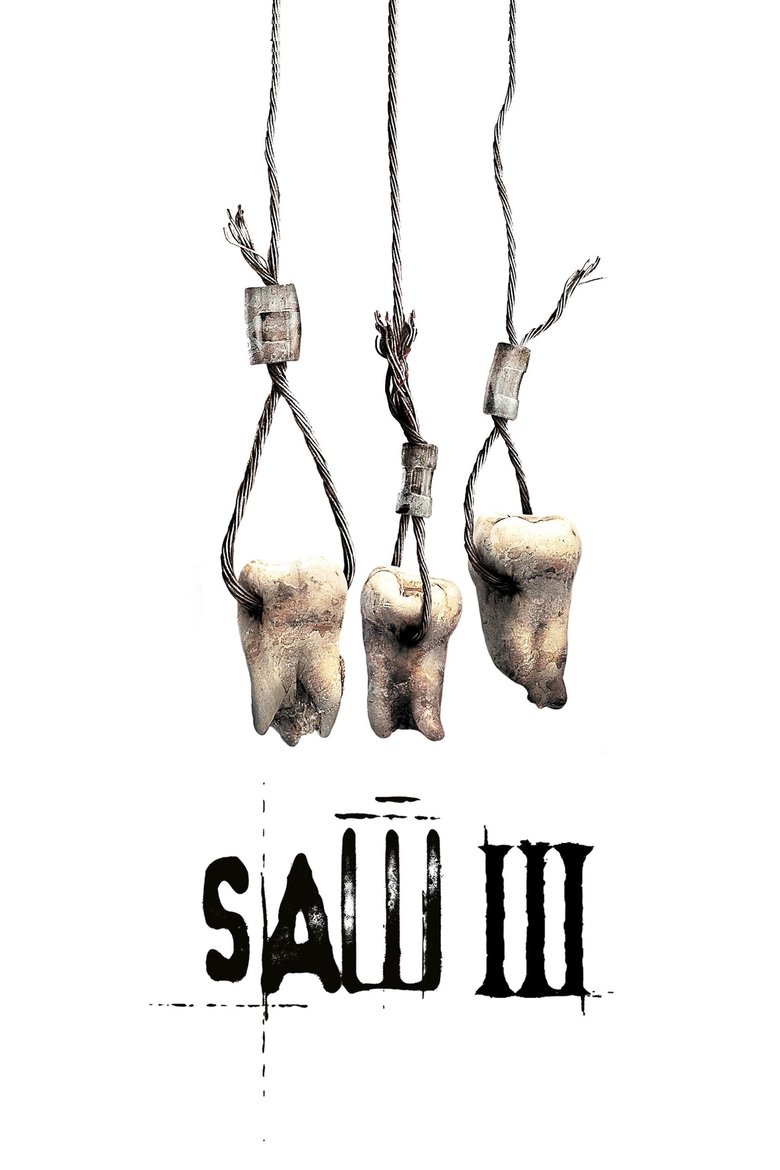
Saw III
“Suffering? You haven't seen anything yet...”
Jigsaw has disappeared. Along with his new apprentice Amanda, the puppet-master behind the cruel, intricate games that have terrified a community and baffled police has once again eluded capture and vanished. While city detectives scramble to locate him, Doctor Lynn Denlon and Jeff Reinhart are unaware that they are about to become the latest pawns on his vicious chessboard.
About Saw III
What makes Saw III worth revisiting
Start with the image people still flinch at: a detective who, after being trapped in a bathroom, literally breaks his foot with a toilet lid to get free. It’s grotesque, yes, but it’s also a promise — Saw III will put its characters through situations that force them to choose in ways ordinary dramas never will.
This is a Darren Lynn Bousman picture through and through: 107 minutes of increasingly personal cruelty directed at bodies and loyalties. Tobin Bell’s Jigsaw is the patient centre of the film, but the movie’s real energy comes from the people around him — the woman who keeps his secrets, the doctor forced to be his custodian, and the father who is made to walk the slow, painful path of his grief.
At its best Saw III pairs visceral setups with very human stakes: parental protection, the clock of mortality, the ache of loss. Those themes sit behind the traps and the theatrics, which is why the film still sparks conversation more than a decade after its 2006 release.
The idea that sets Saw III in motion
The core conceit is simple and nasty: a bedridden John Kramer survives only because someone keeps him alive, and that someone is forced into service. Dr Lynn Denlon is abducted and brought to John; Amanda, John’s apprentice, locks a shotgun‑shell‑armed collar to her that will detonate if John dies or Lynn steps too far away.
Meanwhile, the film runs another throughline: a father is put through tests designed to make him confront the people tied to his child’s death. Those trials play out in an abandoned meatpacking plant, where keys are won and lives are lost — sometimes despite the test-taker doing what the films asks.
The movie keeps flipping between those two pressures: Lynn’s impossible duty to keep a dying man alive, and the father’s punished pilgrimage through a sequence of traps that are as moral as they are physical. It’s a structure that keeps the stakes personal while the traps do the screaming.
If you want the tiny, stubborn spring of tension that propels the plot, it’s in the way the film forces characters to be responsible for one another’s survival — whether they want to be or not.
Why Jigsaw matters
Jigsaw in this film is less a puppet-master running about in a mask and more the stubborn idea at the centre of everything. Tobin Bell’s character is bedridden, but his presence is everywhere — a man whose philosophy has created a whole bureaucracy of tests and loyalists.
Saw III even lets other characters call out his method: one detective notices a welded exit, which directly challenges Jigsaw’s long-standing rule that his victims always have a real chance to save themselves. That small detail does a lot of work; it reminds us the moral logic of these games can be questioned.
Crucially, the movie ties Jigsaw to family. His experiments aren’t just about punishment for wrongdoing; they’re about forcing people to face who they are for the people they care about. The result is that Jigsaw matters not only as a horror villain but as a catalyst for intimate, often ugly family reckonings.
So even when he isn’t the one pulling levers, his view shapes every test and every choice — which is why the character remains the film’s emotional anchor.
Saw III has more on its mind than the plot suggests
Beneath jaws and saws, Saw III keeps returning to parental protection. The movie repeatedly puts family responsibilities under unbearable pressure — who will protect whom, and at what cost?
Closely tied to that is mortality. The film isn’t content to let death be an abstract threat; it times people, measures their distance and uses technology to turn the living into fragile equations of breath and heartbeat.
Loss is the engine that drives many characters. Grief becomes action, and action becomes the reason for the tests. That makes the film less about spectacle and more about how people try—and often fail—to respond to unbearable hurt.
Courage shows up not as bravado but as the small, grim choices characters have to make when the comfortable answers have been stripped away.
Saw III could not belong to any other decade
Saw III arrived in 2006, square in the middle of the 2000s, and its appetite for elaborate moral puzzles and franchise-building cruelty feels very of its moment.
That mid‑00s horror energy is particular: tight runtimes, high-concept traps and a willingness to make the audience complicit in the moral argument. Saw III is unmistakably a 2006 picture in how it treats escalation as a kind of entertainment.
Put simply: its timing matters. The film sits inside the decade’s taste for horror that asked you to think about punishment while being thoroughly unsettled by how it looked on screen.
Seen in that light, Saw III reads as a confident, if very tough, example of what 2000s horror aimed to do.
What has aged — and what hasn't
The family stuff endures. When the plot asks whether a man will forgive or be destroyed by grief, that question still lands; it’s familiar and human, and it keeps the film from being pure shock theatre.
Some of the set-pieces — like the sequence where rotting pig carcasses are used to fill a vat until a character burns a dead child’s belongings to reach a key — remain stomach-turning. They still provoke, and they still underline the film’s thesis: this is punishment portrayed as corrosive, not cleansing.
What feels more dated is the movie’s insistence on escalation for its own sake. Modern horror often rewards restraint; Saw III delights in piling on extremes. That will be either invigorating or exhausting depending on how you handle explicit provocation.
But at its core, the emotional choices about family, loss and responsibility still give the film a beat you can recognise today.
Why Saw III still matters
There are a handful of moments that stick in the memory: a detective who breaks his own foot to flee a trap, a doctor sewn into a lethal collar, and the slow reveal that tests were sometimes designed with cruelty rather than redemption in mind. Those beats give the film something to argue about long after the credits roll.
Key plot turns—an improvised surgery that keeps John alive, Amanda’s betrayal, and the terrible choice offered to a grieving father—turn the franchise’s gimmicks into personal tragedies. The movie’s shocks are tethered to loss, which is why people who grew up with it still talk about it.
Saw III also leans into the uncomfortable idea that the rules can change: a welded exit, traps that aren’t survivable, and the revelation that not every test is fair. That willingness to cheat the victim’s expectations keeps the film morally prickly.
Finally, the last cruel twist—a dying man’s final tape revealing a child is still being held—leaves the audience with an echo of the film’s central demand: how far would you go, and who would you save?
Does Saw III still hold up?
Yes—if you’re watching for a mid‑00s horror that turns elaborate traps into questions about family and grief. Saw III isn’t subtle, but it is purposeful: its violence is arranged around ideas of parental protection, mortality and loss rather than randomness.
If you find moral dilemmas interesting, the film rewards attention. Several sequences force characters to make awful choices to protect others, and those choices give the carnage emotional weight. Even the moments intended to shock—Kerry’s fatal trap, Lynn’s forced surgery, the discovery that some tests were deliberately unbeatable—are woven into that moral fabric.
If, however, you prefer your horror to be quieter or less insistent on escalation, this will feel extreme. The film’s pleasures are specific: a tight runtime, a director happy to put people through hell for a point, and a centre that keeps returning to who we owe our lives to.
So should you watch it? If you’re curious about a horror that tries to make its nastiness mean something — and you can stomach its methods — Saw III remains a worthwhile, if bruising, experience.