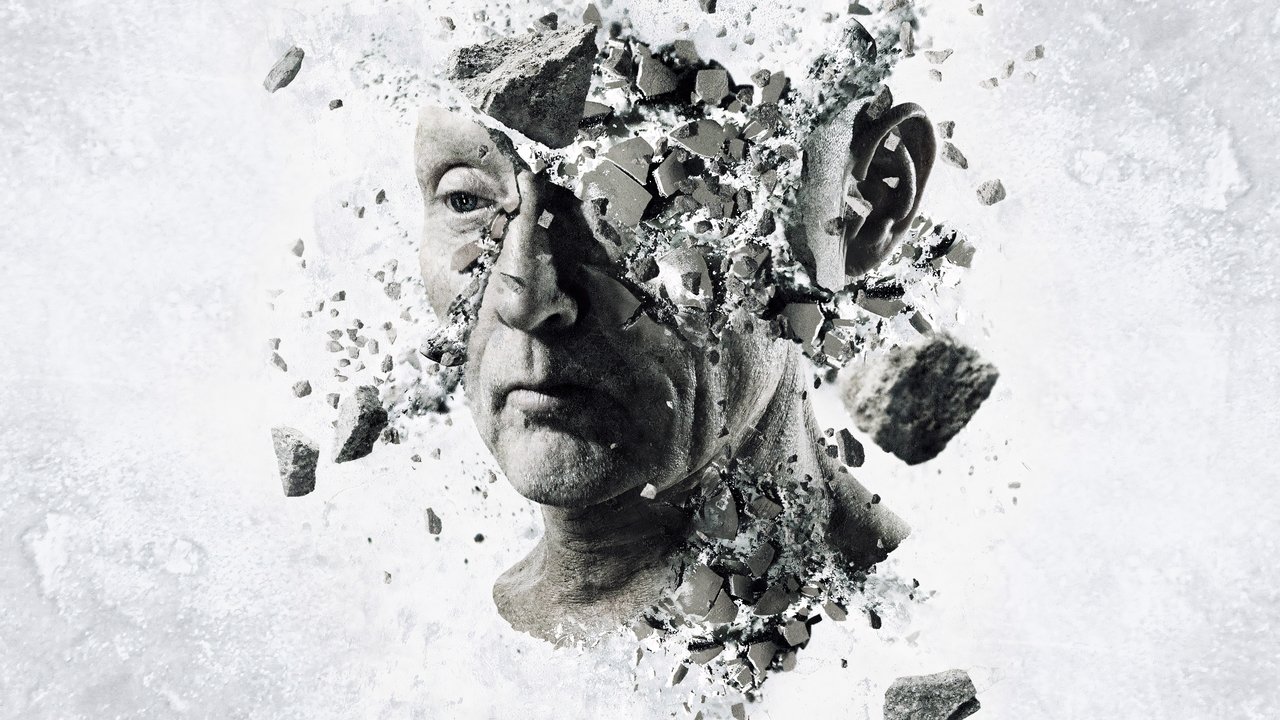
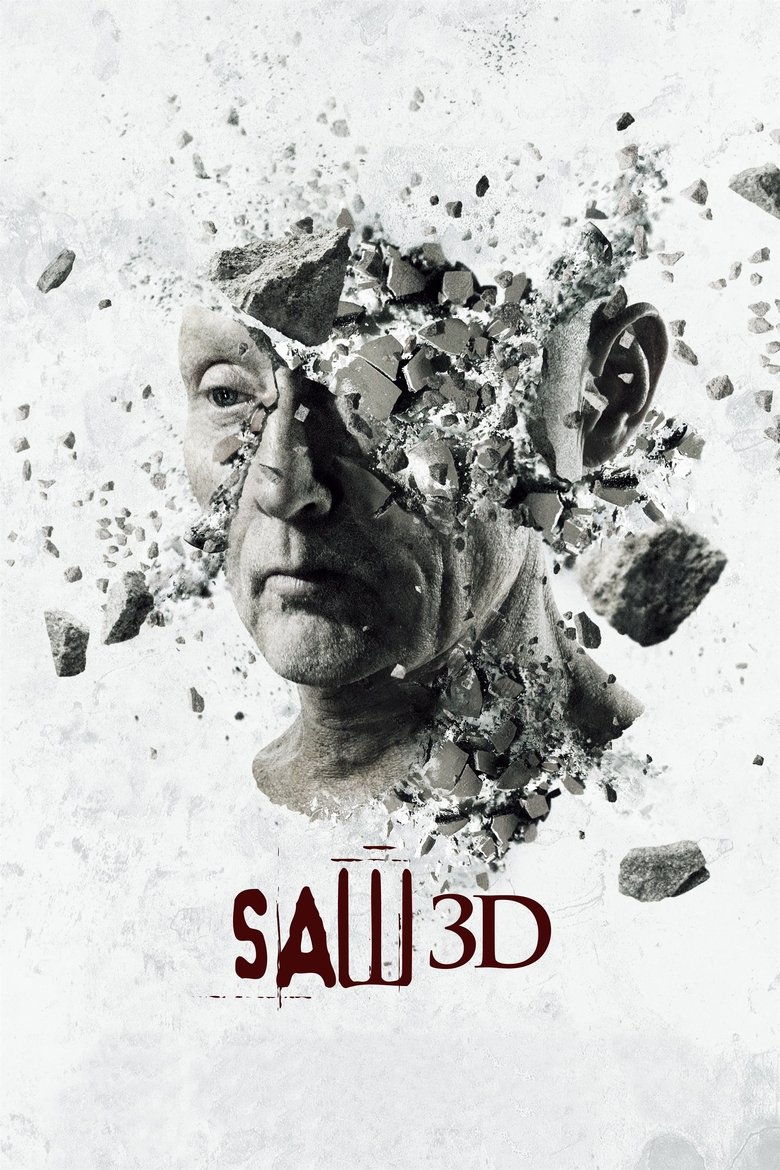
Saw 3D
“The traps come alive.”
As a deadly battle rages over Jigsaw's brutal legacy, a group of Jigsaw survivors gathers to seek the support of self-help guru and fellow survivor Bobby Dagen, a man whose own dark secrets unleash a new wave of terror.
About Saw 3D
Why Saw 3D still stands out
If you remember one image from the later Saw films, it’s probably a man you thought was gone returning to tie up loose ends. In this case that’s Dr. Gordon — the quiet, improbable survivor of the infamous bathroom test — turning up in a way that rewrites what we thought we knew about escape and loyalty.
Saw 3D doesn’t loiter. Kevin Greutert keeps the runtime lean — 90 minutes — and waves the franchise’s familiar puppet-strings with Tobin Bell’s Jigsaw still looming over the action, even when other players scramble for the spotlight. Released in 2010, it feels like a film with one eye on past tricks and the other on a grand send-off: familiar faces, fresh brutality and the kind of wink that says, ‘You thought that was the end?’
The idea that sets Saw 3D in motion
At its simplest, Saw 3D is a game about exposure. A self-help celebrity built a career on a lie — claiming he survived a Jigsaw trap — and the jig is, quite literally, up. Mark Hoffman abducts that celebrity, Bobby Dagen, and drops him into a series of tests designed to show the distance between story and truth.
Bobby wakes in an abandoned psychiatric hospital and is told he has a very limited window to save the person he loves, while also facing people from his own circle who helped fake his survival story. The setup traps him between public persona and private accountability.
His attempts to rescue his publicist, his lawyer and a close friend all end badly, which sharpens the film’s interest in what people will risk to keep a lie afloat — and what they will sacrifice when the lie collapses.
Even when Bobby scrapes together a grim victory — using his own teeth to open a lock and reach his wife — the film keeps nudging the idea that surviving a test and surviving the consequences are different things, and that someone else might be keeping score.
Why Jigsaw matters
Jigsaw — as a presence rather than a walking corpse of exposition — is the ledger against which every choice is tallied. Tobin Bell’s figure remains the reference point: a moral engine whose rules keep the rest of the machine moving.
This entry uses Jigsaw’s logic to interrogate fraud and courage. The abduction of a celebrity who lied about surviving a trap is the sort of punishment the mythology specialises in: public performances of virtue exposed with brutal private tests.
Crucially, Jigsaw also persists as an idea that invites apprentices. The reveal that Dr. Gordon has become the kind of person who continues John’s work matters because it keeps the responsibility for those rules in human hands — messy, vengeful, fallible hands — rather than letting the gimmick be solely about shocks.
So Jigsaw matters not because he’s a puzzle-box villain but because his rules ask the audience to judge. And the film keeps throwing back that judgement at its characters until at least one of them is made to answer.
Saw 3D has more on its mind than the plot suggests
Parental protection in Saw 3D isn’t only about literal parents; it’s the idea of shielding someone from truth and the cost that protection exacts when the cover is lifted. The film keeps circling the awkward, sometimes violent gap between keeping someone safe and keeping them ignorant.
Heroism here is uneasy. Characters are pushed into actions that look brave on the surface but often begin as self-preservation or reputation management. The movie enjoys playing with that slipperiness — who’s heroic, who’s complicit and who’s deluding themselves.
Authority is interrogated constantly: law, vigilante justice, and the moral authority a person claims after surviving trauma. The traps force characters into confronting those institutions and the people who bend them. Freedom is the final joke and the final question. Are the survivors freed by truth, or bound tighter by the consequences? The film keeps answering that question in ways that are messy rather than neat, and that’s where its darker interest lives.
Saw 3D could not belong to any other decade
Dropping into cinemas in 2010, Saw 3D arrived as the 2000s’ appetite for serialised shock met the 2010s’ taste for quick, compact continuations. It knows what it is: a late franchise entry that wants to tidy loose ends while still serving up the visceral set-pieces audiences expect.
At a time when horror was splintering into niche experiments and franchise finales, this film wears its pedigree plainly. It’s short, brisk and intent on delivering one final, loud course for people who had followed the saga.
That sense of being a decade-bridge — finishing a chapter while nodding to the old rules — is what gives the film its particular 2010s personality: unapologetically commercial, willingly mean, and keen to reward familiarity.
Seen from this angle, Saw 3D belongs to 2010 because it’s overtly a product of franchise logic: it wants to resolve, to shock and to leave an image or two that will stick in your head.
Why Saw 3D still matters
There’s a handful of set-pieces that people still talk about because they do exactly what the series promises: force moral choices into grotesque, unforgettable frames. The storefront double-saw test — two men forced to choose violence against each other to save the woman between them — is the sort of image that lodges in the memory because it’s ugly and precise.
Then there’s the celebrity hoax angle. The film’s focus on Bobby Dagen — a self-help star exposed as a fabricator — makes the horror feel contemporary: the trap is not only physical but reputational. His arc, from caged man to the one who pulls his own teeth to try to set things right, is the movie’s grim moral experiment.
Saw 3D also raises the stakes by expanding the carnage: police teams sealed off, officers killed by traps and the chaos of an infiltrated station. When a franchise starts killing institutions as well as individuals, it gives the mayhem a bigger scale and a bleaker sense of consequence.
Finally, the film’s last card — the appearance of Dr. Gordon as an avenging figure who reclaims the bathroom test’s moral bookkeeping and punishes the fellow apprentice — ties the whole series back into a circle. It’s a tidy, cruel endnote that keeps everyone guessing about who is judge and who is judged.
Does Saw 3D still hold up?
If you’re after tidy moral lessons, you’ll be disappointed. Saw 3D is not apologetic; it’s a last gasp of contrived tests and public shaming wrapped in a short, sharp runtime. It’s here to do what it set out to do: interrogate lies, punish hypocrisy and deliver baroque punishments.
That means it works when you want the series’ particular currency: a villain who made rules and a chain of characters who must answer to them. Tobin Bell’s Jigsaw remains the reference point, and Costas Mandylor’s Mark Hoffman keeps the plot’s tension taut as the man pulling the strings in the shadows.
If you prefer horror that seeks new territory, this won’t be your cup of tea — the film is a closer more than an innovator. But if you’ve followed the saga, the pay-offs land: the celebrity fraud plot, the fatal tests, and the final, strange justice delivered by a familiar survivor give the movie a closed-loop satisfaction. So should you watch it today? If you expect nuance, skip it. If you want an efficient, occasionally brutal franchise finale that ties a ribbon — however knotted and bloody — around long-running grudges, then yes: Saw 3D still does the job it set out to do.