
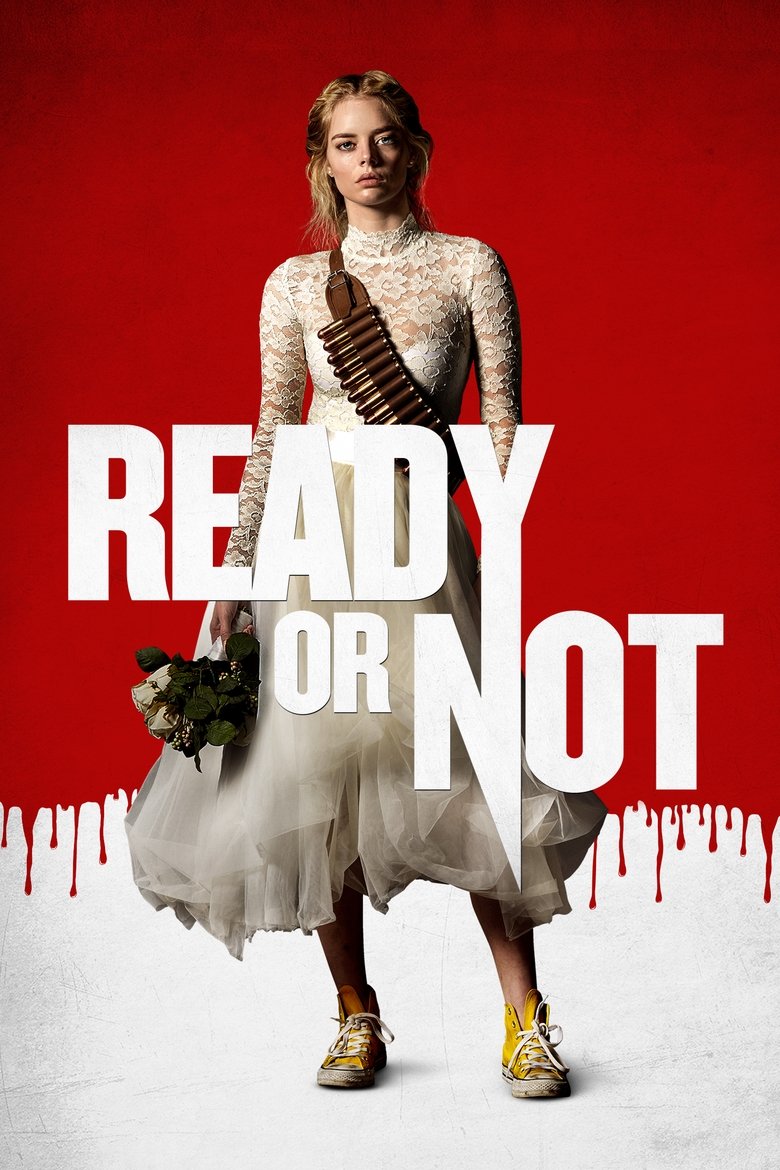
Ready or Not
“A killer game of hide and seek.”
A young bride's wedding night turns into her worst nightmare when her ridiculously rich in-laws force her to play a gruesome game of hide-and-seek.
About Ready or Not
Why Ready or Not still works
There’s an image that sticks: a child, alone in a huge house, faced with a wounded stranger and the awful decision to call for help — and the family that answer the call arriving in ceremonial masks. That opening sets the tone: secrets, rites and fast-moving consequences.
Matt Bettinelli-Olpin keeps the pressure high and the jokes dark across a brisk 95 minutes. The film wears its three hats — thriller, black comedy and horror — at the same time, which is partly why it’s so immediately watchable. At the centre is Grace, played by Samara Weaving, a character who carries the film’s moral and practical weight: she’s the newcomer who discovers what the family will do to protect itself, and the audience goes wherever she goes.
The idea that sets Ready or Not in motion
On their wedding night, Grace meets Alex’s extended clan — an eccentrically malignant household assembled under one roof. The guest list reads like trouble: siblings, cousins, an aunt, parents and a butler, all present for what’s supposed to be a family ritual.
Tension between Alex and his family runs deep: at one point Daniel and Tony have to restrain Alex after he lashes out, which tells you about loyalties already fraying beneath the surface. That friction matters because the story traps Grace between people who should protect her and people who might betray her.
Grace tries to get away, and the night builds into a sequence of desperate attempts and near-misses. Near a later crash, Daniel detains her when he thinks his father is watching — you can feel the family’s eyes everywhere, judging and deciding what’s permissible.
By the film’s end, the personal and the ritual have tangled so tightly that even acts of supposed love look like control. Grace refuses to be simply taken along with the family’s story, and that refusal is what keeps the plot moving.
Why Grace Le Domas matters
Grace matters because she’s the outsider who refuses to play along. She arrives as a former foster child marrying into the Le Domas dynasty, and that status — not born into the family, not part of the agreements that built their fortune — is the wedge the story drives in.
Her position forces the family’s secrets into the open. She sees things other characters can ignore; she witnesses Emilie accidentally kill a maid and gets blocked by the butler Stevens when she tries to run. Those moments emphasise how trapped she is and make her choices urgent.
She’s not simply a victim. Daniel, disillusioned with the family, finds her and even gives her a head start at one point — which shows that loyalties are complicated, not binary. That complication makes Grace interesting: she’s fighting for survival while also negotiating whether anyone inside the family can be trusted.
Most crucially, Grace’s refusal to accept the family’s terms — the argument that she will never trust Alex again and must ultimately break away — keeps the movie honest. Her resistance turns the plot into something more than a set of shocks; it becomes a story about what it takes to leave.
Ready or Not has more on its mind than the plot suggests
At face value it’s a late-night game gone monstrous. Underneath, the film is tugging at family as authority: who gets to decide what’s sacred and who gets sacrificed to keep the machine running.
There’s an origin to that authority — a family bargain with a figure called Le Bail, handed down through generations — and that bargain is the film’s way of talking about inherited obligation. Being born into a system doesn’t make you exempt from its cruelties; it often makes you the worst enforcer.
Freedom is therefore complicated here. Grace’s attempts to escape aren’t just physical; they’re attempts to reclaim a life that isn’t scripted by someone else’s deal. Even when the family’s curse seems mere superstition, the social pressure to conform is real enough to kill. Mortality sits at the centre, too. The ritual frames lifespan as negotiable if you keep the rules; when the rules break down, bodies and loyalties follow. Fear in this film is both literal — running from masked relatives — and existential: the terror of being owned by tradition.
Ready or Not could not belong to any other decade
Released in 2019, Ready or Not arrives at the very end of a decade that enjoyed genre-mashing: horror with sharp comedic teeth became a tidy shorthand for filmmakers trying to say something while still entertaining.
This is a late-2010s picture in the way it mixes tones briskly and refuses to let one mood dominate for long. The film’s appetite for black comedy wrapped in a thriller structure is very much of that moment.
It’s also a compact movie: tight, efficient and prepared to make its point quickly, which mirrors the decade’s taste for punchy, high-concept pieces that can be watched in a single sitting and then argued about.
What has aged — and what hasn't
The central engine — a bride discovering a family’s murderous ritual and refusing to go along — still lands. The moral clarity of an outsider resisting a corrupt dynasty feels immediate and easy to get behind.
The film’s use of ceremonial masks and the monstrous family ritual keeps the stakes visually and narratively sharp; those choices still read as unsettling rather than quaint. The Le Bail bargain that created the fortune also reads neatly as both a plot device and a comment on inherited sin.
Some sequences — the butler blocking Grace, the desperate scramble through the house, the accidental deaths that underline how chaotic the family is — hold up because they are built from simple, physical jeopardy rather than trendy tricks.
And when the mythology finally answers the film’s suspicion — when the curse reveals itself — it lands as a payoff rather than a cheat. The movie still feels like it earns its final beats.
Why Ready or Not still matters
The film sticks with people because of its opening promise — that childhood moment when a wounded man appears and the family answers in masks — and because the movie follows through on that promise in violent, comic and surprising ways.
The central conceit — a family tradition tied to a bargain with Le Bail — gives the story a neat engine that’s both camp and deadly serious. It’s the kind of high-concept idea that’s easy to talk about: a game at midnight that means life or death.
There are images that linger: a frightened bride falling into a pit of past victims, a child firing a shot that changes everything, a car crash that kills a would-be captor and the subsequent poisoning and housefire as the night collapses into chaos. And finally, the peculiar, almost absurdist final notes — the curse revealing itself in violent splinters, Le Bail’s brief appearance and Grace walking away from the burning manor — give the film a particular last look that people remember. It’s a film that ends with a punchline and a body count, and that memory is hard to shake.
Does Ready or Not still hold up?
Yes. Ready or Not remains a sharp, entertaining little beast. It knows what it wants to do — unsettle you, make you laugh, then pull the rug out — and it does those things within a tight 95-minute frame.
Samara Weaving’s Grace is the necessary throughline: an outsider whose survival and choices expose how ugly family loyalty can be. The film’s stacking of a peculiar family bargain against a bride’s claim to freedom keeps the stakes emotional as well as physical.
It’s also a neat example of late-2010s genre play: Matt Bettinelli-Olpin delivers a movie that’s witty and vicious in equal measure, and it rarely overstays its welcome. When the mythology finally snaps into place and the curse answers the night’s violence, the payoff lands.
If you want a compact, clever horror that’s happy to be nasty and funny at once, Ready or Not still deserves your time. And if you ever need a one-word summary for a disastrous wedding, this film has already given you the perfect reply: “In-laws.”