
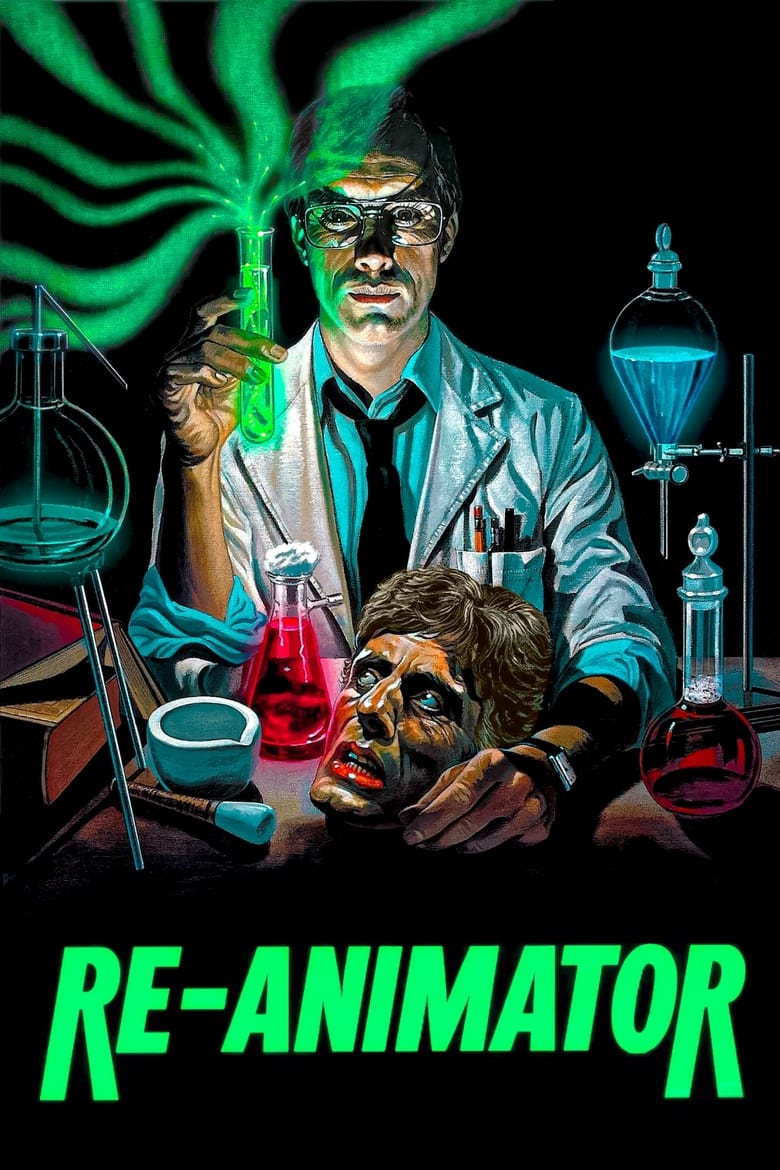
Re-Animator
“Herbert West has a good head on his shoulders...and another one on his desk.”
Conducting clandestine experiments within the morgue at Miskatonic University, scientist Herbert West reveals to a fellow graduate student his groundbreaking work concerning the re-animation of fresh corpses.
About Re-Animator
Why Re-Animator is still worth talking about
There’s a moment early on when a revival experiment does not go quietly. Herbert West’s attempt to bring a dead professor back to something like life announces the film’s character: curious, clinical and unembarrassed by the nastiest results. That single choice—showing the reanimation and its horrific side-effects—sets the tone for the next 104 minutes.
Stuart Gordon directed the whole thing in 1985, and he doesn’t hedge. Re-Animator sits squarely between science fiction and black comedy, but it’s also a body-horror picture that delights in physical surprises. It’s the sort of movie that will make you laugh, then wince, then laugh again because the audacity of the moment refuses to stop being funny.
Jeffrey Combs plays Herbert West and shares the screen with Bruce Abbott and Barbara Crampton; together they give the film a frantic, student-house energy. The mix of medical curiosity, gallows humour and gross outcomes is exactly why people keep bringing this one up: it’s distinctive, unflinching and mischievously specific.
Why Herbert West matters
Herbert West matters because he’s the machine in the room insisting the machine can be improved. He’s not a madman for the sake of spectacle; he’s the personification of scientific single-mindedness: if death is a problem, then he will treat it like a lab procedure until something gives.
We first see the consequences of that belief when West revives his professor in Zurich and the result is disturbingly unstable. That early episode makes clear what West is interested in — not prudence, not ethics, but proving a method works, even if the method howls back.
His willingness to demonstrate the reagent—reanimating a dead cat to convince a sceptic—does two jobs. It convinces Dan that there’s something real to work with, and it reveals West’s impatience for polite consent. He treats life and death as data points to be manipulated, and that puts him on a collision course with family structures and authority around him.
West’s experiments upset domestic and familial order. When those experiments spill into other people’s lives the film asks who gets to decide what a life is worth saving, and who pays the price when the answer is ‘anyone’.
Re-Animator has more on its mind than the plot suggests
On the surface it’s chaos and one-upmanship; underneath there’s a steady conversation about freedom and mortality. The film constantly asks whether conquering death is an expression of freedom or an act that removes agency from others.
Family and parental protection are quieter engines. The movie repeatedly positions family as something the reanimated intrusions threaten, which in turn reveals how fierce ordinary attachments can be when tested by grotesque events.
Fear and courage sit next to each other throughout: fear in the face of bodily violation, courage in the decisions characters make to protect or abandon what remains human. That tension prevents the film from becoming mere gross-out set pieces; it keeps us emotionally invested enough that the nastiness stings.
Authority rounds things off. Whether it’s institutional dismissal of West’s ideas or attempts to control his discovery, the film loves the friction that comes when experiment outruns consent — and when the people who are supposed to keep order are suddenly outgunned by the very things they study.
The effects work that gives Re-Animator its physical personality
One of the clearest statements the film makes is that reanimation has a price. The sequence where Herbert West brings his professor back — and the awful consequences that follow — gives the whole picture a physical personality you can’t ignore. It isn’t interested in suggestion; it’s invested in showing the messy result.
Because the film foregrounds those physical consequences, it acquires a tactile identity. The shocks are not abstract; they’re bodily and immediate, which is why scenes of revival register as moments you’ll remember long after the credits roll.
That appetite for visible consequence is an artistic choice. It says: if you’re going to play with life and death, you should be willing to show what that looks like up close, and accept the moral discomfort that follows.
Seen this way, the effects aren’t just spectacle; they’re part of the storytelling. The physical nastiness is the narrative punctuation to the film’s obsession with experimentation and its fallout.
Re-Animator could not belong to any other decade
Re-Animator arrived in 1985, and a lot of its personality belongs to that moment. The mid-80s had space for films that mixed genre registers — science fiction, horror and black comedy — and this one takes full advantage of that breathing room.
It’s not just a date; it’s a cultural slot where films could be smart and shameless at the same time. Re-Animator feels like a product of that freedom: ambitious in its premise, and uncompromising in its willingness to take the joke and the shock to their limits.
Put differently: the film wouldn’t read the same if it were made in a decade less tolerant of cross-genre scrappiness. 1985 gave it the wiggle room to be both daft and serious about what it was doing.
What has aged — and what hasn't
What holds up are the human rhythms underneath the nastiness. The film’s concern with family — what people will do when their loved ones are threatened or violated — still lands because those reactions are recognisable and immediate.
Fear, too, is a durable weapon in the film’s arsenal. The kind of unease created by bodily violation and the loss of control remains effective; you don’t need period context to respond to that kind of tension.
Where it feels more fragile is in how thoroughly it relies on the shock of extreme physical imagery to score emotional beats. If you’re less inclined toward visceral content, parts of the film will feel blunt. But if you accept the premise — that scientific hubris will produce ugly, literal consequences — then the emotional through-lines about family and fear still work.
Bottom line: the emotional scaffolding is simple and solid, and it keeps the movie from dissolving into mere gross-out after a couple of viewings.
Why Re-Animator still matters
There are set pieces you can’t easily forget: the demonstration on a pet that convinces a sceptic; the jump from lab experiment to a morgue test that goes badly wrong; the moment when a supposed authority is reduced to separate head and body and then made a spectacle. Those beats give the film a sequence of outrages that stick in the mind.
It’s the accumulation that matters. One scene proves the reagent works, the next escalates it to human subjects, and then the consequences build into something more complicated — control, humiliation, and the collapse of rules meant to keep people safe. The film stages those escalations so the moral stakes feel immediate.
There are also uncomfortable, explicit moments that are part of the film’s makeup. They’re upsetting by design, and they matter to the movie’s emotional logic because they show how experiments on life can become abuses of power when left unchecked.
All of this is why Re-Animator remains a talking point: it’s not only the flavour of its outrageous scenes, but the way those scenes string together into a narrative about ambition, control and the fallout when those ambitions are realised.
Does Re-Animator still hold up?
Yes — but with a caveat. Re-Animator still works as a fiercely specific piece of cinema: a 104-minute splice of sci-fi ideas, black comedy and body horror that uses shock to make an argument about mortality and the cost of trying to cheat it. That argument begins in Switzerland with a risky experiment and follows Herbert West to Arkham, where his work affects the people around him.
If you like films that wear their intent on their sleeve — that are happy to be clever and gross in equal measure — this will still thrill. The film foregrounds family and parental protection as stakes you care about, and those human concerns keep the nastiness from becoming empty spectacle.
If you’re put off by graphic material, the movie will test your tolerance; some sequences are designed to be upsetting. But the emotional through-lines — who protects whom and why — remain recognisable, and that gives the whole enterprise a spine.
So yes: watch it if you want a film that is bold about its choices. Re-Animator hasn’t mellowed with age; it either still has the nerve to provoke you, or it doesn’t. And that bluntness is precisely its point.