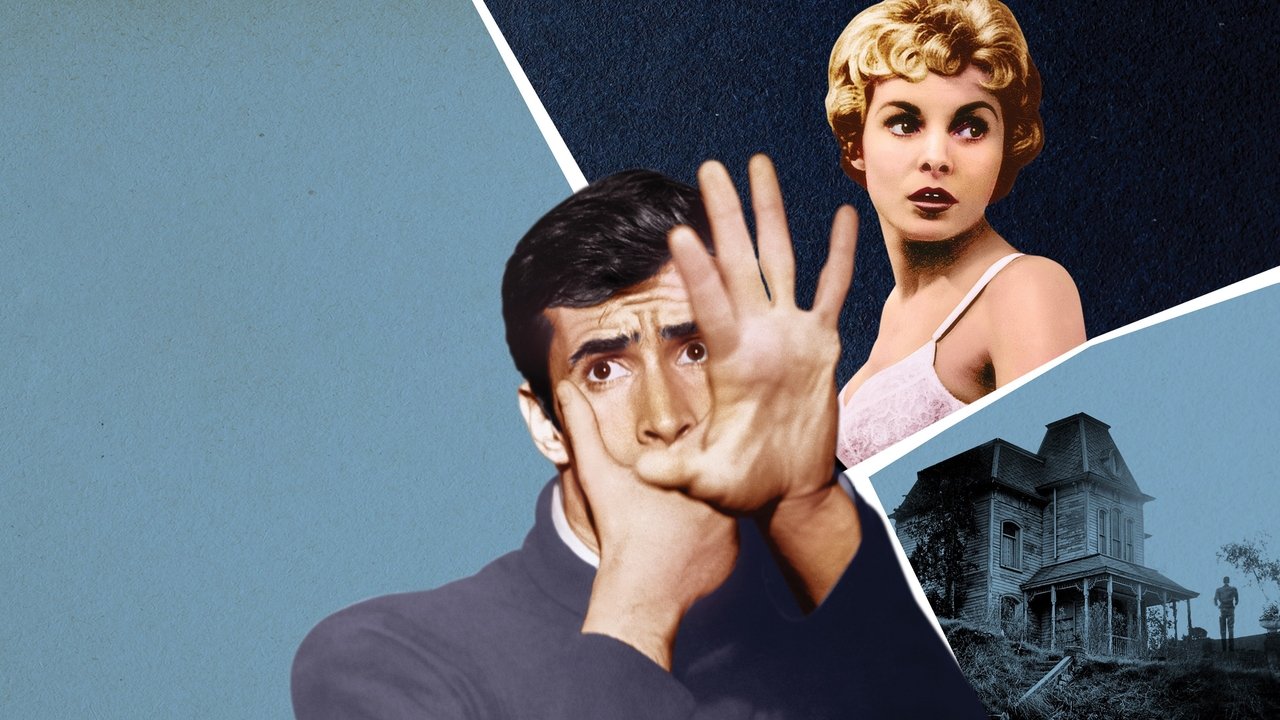
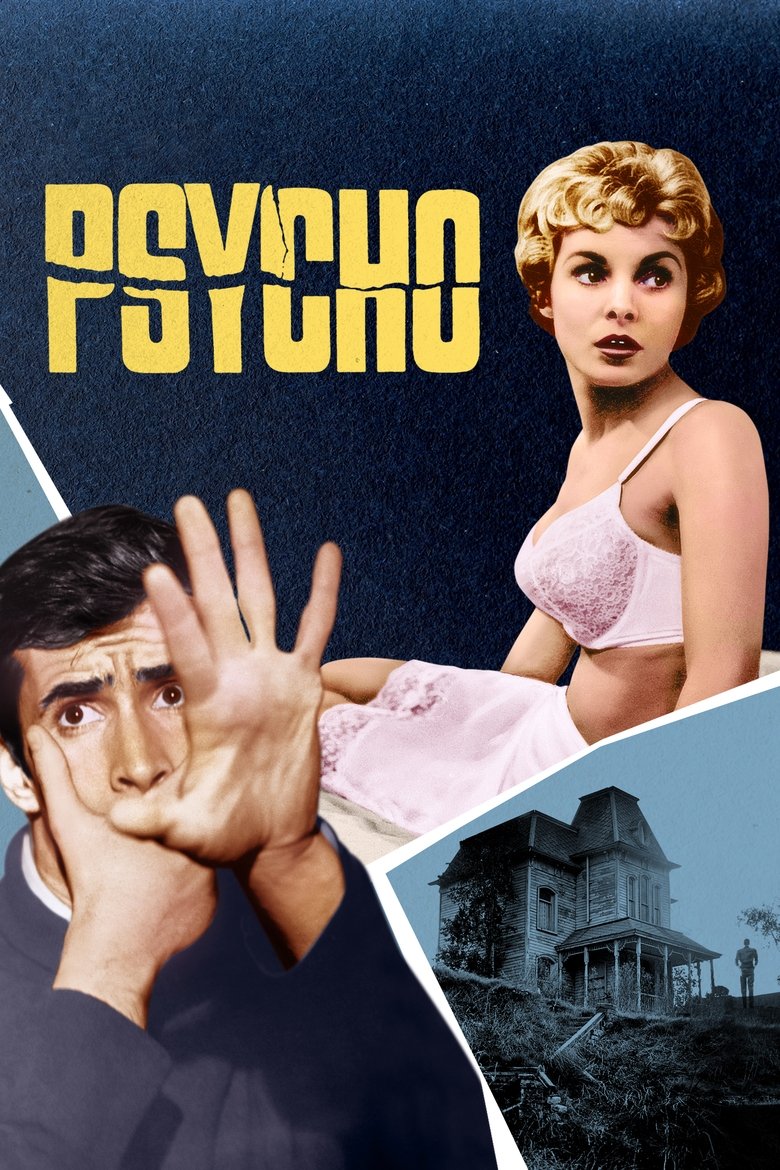
Psycho
“A new and altogether different screen excitement!”
When larcenous real estate clerk Marion Crane goes on the lam with a wad of cash and hopes of starting a new life, she ends up at the notorious Bates Motel, where manager Norman Bates cares for his housebound mother.
About Psycho
Why Psycho still stands out
People still talk about Psycho not because it yells at you but because it whispers through ordinary life until the whisper becomes a scream. The film opens with a chain of everyday decisions — a woman taking money, a drive across the state, a rainstorm — and turns those small choices into a machine that never quite lets the viewer settle.
That rain forces Marion Crane to pull off the road a few miles outside Fairvale, and the Bates Motel — a quiet, unassuming place — becomes the epicentre of everything that follows. The shock feels sharper because it arrives in a bathroom, in the middle of a domestic routine.
Alfred Hitchcock keeps the storytelling honed: 109 minutes, a handful of people and a piling up of secrets. Janet Leigh plays the woman whose choices start the chain; Anthony Perkins plays the proprietor who runs the motel and keeps the house on the hill. Their names are the scaffolding, but the movie is really about what living with other people asks of you.
The idea that sets Psycho in motion
At its most basic, Psycho begins with a simple moral misstep. Marion Crane takes a large sum of cash from her employer after hearing how debt is stalling her plans to marry. It's not a grand act of villainy — more a desperate, personal gamble to get her life moving.
She drives north toward Sam Loomis's home but swaps cars in Bakersfield after a tense run-in with a policeman. Those pragmatic choices — and the rain that forces her to stop at the Bates Motel — make the film feel like a chain of cause and effect rather than a contrived plot.
Norman Bates appears at first like an awkward, hospitable host: he registers Marion, invites her to dinner and, in conversation, reveals an odd mixture of interests and anxieties. He talks about taxidermy and about his mother's illness, and Marion presses him toward what she thinks is help.
That ordinary exchange is the hinge: Marion decides to return the money and put the mess behind her, but what follows takes place in the most ordinary setting imaginable — a shower — and so makes the whole setup feel both inevitable and horribly intimate.
Why Norman Bates matters
Norman Bates matters because he turns the idea of home into a question. He runs the Bates Motel and lives with a house that looks over it; both places are meant to offer shelter, yet they hide secrets. He invites Marion in, he talks about his mother, and those small domestic touches are the things that make the character stick in the mind.
There are concrete things that complicate him: Marion overhears him arguing with his mother, he speaks about taxidermy and 'private traps' people fall into, and he refuses requests to introduce visitors to his mother. Those moments add up to a portrait of someone whose personal life is tightly controlled and strangely guarded.
Norman's behaviour escalates from awkward hospitality to violence: a private investigator who presses for answers is killed when he enters the Bates' house, and later Lila discovers what has been hidden in the cellar. The revelations about Norman — that he murdered his mother and her lover, that he stole and preserved his mother's corpse and then recreated her as an alternate personality — explain the pattern of secrecy and the terrifying lengths he goes to to protect that private world.
In short: Norman matters not because of a single shocking act but because the film turns commonplace family obligations and anxieties into the sources of its unease.
Psycho has more on its mind than the plot suggests
On the surface Psycho is a thriller about a missing woman and a suspicious motel. Underneath it’s quietly occupied with family — how loyalties, shame and possessiveness can ossify into something monstrous.
Home and safety are treated with irony: the motel is supposed to be a temporary refuge, but the real threat is the domestic arrangement on the hill. The film asks who keeps us safe and who uses the idea of family as a reason to control others.
Mortality crops up in different ways: people disappear, corpses are kept, and the knowledge that death can be hidden in plain sight makes ordinary spaces feel precarious. There's also greed and consumer pressure as a motive for Marion's choices — a reminder that even practical, material decisions can ripple into catastrophe.
Loss threads through the story as well: relationships, plans and identities are all vulnerable to small acts that spiral. Psycho, then, stays with you because it makes everyday motives — love, money, the need for a home — the things that quietly lead to disaster.
Psycho could not belong to any other decade
Psycho was released in 1960, and that timing matters because the film sits on a cusp: it looks back to classic crime and noir storytelling while also nudging into newer, more intimate psychological territory. It isn't dressed up as spectacle; it works on small, domestic pressure points.
The film's concerns — private lives cracking under pressure, the uneasy domestic bargain between public appearance and private despair — feel very much like the kinds of stories late 50s and early 60s cinema were starting to examine more honestly.
Because it foregrounds ordinary decisions and household spaces rather than grand villainy, Psycho feels like a transition piece: part thriller, part psychological case study, and very much of its moment when movies were beginning to probe what lies behind respectable fronts.
That blend of genres and focus on private trouble gives Psycho a specificity tied to the era; it could only have been made when audiences were ready to be unsettled by the domestic rather than only by the exotic.
What has aged — and what hasn't
Watching Psycho today, the knot of ordinary choices that set everything off still reads sharply. Marion's decision to take the money and the practical steps she takes to cover it — swapping cars, trying to get where she needs to go — keep the early part of the film grounded in recognisable, believable behaviour.
What endures most is the way the movie makes the expected sources of shelter feel unreliable. Family and home remain powerful themes: the idea that someone you might count on could be hiding something terrible still lands in a way that doesn't depend on period clothes or props.
Some plot conveniences feel of their time, but the emotional logic — people making small selfish or desperate choices and those choices unraveling lives — still plays. Even the messy, desperate attempt to hide wrongdoing — a body cleaned up and a car sunk in a swamp — reads as a recognisably human scramble rather than an invented thriller trick.
In short, Psycho's core transactions — money, shelter, family — still speak to a modern viewer because those are timeless human problems, and the film keeps them tight and personal.
Why Psycho still matters
Psycho stays in the conversation because it turned everyday spaces into sites of dread and populated them with people whose private arrangements do the real work of the story. The sequence that begins with Marion's stop at the motel and ends with that brutal, domestic murder remains a touchstone precisely because the violence happens inside the mundane.
Norman Bates's house and the motel office work as shorthand for how family life can both hide and create danger: Marion overhears the argument about his mother, Lila later discovers the mummified body, and the psychiatrist's explanation ties the crimes to a private, pathological family history.
Those clear, unsettling revelations — a corpse hidden at home, an alternate personality born from guilt and jealousy — are the elements that keep the characters memorable. Marion's practical choices, Sam and Lila's search, and the private investigator's probing make the story feel populated with ordinary, motivated people rather than cardboard figures.
Ultimately, the movie's afterlife comes from how directly it links small human motives and domestic arrangements to shocking outcomes. When the ordinary becomes suspect, the story keeps returning to viewers.
Does Psycho still hold up?
Yes — but not because it’s flashy. Psycho still holds up because it keeps its focus narrow and human. The film’s shocks are effective largely because they grow out of believable choices: Marion taking a sum of money, trying to reach Sam Loomis, stopping at a motel in bad weather.
The central relationship between Norman and his household — the idea that his mother's presence looms over the motel and that her memory is literalised in a terrible way — gives the film a tidy but chilling spine. Those things don't date: family pressures and the urge to hide wrongdoing are evergreen storytelling fuel.
At 109 minutes, Hitchcock and his collaborators compress the set-up, the mystery and the revelation into a compact piece of storytelling. The shower death, the attempt to conceal a crime, and the final explanations about Norman’s recreated mother all serve the same, grim point: ordinary life can contain monstrous secrets.
If you’re wondering whether to watch it now, treat Psycho as a lesson in how a thriller can be built from domestic choices rather than spectacle. It still unnerves because it makes the places we trust — showers, cars, homes — the ones most worth watching.