
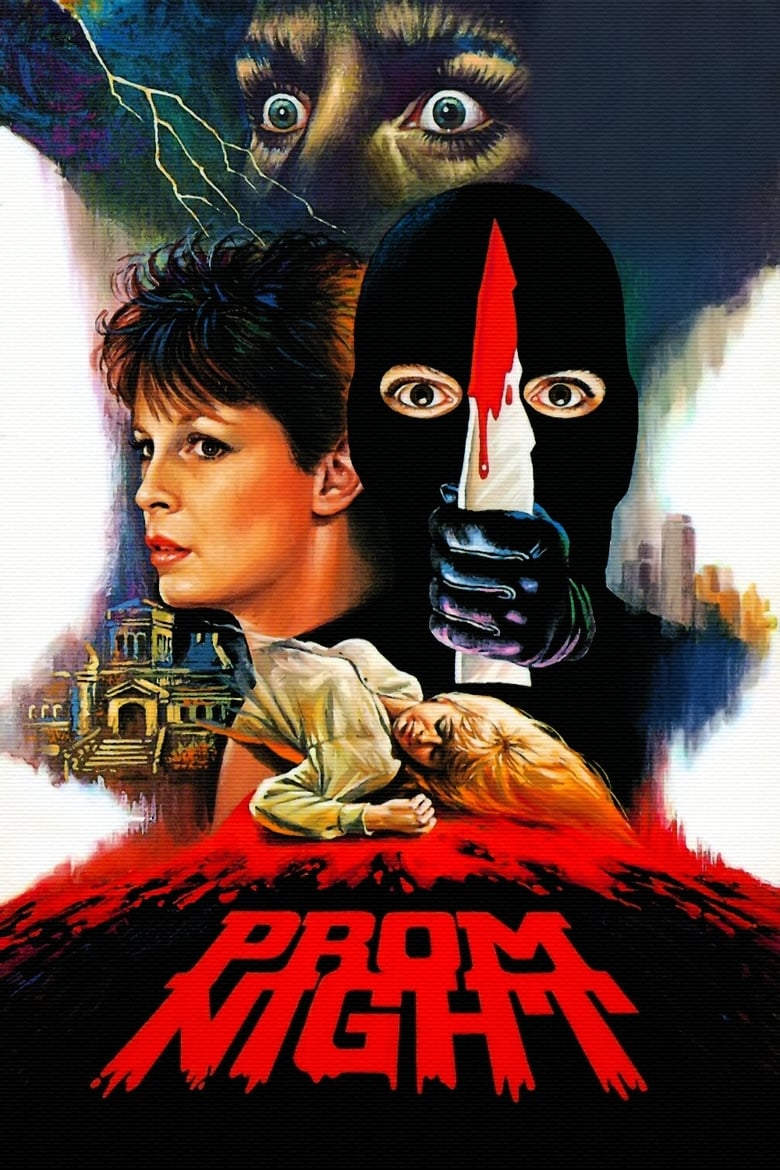
Prom Night
“If you're not back by midnight...You won't be coming home!”
At a high school senior prom, a masked killer stalks four teenagers who were responsible for the accidental death of a classmate six years prior.
About Prom Night
Why Prom Night is still worth talking about
Prom Night opens on a childish dare that goes horribly wrong: a game of hide-and-seek in an abandoned place that ends with Robin falling through a window. That accident isn’t a throwaway set-piece. It hangs over everything that follows — a secret sworn into silence by the kids who were there.
Six years later the anniversary has become a date. The prom falls on that same night, which means high-school ritual collides with a private trauma. The idea of a party held on the memory of a death is, frankly, a neat piece of premise design: joy and danger braided into a single evening. Paul Lynch directs with a clear sense of purpose — this is 91 minutes of horror that’s as much about what the characters carry as about the masked figure who turns up at the school. And yes, Leslie Nielsen is in it as Mr. Hammond, while Jamie Lee Curtis plays Kim — the family caught in the middle of all of this.
The idea that sets Prom Night in motion
The film keeps its central mechanics simple and, crucially, recognisable: teenagers, a secret, and a night that’s meant to tidy everything into a rite of passage. That tidy night is the prom — the point at which adolescent stories usually tie up neatly. Prom Night pulls the knot the other way.
We get a jolt early on when a masked figure targets Kelly in the girls’ locker room, using a shard of glass as a weapon after she refuses a sexual advance. It’s a brutal, specific escalation: the gendered threat of a teenage environment made literal.
And the other pivot: when Kim chases the assailant and, in a desperate moment, pleads with police not to fire. That chase ends with the attacker collapsing — a stop that looks like resolution and doesn’t quite feel like one.
So the setup is economical. Party expectations, a secret that won’t stay buried and a violent interruption. From there the film spends its runtime unpicking who bears the blame and how a single accident ripples through a family and a school.
Why Mr. Hammond matters
Leslie Nielsen’s Mr. Hammond isn’t just the principal on paper — he’s the father whose family narrative carries the film’s weight. He discovers that a man connected to Robin’s death has escaped custody, and that fact shifts the film from suburban mystery to a family under siege.
That discovery rattles the household. The Hammond clan are preparing for the prom on the night that marks a tragedy; the father’s role amplifies the stakes because the threat is not only to the school but to his children.
The movie keeps coming back to family. Mr. Hammond’s position as both parent and authority figure forces the story into conversations about responsibility: who protects, who fails, who investigates. It’s a small map of loyalties centred on one household.
And because the events tie directly to the twins’ past — the childhood accident and its secret — Mr. Hammond becomes the human hinge. He’s where public duty and private grief meet.
Prom Night has more on its mind than the plot suggests
On the surface it’s a slasher: a masked attacker, a night of murders, and a body count that shocks a prom crowd. Underneath, Prom Night keeps circling mortality — not as an abstract idea but as something that changes how people behave. A childhood death becomes a measuring stick for the characters’ choices.
Loss is threaded through the whole thing. The kids who were present at the convent carry the memory like a bruise. Their silence is a pact born of fear, and that silence eventually alters relationships, loyalties and the simplest of decisions — like who you ask to the prom.
Family matters here in ways that slasher films don’t always bother with. The Hammond household is at the emotional centre; the stakes are personal, not just situational. The film uses that closeness to give moments — a chase, a confrontation, a final collapse — a sharper human cost. Authority also sits awkwardly in the picture. Parents, principals, the police: the film toys with who we trust to resolve danger and who’s simply carrying their own baggage. Together these themes mean Prom Night isn’t only about the kills; it’s about how a single night exposes everyone’s lifespan of choices.
Prom Night could not belong to any other decade
Prom Night arrived in 1980, right at the turn of a decade that would embrace teen horror in a particular way. That release date anchors it to a specific moment when filmmakers were keen to blend youthful ceremony with lethal stakes.
Calling it ‘an 80s movie’ isn’t a shrug. The picture reads as something made for — and about — that era’s audience: a school prom matters as a cultural marker, and the film treats the rituals of adolescence as real territory for suspense.
It’s also compact storytelling from that period: a tight run-time and a clear genre identity. You can see it as a piece of its moment without needing to lean on nostalgia for costumes or music.
What has aged — and what hasn't
Some elements hold up because they’re human and small rather than trendy. The kids’ secret — a pact to hide what happened out of fear — still reads as believable teenage cowardice and shame. That compact moral compromise is easy to recognise, now as then.
The film’s focus on the prom as a hinge between childhood and adulthood also works. Having the big night fall on an anniversary of death is a neat dramatic shape; it gives the teen-genre trappings a weight that isn’t merely decorative.
Its identity as a teen picture keeps it readable. You don’t need to know a lot about 1980s subculture to follow who’s connected to whom, which helps the film remain watchable to modern viewers.
And family remains the tether. The Hammond siblings and their history keep the plot personal, so even when the action gets extreme it’s tied to the characters’ past choices rather than feeling arbitrary.
Why Prom Night still matters
There are images in Prom Night that are hard to shake: the secret in the convent, the pact the children make, the way that childhood accident colours a prom night years later. Those narrative anchors make it memorable in a way that transcends one or two shocking set pieces.
The movie doesn’t shy away from moments intended to stick in the head. There are scenes that were clearly designed to register — a severed head rolling onto a stage, for instance — and they do what they intend: they turn a rite of passage into something grotesquely unforgettable.
At the same time, the emotional finale — when Kim chases the attacker and the truth of the past is forced into the open — keeps it personal. The reveal ties the whole story back to its origin: the accident at the convent and the consequences of silence. So it matters because it combines simple, potent imagery with a familial through-line: the film’s shocks are anchored to people who remember, grieve and pay for a childhood mistake.
Does Prom Night still hold up?
Yes — if you’re after a tight, character-anchored slasher that treats its teen rituals as more than wallpaper. The movie’s engine is simple: a childhood accident, a pact to stay quiet, and the way that secret blooms into violence when the prom anniversary arrives.
Paul Lynch keeps things lean — it’s a short run at 91 minutes — and that economy is part of its charm. There’s no fat. The story pushes from the convent to the school and keeps the Hammond family at the emotional centre, with Leslie Nielsen’s principal/father figure present as the adult stake in the proceedings.
Some moments are designed to shock, and they do. But what lets Prom Night still work for a modern viewer is that those shocks are connected to loss and responsibility rather than random spectacle. The themes of mortality and family give it a thread that holds the slasher mechanics together.
So if you’re deciding whether to watch: go for it if you want a compact slice of early-80s teen horror that remembers its people. It’s less about who wears the mask and more about what a single childhood mistake does to a family — and that, oddly, is what keeps it interesting decades on.