Predator 2
“Silent. Invisible. Invincible. He’s in town with a few days to kill.”
A police chief in the war-torn streets of Los Angeles discovers that an extraterrestrial creature is hunting down residents - and that he is the next target.
About Predator 2
Why Predator 2 still works
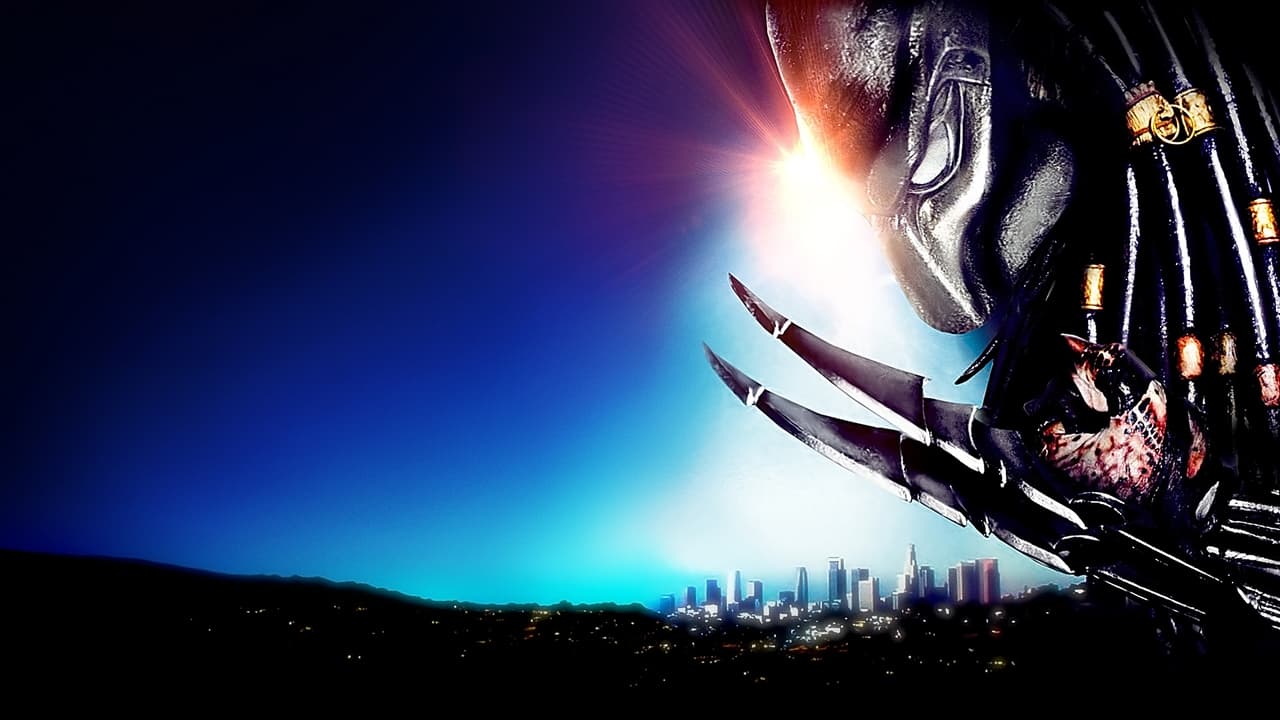
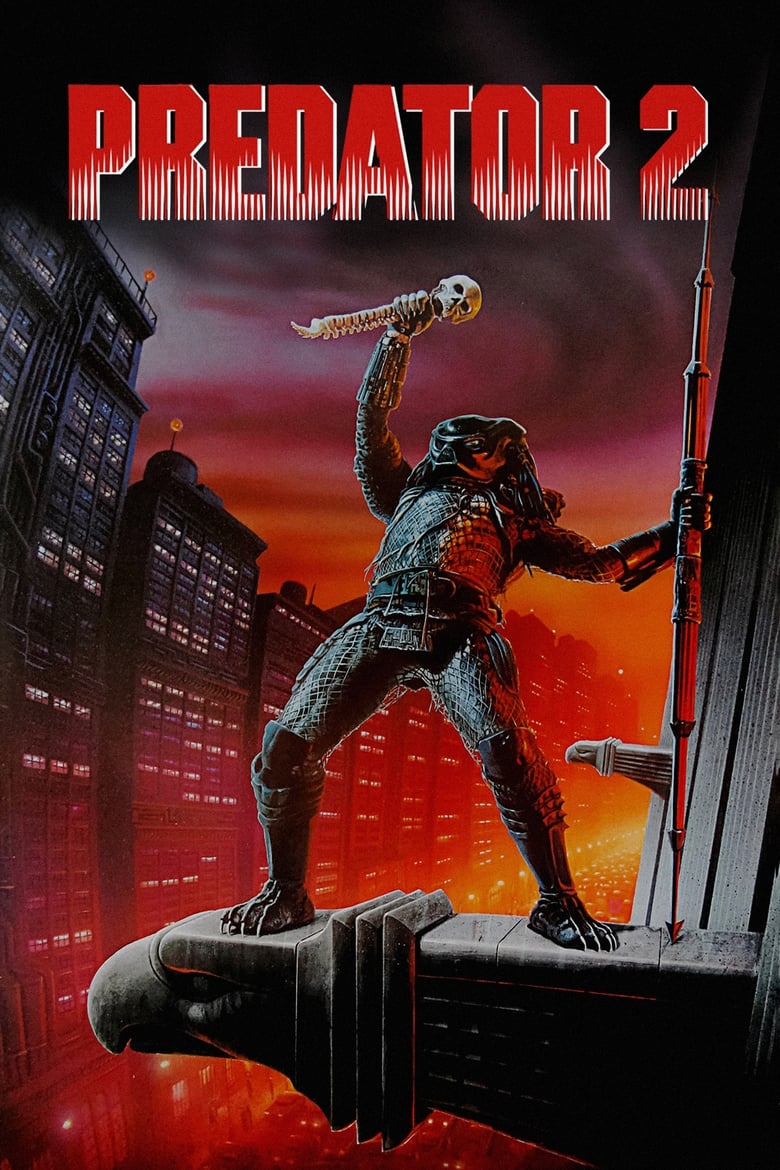
There’s something arresting about seeing an otherworldly hunter stalking the streets of Los Angeles rather than the jungle. Predator 2 makes that swap and keeps the promise: this is a movie about a city that’s boiling over and a lethal guest who treats human violence like sport.
Stephen Hopkins directs the whole thing with a lean, propulsive energy, and the centre of it is Lieutenant Mike Harrigan — Danny Glover’s straight-talking cop who simply charges into a firefight to pull wounded officers out and push the Colombians back. That rescue sets the tone: Harrigan moves through chaos the way a magnet moves through iron filings. It runs a compact 107 minutes and doesn’t waste time. The creature is still the point — Kevin Peter Hall’s City Hunter is the predator of the title — but the movie is quietly interested in what the hunt does to people: loss, the shape heroism takes under pressure, and the cost of wanting to be free from fear.
The idea that sets Predator 2 in motion
Predator 2 opens with a simple, effective trade-off: swap the jungle for the sprawl of Los Angeles and the anonymous carnage of gangland for the theatre of a public shootout. The Predator is watching as Harrigan charges into that firefight — and that single impulsive rescue is the domino that tips the rest of the film into motion.
From there the story treats the Predator like a corrosive force that keeps turning the city’s violence inward. Crime scenes repeat themselves — flayed corpses and violent overkill — and that repetition makes Harrigan obsessive. He’s not interested in theory; he wants answers and he won’t let bureaucracy stand in the way.
A darker, almost mythic streak runs alongside the police procedure. Harrigan meets King Willie, a local figure who believes the killer is supernatural and prepares himself accordingly — the film lets local belief sit beside forensic mystery, which enlarges the hunt beyond mere detective work.
Threats pile up in public places: the subway becomes a hunting ground and the Predator’s behaviour — from slaughter to oddly selective mercy — keeps the characters and the audience off-balance. It’s a premise that works because the film never forgets it’s basically about one predator treating a modern city as its arena.
Why Lieutenant Mike Harrigan matters
Harrigan matters because he’s the practical eye in a film that could easily have been all spectacle. Danny Glover plays him; Harrigan cuts through protocol and runs toward violence because that’s how he thinks you save people.
That charge into the firefight — rescuing two wounded officers and pushing Colombians back into a hideout — is more than an action beat. It establishes Harrigan as someone whose instinct is to protect, even when his superiors prefer caution.
He’s also a useful anchor for the movie’s tone. While the Predator and a shadowy federal task force add layers of mystery and paranoia, Harrigan keeps the story human-sized. He’s stubborn, practical and carried forward by clear, immediate stakes rather than abstract heroics.
Finally, Harrigan’s refusal to accept simple explanations — he briefly sees the invisible Predator and dismisses it as a mirage — keeps him in motion. The plot pushes weirdness at him and he answers with action, which is why the city’s collapse becomes, for a while, his problem to fix.
Predator 2 has more on its mind than the plot suggests
At surface level it’s an action-monster film. Underneath, it keeps nudging at three ideas: the losses violence forces on a community, the odd shapes heroism takes in a city under pressure, and the rough, almost brutal idea of freedom.
Loss is threaded through the movie as a constant: people disappear, neighbourhoods are traumatised and those gaps drive decisions. The Predator’s presence escalates existing violence into a different register, making every casualty feel both personal and senseless.
Heroism here isn’t posed as glamor. It’s insistence — Harrigan’s willingness to step in where others hesitate — and the film treats that insistence as something costly rather than triumphant. The movie lets heroism be stubbornness as much as glory. Freedom operates on two levels: the Predator’s utterly selfish liberty to hunt, and the human desire to live without fear. That tension — between a creature that values liberty as license and people who want ordinary freedoms — quietly gives the action a moral angle.
Predator 2 could not belong to any other decade
Predator 2 sits at the cusp of the 1990s — it was released in 1990 — and it has the decade’s appetite for blending genres. It’s part cop drama, part creature feature and part urban nightmare, which feels very of its moment: ambitious mash-ups rather than rigid categories.
The film’s urban setting — Los Angeles in the late-1990s fiction of the movie, gripped by a heat wave and a turf war between heavily armed Colombian and Jamaican cartels — is exactly the sort of contemporary pressure-point a 1990 picture would latch onto. It gives the monster story an immediate civic sting.
There’s also a late Cold War-ish flavour to the film’s concerns: Keyes reveals the Predator is an extraterrestrial hunter with infrared vision and active camouflage, a creature that has hunted humans for sport before. That reference to a previous hunt a decade earlier adds a continuity of danger that fits the era’s taste for sequels and expanding mythologies.
Put simply: Predator 2 wears its time on its sleeve without being camp about it. It’s a product of an era that liked big ideas shoved into familiar frameworks — and that willingness to mix tones is why it still feels distinctly 90s.
Why Predator 2 still matters
There are a few stubborn images this movie owns: the Predator watching a city shootout while Harrigan dives into the carnage; the repeated crime scenes with flayed corpses that make the threat feel ritual rather than random; and the subway attack that suddenly turns public transit into a hunting ground.
The film also sticks in the mind for its willingness to mix the procedural with the weird. Keyes’s briefings — where the creature is explained as an alien hunter with infrared vision and active camouflage — give the monster a believable biology while keeping the movie invested in police work and forensic detail.
Moments like the Predator sparing one passenger after its helmet scans a pregnancy give the creature an odd code of conduct, which complicates the threat and leaves room for character reaction rather than just spectacle. These little choices are what people tend to remember: not just the kills, but the rules the killer seems to live by.
And the final exchange — when Harrigan kills the hunter and receives a flintlock pistol as an odd sort of prize — gives the whole thing a strange, mythic coda. It’s the kind of finish that makes the film linger in memory: violent, a little baffling, and oddly, audacious.
Does Predator 2 still hold up?
Yes — with a small, sensible asterisk. If you want tightly trimmed thrills and a monster that treats a modern city as its hunting ground, Predator 2 delivers. It opens with a concrete action beat — Harrigan rescuing officers during a gang shootout — and keeps that momentum, which makes the film feel alive and purposeful across its 107 minutes.
It’s not subtle. The movie trades in big gestures: a spear tip that turns out to be made of something not on the periodic table, a slaughterhouse showdown, and a rooftop duel that ends with Harrigan confronting a ship hidden beneath the city. Those beats add up to something more than effects and stunts because they’re anchored by a cop who refuses to step back.
What makes it worth revisiting is how it combines human stubbornness with the alien. The themes of loss, heroism and freedom run through the action; you feel why Harrigan keeps pushing even when official channels want to mop up and move on. The Predator is terrifying because it treats freedom to hunt as a principle, and that opposition—human duty versus animal liberty—gives the film a moral spine. So yes: watch it. For the specific pleasure of seeing a city-sized hunt, for the odd mythic finishing notes — a flintlock for a modern cop — and for a lead who won’t be patient, Predator 2 still has teeth.