
Predator
“Soon the hunt will begin.”
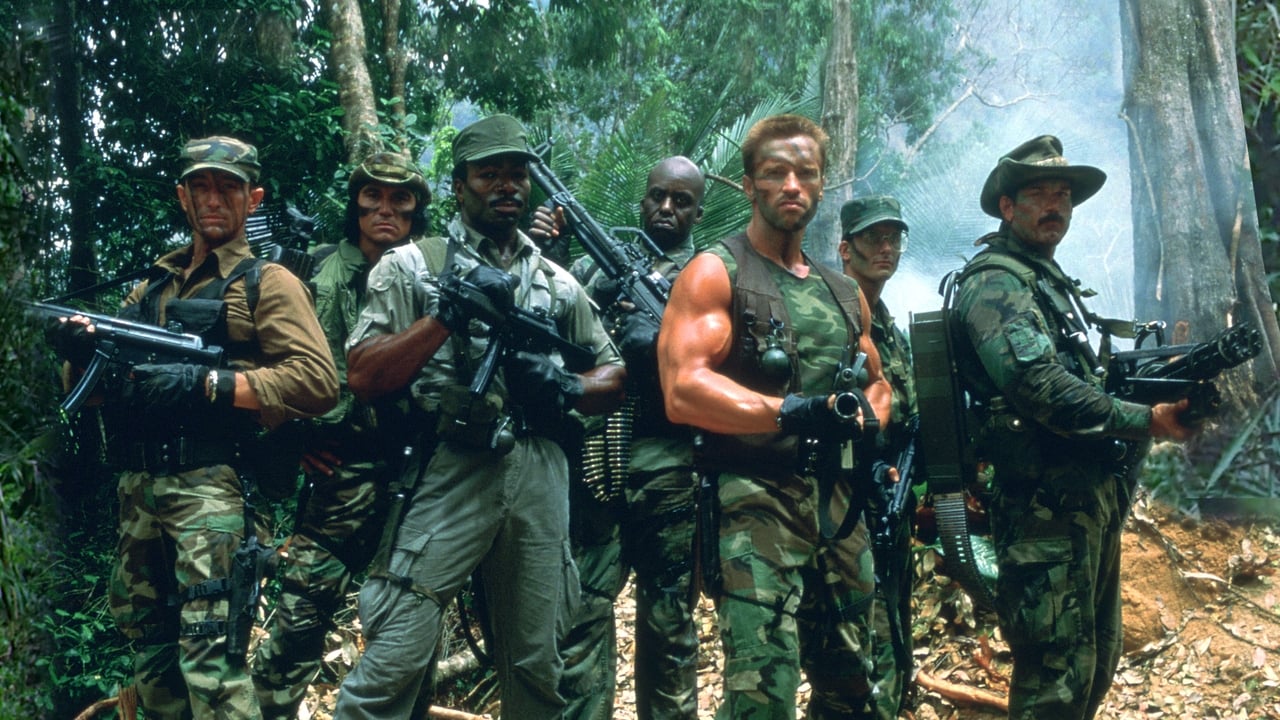
A team of elite commandos on a secret mission in a Central American jungle come to find themselves hunted by an extraterrestrial warrior.
About Predator
Why Predator still works
A spacecraft drops a shuttle to Earth and, with that single blunt image, Predator announces it intends to take ordinary action-movie muscle into slightly stranger territory. From there John McTiernan steers a tight, high-stakes hunt that rarely wastes a beat.
It’s a compact picture — 107 minutes — and it keeps the focus small: Dutch at the centre (Arnold Schwarzenegger), a tight crew around him and a creature you gradually realise is playing by different rules. The film layers action, science fiction and horror in ways that make each kill feel like a negotiation rather than a spectacle. That negotiation is what people keep talking about. The movie’s not subtitled philosophy, but the themes are loud enough — freedom, the threat and promise of technology, simple fear and the uneasy measurement of lifespan — and they sit comfortably under the boots-and-machetes surface.
The idea that sets Predator in motion
At its heart Predator is built on a simple switch: Dutch spots something off about a mission and refuses to be used. That moral stubbornness is the tiny hinge the whole film swings on.
Al Dillon, Dutch’s old Vietnam ally now working for the CIA, admits he lied to get Dutch to attack a guerrilla camp — to stop a bigger geopolitical threat. The lie turns a rescue mission into a moral trap and pulls the team into a situation they didn’t sign up for.
Into that claustrophobic tension steps a far more literal trap: a technologically advanced hunter who can vanish and who sees through heat. It changes the rules of combat; sudden death arrives without warning and with an intelligence the men aren’t prepared for.
By the time Dutch realises how the thing chooses its prey — that it only strikes those it regards as a threat — the film has already turned the mission inside out. The set-up works because it pairs human deception with an utterly non-human adversary, and because neither side obeys the rules the other expects.
Why Dutch matters
Dutch is the guy who refuses easy moral shortcuts. His refusal to use his team for assassinations — and his suspicion when he finds three skinned corpses — means he’s not just a muscle-bound presence: he’s a leader with lines he won’t cross.
That matters because the film keeps narrowing choices. When the jungle becomes a hunting ground, Dutch’s decisions are the difference between motion and reaction. He’s the one who works out how the predator sees, who chooses to release Anna because he needs somebody who understands the place, and who keeps pushing the team toward some kind of survival logic.
Dutch’s resourcefulness is practical rather than heroic in the cartoon sense: he builds traps, improvises weapons and uses the one advantage the jungle gives him. He discovers the mud masks body heat and turns hiding into strategy.
All of which makes the final confrontation feel earned. The film has already staged a progression — suspicion, deduction, improvisation — and Dutch’s arc is less about personal transformation and more about a leader adapting to a set of rules the enemy invented.
Predator has more on its mind than the plot suggests
Freedom is threaded through the film in a blunt, old-fashioned way: Dutch and his team are professional soldiers who have rules about what they will do. The story strains that freedom, showing how orders — and lies — can erode agency quickly.
Technology sits opposite that freedom. The hunter’s gear — the ability to vanish, to see heat instead of flesh — makes the men suddenly vulnerable to a logic they cannot match. It isn’t just a stronger opponent; it’s an opponent that rewrites the terms of engagement.
Fear is the engine. The predator’s presence is often inferred rather than seen, which makes every rustle and shadow count. The film uses that fear economically; it’s less about screaming and more about the steady, tightening dread of an invisible eye. And there’s a quiet meditation on mortality. The hunter’s trophies, the escalating body count and the sense that lifespan can be measured by skill rather than age all nudge the picture toward thinking about who gets to survive and why.
Predator could not belong to any other decade
Released in 1987, Predator sits at a particular crossroad of 80s cinema: action muscle plus a curiosity for genre-mixing. It’s the sort of film that cheerfully lets sci‑fi and horror crash into a soldier movie and expects you to come along for the ride.
The decade loved clear, punchy premises and a certain confident brutality; Predator gives you both. It doesn’t fuss with ambiguity — it sets up rules and tests them — and that directness feels typical of its moment.
It’s also a product of an era that trusted straightforward setups and bright, kinetic genre hooks over irony or distance. So when the movie puts a hunter into the jungle it can commit to the consequences without apologising for them.
That’s not nostalgia for nostalgia’s sake. It’s recognising that the film’s mixture of genres and its appetite for physical stakes are very much of 1987 — and that’s part of its character, not a curio.
What has aged — and what hasn't
The feeling of fear in Predator still works. The movie carefully builds tension around the idea of an unseen hunter and that approach — inference over spectacle — is something a modern viewer still responds to.
Some of the film’s military framing is anchored by supporting characters who remind you this is not just a monster movie but a story about men in uniform reacting to a situation gone wrong — R. G. Armstrong’s presence as General Homer Phillips is a small, steady signpost of that world.
Because the film keeps its focus tight, a lot of its power comes from mood and stakes rather than flash. That economy helps it survive being revisited; you’re not watching the movie for gimmicks, but for the structure it builds around fear and survival.
That said, tastes have shifted and some viewers may notice the film’s blunt plotting and uncluttered emotional cues. But when you want a lean, well-turned hunter-versus-prey story, Predator still delivers.
Why Predator still matters
It starts with a simple, striking visual — an extraterrestrial shuttle arriving — and that insistence on the otherworldly right away gives the film a clear spine. From there the screenplay keeps tightening: a paramilitary team, a supposed rescue, and a revelation that the mission wasn’t what it seemed.
The predator itself is memorable because it changes the game. Its cloaking device and thermal vision turn the jungle into a weapon; men can be visible to one another but invisible to the hunter. That redefinition of the battlefield is a tidy, chilling idea.
There are a string of set pieces that stick: the discovery of skinned corpses in the trees, the methodical way the creature takes trophies, Dutch learning the mud trick and the final decision by the hunter to face its opponent unarmed. Those beats give the movie a compact mythology you can talk about afterwards. And it closes on consequences: an enormous self-destruct, a dawn extraction and a survivor who is exhausted rather than triumphant. That combination of spectacle and weariness is why people who grew up with the film still find themselves quoting particular moments — the movie gave them scenes worth remembering, not just a poster.
Does Predator still hold up?
Yes. Predator remains worth watching because it’s a compact, confident piece of filmmaking: John McTiernan keeps the time tight (107 minutes), focuses on a small number of players and lets the situation do the talking. When the premise — a military team sent into the jungle and a hunter that violates all their assumptions — is this crisply executed, you get a movie that rarely overstays its welcome.
What keeps it interesting for a modern audience are the themes. Freedom and the corrosive effect of being used for someone else’s agenda sit uneasily beside the creature’s cold technology and the simple, visceral fear it creates. That combination still lands: a human leader forced to learn new rules and an opponent whose kit makes conventional tactics obsolete.
There are rough edges — the plotting can be blunt and the tone isn’t coy — but those are strengths as often as weaknesses. The film asks you to accept a premise and then tests it thoroughly: the hunter’s invisibility, Dutch’s discovery that mud masks body heat, the stripped-down one-on-one ending and the self-destructing final act all make sense inside the world the film sets up.
So watch it for the idea and for the way the movie follows that idea to the end. Predator isn’t subtle, but it’s steady; it’s a thriller that converts a single, eerie technological advantage into a test of character. It still hits because it remembers it’s a manhunt first and everything else second — and that, oddly, is what makes an alien creature feel terrifyingly human.