
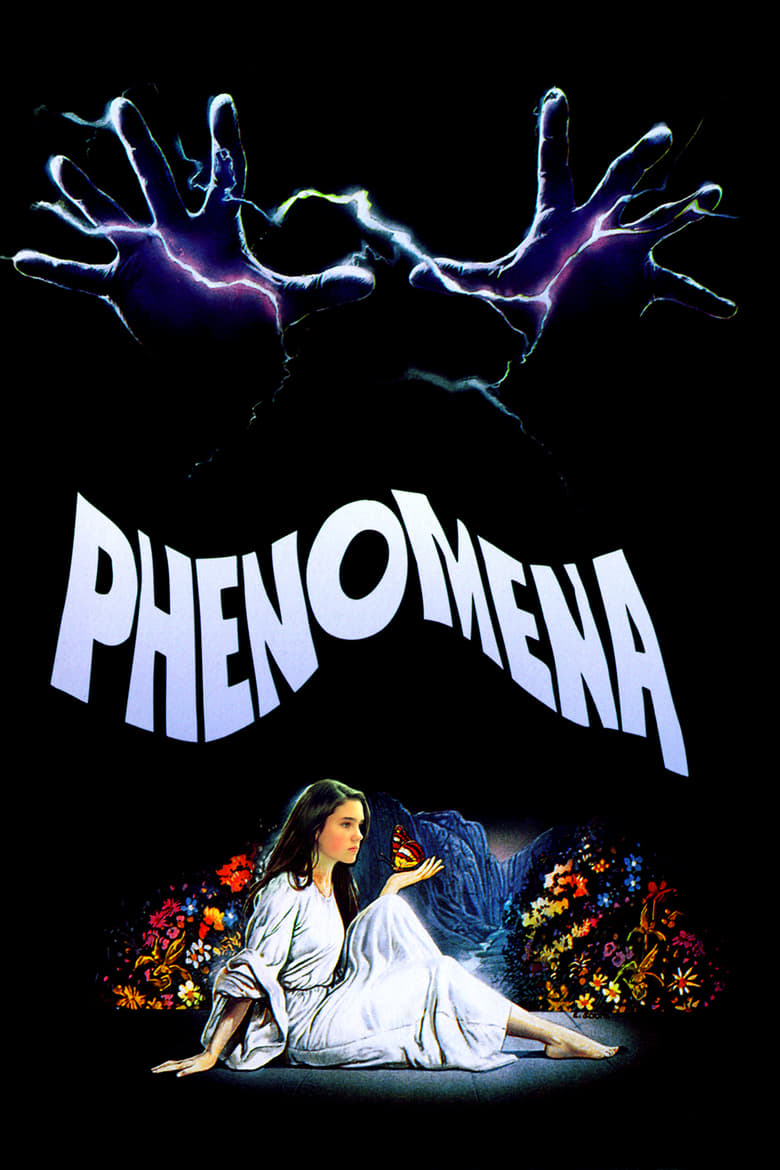
Phenomena
“Jennifer has a few million close friends. She's going to need them all!”
A young girl, with an amazing ability to communicate with insects, is transferred to an exclusive Swiss boarding school, where her unusual capability might help solve a string of murders.
About Phenomena
Why Phenomena still works
If you remember one arresting image from Phenomena it’s the lonely girl who stumbles on a country cottage and is found horribly, abruptly silenced. That first jolt — a small, terrifying encounter in the woods — sets the tone: Argento has never been content to ease you in.
This is Dario Argento doing what he does best: committing fully to a mad idea and letting it run. He hands the centre of the film to Jennifer Corvino, an American actor’s daughter dropped into a Swiss girls’ academy, and then piles on oddness until the rules of the world are unfamiliar and slightly dangerous. Clocking in at just under two hours, Phenomena doesn't dawdle. It keeps introducing new, unsettling threads — a forensic entomologist who notices a strange chemistry between the girl and his insects, a school that isn't as safe as it seems — and asks you to keep up, or else get swallowed by it.
The idea that sets Phenomena in motion
The film opens with a savage, isolated incident: a young tourist is attacked after missing her bus and taken to a cottage where something awful happens. That single violent image haunts the rest of the story and keeps the countryside from ever feeling safe.
Into this uneasy landscape arrives Jennifer Corvino, placed at a Swiss academy and watched over by Frau Brückner. From the start she is an outsider — new, observed, vulnerable — which makes her a natural focal point for the story's various dangers.
The personal stakes tighten when Brückner drugs Jennifer at night. The moment is small — a handful of pills — but it changes the balance between guardian and threat. It’s a neat, mean piece of plotting: the person paid to protect the girl becomes the most suspicious presence.
When Jennifer finally breaks free of the immediate threat she engineers an escape that flips the film into its next phase: from being hunted to trying to understand what is hunting them.
Why Jennifer Corvino matters
Jennifer Corvino is the practical centre of the film: she arrives at the academy as an outsider and spends much of the movie trying to be believed. The fact she’s the daughter of a famous American actor adds a small, useful wrinkle — someone with a public family life who is suddenly deeply private and endangered.
Her presence restructures the movie’s anxieties. Argento places a child — literally, in many scenes — into a world of adults who should be in control and aren’t, and the film’s choices about safety hinge around her movements and decisions.
She is also the link between the investigative strand (the adults piecing together the killings) and the more uncanny elements: when she seeks help she doesn't just meet detectives and scientists, she becomes the axis for a theory that is part crime story, part strange folklore.
At a practical level Jennifer drives the action: she phones her father’s lawyer when she wants to go home, she refuses to swallow dangerous pills, and she engineers the escape that keeps the plot moving. That resourcefulness keeps the film from being simply a sequence of shocks.
Phenomena has more on its mind than the plot suggests
Underneath the gore and oddball ideas, the film keeps returning to family. Who is allowed to look after a child? Who fails? That question loops through the story — from the absent father to the women who are meant to protect at the academy.
Closely related is the sense of home and safety being fragile. The places that should be secure — the school, a chaperone's house, even the home of an expert who might help — are shown to have cracks. Argento piles up betrayals of trust until the idea of shelter feels precarious.
Parental protection becomes complicated rather than comforting. Adults who believe they are protecting often make choices that put the child at greater risk, or they carry secrets meant to protect a family that end up causing harm. All of this sits beside a quieter idea about freedom and loss. The film repeatedly frames what a young person can do: sleepwalk into danger, talk to odd allies, refuse to be silenced. That tension — the wish to be safe versus the need to act — is the emotional engine.
Phenomena could not belong to any other decade
Released in 1985, Phenomena sits neatly in a moment when horror directors were comfortable mixing genre rules. This isn’t a straightforward slasher or a simple supernatural tale; it borrows from crime, science fiction and thriller modes in a way that felt of its time.
That mid-80s intersection — genre playfulness with a willingness to be strange — gives the film its particular personality. It’s a movie that will happily ask a forensic entomologist to help decode a murder and then expect you to accept a child’s weird rapport with insects as plausible within its own rules.
Argento was working in a period when films often tried to surprise by blending registers. Phenomena is a neat example of that impulse: it refuses to be simple and keeps stitching different tones together until the seams show.
What has aged — and what hasn't
Some elements still land. The film’s teen-centred concerns — an outsider at school, the scramble for belief when adults don’t listen — remain easy to relate to, which helps modern viewers stay invested despite the film’s strangeness.
Certain set-pieces, like when the investigative strand brings the girl to a scientist’s house and he hands her a glass case containing a single, telling insect, still feel strangely clever: a prop that turns into a compass for the plot.
Other moments are less comfortable today. The film's fixation on bodies and the grotesque can feel gratuitous at times; those scenes are bold and specific but will divide viewers depending on how much gore they’re willing to tolerate.
Finally, the betrayal of domestic spaces — an expert’s home where murder occurs in front of a captive animal — holds up as an unsettling idea. The sense that safety is porous is timeless; how Argento stages that loss is what keeps parts of the film effective.
Why Phenomena still matters
People talk about this film because it piled together memorable, slightly absurd ideas and committed to them. The opening wilderness terror — a young woman cut down at a cottage — is the kind of grabber that refuses to let you forget the movie.
From there it becomes an odd detective tale: forensic entomologists and canton police noting a string of murders, a girl who sleepwalks into the middle of violence, and a chimpanzee that becomes an unlikely guardian. Those contrasts — clinical investigation and weird tenderness — stay in the mind.
There are images that stick: a girl led by a firefly to a glove crawling with maggots; an entire school covered by a swarm of flies; an expert murdered in his own house in front of his captive animal. They’re grotesque, but they’re precise and strange in a way that feels authored rather than random. The film also keeps returning to its final reckonings: the reveal of a deeply hidden family secret, the chase across water that ends in flames, and the last-minute violence in which a protector appears to set things right. The ending — two very different survivors embracing — gives the story a peculiar intimacy after all the chaos.
Does Phenomena still hold up?
Yes — if you come for unsettling ideas and memorable set-pieces rather than a neat, polite mystery. The film's core question about who protects children and how easily those protections can be subverted still resonates, and Jennifer Corvino’s arc keeps those questions from ever feeling abstract.
Watch it for the strange alliances: a forensic entomologist who treats a kid as part of his investigation, a chimpanzee that finds and protects her, and a small object — a fly in a glass case — that becomes a clue. Those choices make the film feel like an unusual detective story rather than a straight slasher.
Be warned: the movie asks you to accept some very odd logic and to tolerate sequences that traffic in body horror. If that’s not your cup of tea, the tonal jumps will frustrate. If you’re curious about mood, daring plotting and a horror that keeps asking who gets to decide what ‘safe’ means, it’s worth the time.
So yes: watch it. Come for the weirdness, stay for the way Argento keeps the question of protection centre-stage — and for the odd consolation that, after such a long, strange night, two survivors finally find one another.