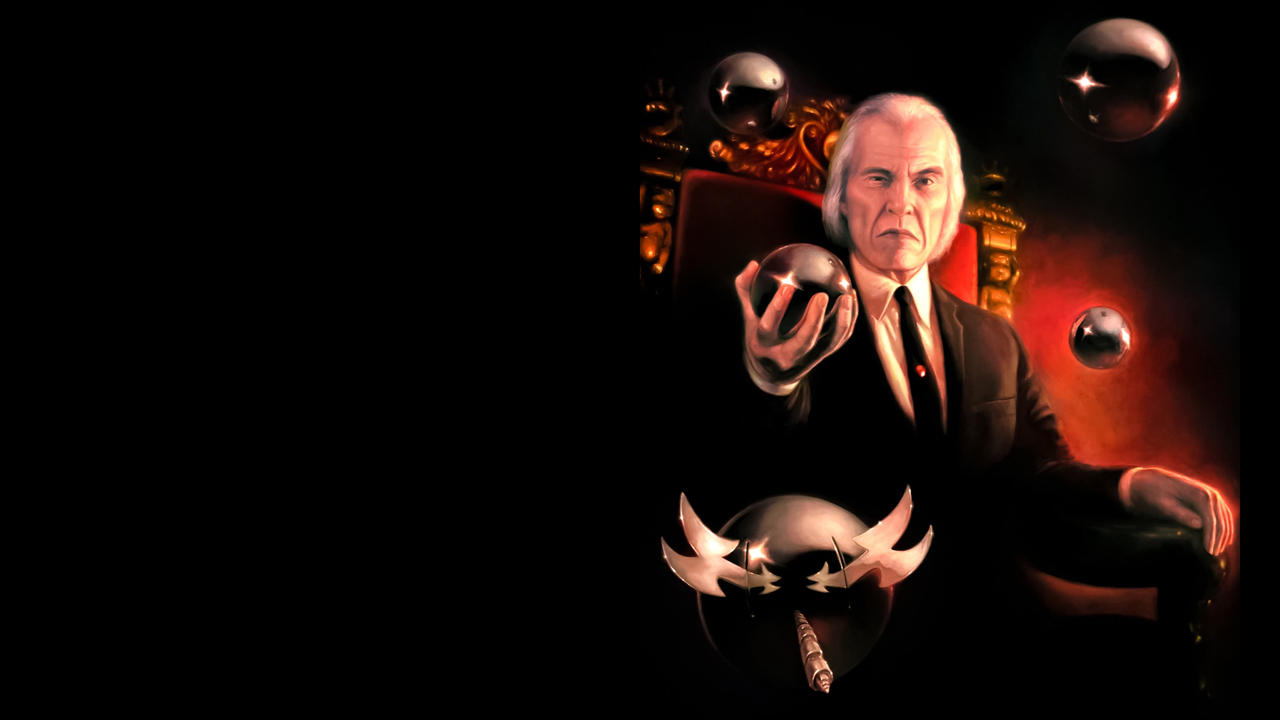
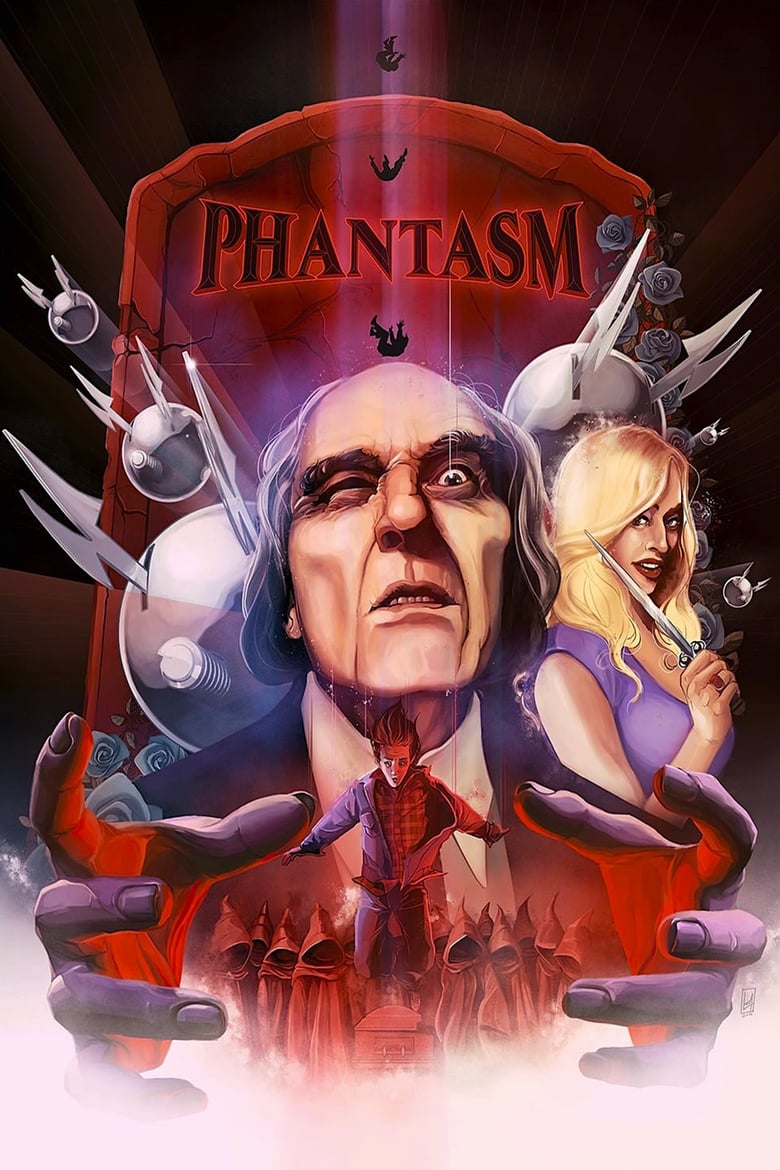
Phantasm
“If this one doesn't scare you...you're already dead!”
A teenage boy and his friends face off against a mysterious grave robber, known only as the Tall Man, who employs a lethal arsenal of unearthly weapons.
About Phantasm
Why Phantasm still works
It begins with something very simple and unpleasant: a young man in a cemetery, a sexual encounter that turns murderous, and a mortician who is hiding more than hairline secrets. That blunt, uncanny start sets the film’s tone — domestic life shoved up against something utterly wrong.
Don Coscarelli packs that energy into a compact 88 minutes. There isn’t much fat; the film moves with the impatience of someone determined to keep you off balance, and that briskness helps preserve its jolts. And at the centre of the scramble are a small set of figures you’ll remember — Mike, the kid who won’t let the cemetery go; the Tall Man, who turns burial into menace; and Reggie, an everyman companion who becomes the film’s human anchor. Their mix of friendship, fear and stubborn loyalty is where Phantasm keeps its teeth.
The idea that sets Phantasm in motion
Phantasm trades in a very old, very effective horror trick: seed the ordinary with a hint of the impossible, then let that hint grow. One early beat — a fortune‑teller asking a boy to put his hand into a box, to test his nerve — is a tiny exercise in trust that quickly becomes ominous. It tells you the film will ask its characters to face things they can’t explain.
That testing of courage flips into physical weirdness: an otherworldly figure whose fingers can be cut from his hand and keep moving. The detail is grotesque and stubborn in a way that makes the Tall Man feel less like a movie villain and more like a persistent natural law you can’t bargain with.
Those two ingredients — private rites that go wrong, and an unrelenting unnatural force — give the story its push. The film doesn’t need to explain every strange object; it just keeps piling them on until the town feels infiltrated.
And when things look bleak, there’s always movement. A promise of a road trip — an offer to look after one another and get away — becomes the simplest plan in a film full of absurd danger. It’s a reminder that the human solution here is to stick together and keep moving.
Why Reggie matters
Reggie is not the lone, doomed teen; he’s the person who turns up with a plan, an ice cream truck and a willingness to get his hands dirty. He evidences something the film needs: someone who treats the weird as a problem to be solved with elbow grease rather than existential dread.
When the gang finds a shrunken, reanimated friend hiding in the truck, it’s Reggie who helps make that discovery feel like an action beat instead of a metaphysical aside. He’s the practical link between the boys’ terror and their attempt to fight back.
The film keeps testing him. At one point he is left alone in the Tall Man’s laboratory of horrors and accidentally powers open a portal; he survives a near‑fatal encounter and later is stabbed by the Lady in Lavender. Through it all, he endures — and that endurance matters, because it carries the film’s human warmth amid its strange business.
In the end his promise to look after the youngster and to propose a road trip is telling. Reggie turns the movie’s surreal nightmare into a kind of stubborn hope: if you can’t make the world safe, you at least try to keep each other moving through it.
Phantasm has more on its mind than the plot suggests
On the surface Phantasm is a procession of uncanny images. Underneath, it’s got a surprisingly tight set of concerns: freedom and its loss, the idea of home as a supposedly safe space that can be invaded, and a blunt reckoning with mortality.
There’s also the matter of belief. The film toys with whether people accept the supernatural — the boy sees things adults dismiss — and that gap between childhood certainty and adult scepticism keeps churning. It makes the film feel less like a simple scare and more like a collision between two ways of seeing the world.
Friendship and fear are braided together. The characters’ attempts to protect one another give the strange events an emotional anchor, so the terror never feels merely decorative. Finally, loss is constant: whether it’s the death that starts the story or the sense of something irreparably wrong in the small town, the movie keeps returning to the ache that follows damage to home and safety.
Phantasm could not belong to any other decade
Phantasm arrived in 1979, at the tail end of a decade that loved to push genre boundaries. That timing matters: it’s a product of an era willing to blend science fiction, fantasy and horror into unsettling hybrids.
The movie’s coming‑of‑age backbone — a child’s eye on a town of grown‑up secrets — sits comfortably within late‑70s cinema, where filmmakers often mixed intimacy with strangeness.
There’s a rough, do‑it‑yourself energy to Phantasm that reads as of its time. It isn’t dressing up nostalgia; it simply wears its decade in the way it chooses to surprise you, fast and uncompromising.
So while you can watch it now and still be unnerved, part of its personality is that specific 1979 willingness to make horror small and weird rather than slick and explanatory.
What has aged — and what hasn't
Phantasm still hits where it counts because it makes the familiar feel unsafe. The idea of a child watching a coffin being handled with impossible ease — and then not being believed — remains a quietly unnerving image that translates decades later.
The film’s insistence on friendship as the counterbalance to horror also endures. Reggie joining the brothers after witnessing something impossible keeps the stakes human; it’s not only about monsters, it’s about looking out for one another.
Some of the story’s set pieces — the discovery of a photograph that ties a town to something older and stranger, an attack that follows a home invasion — keep their power because they threaten ordinary life. That ordinary life is still recognisable, and that’s why the intrusions feel sharp.
And the Tall Man’s persistence — his falling into a mine shaft only to be buried, the way he keeps returning — gives the film a dreamlike persistence. It’s the kind of horror that clings to you; that stubbornness still works.
Why Phantasm still matters
There are specific images and moments that stick: a seduction gone wrong in a cemetery, a finger that refuses to be dead, a flying silver sphere that suddenly kills an innocent caretaker. Those things lodge in the memory because they are weirdly precise and unapologetically strange.
The film mixes the small — boys in cars, an ice cream truck used as a hiding place — with the enormous: hooded figures, driverless hearses and glimpses of a red, hostile other world where captives toil. That contrast between everyday trappings and cosmic threat gives it a distinct emotional pitch.
It’s also a movie that attaches itself to characters. The image of friends running off a hearse to reveal a shrunken, reanimated pal in Reggie’s truck is the kind of odd episode that becomes a shared memory for people who saw the film young. The human beats keep the weirdness rooted. Finally, the film’s final twitches — the strange explanation that reframes events as grief, the promise of a road trip, and then a last, violent tug through a mirror — leave you with an unresolved, lingering sensation. That mixture of comfort and horror is why people remember it.
Does Phantasm still hold up?
Yes — for a particular sort of viewer. If you like your horror quick, slightly chaotic and uninterested in tidy explanations, Phantasm is still a rewarding watch. It was made in 1979, runs a tight 88 minutes, and spends almost all of that time throwing strange objects against the walls to see what sticks.
What helps is that the movie balances the bizarre with real human steadiness. Reggie’s practical loyalty and the boys’ refusal to accept oddness as normal give the story emotional ballast. The Tall Man and his refusal to behave like a reasonable antagonist give it the other kind of ballast: relentless, uncanny menace.
You won’t be watching for clarity. This is horror that prefers suggestive jolts — a child seeing a coffin handled oddly, a fortune‑teller’s test, a flying sphere that kills without ceremony — to long explanations. If that’s your cup of tea, the film’s mixture of home invasion and cosmic weirdness still lands.
So yes, watch it. Bring a friend. And don’t be surprised if — like the final image of hands dragging the boy through a mirror — it’s the small, brutal moment that lingers long after the credits roll.