
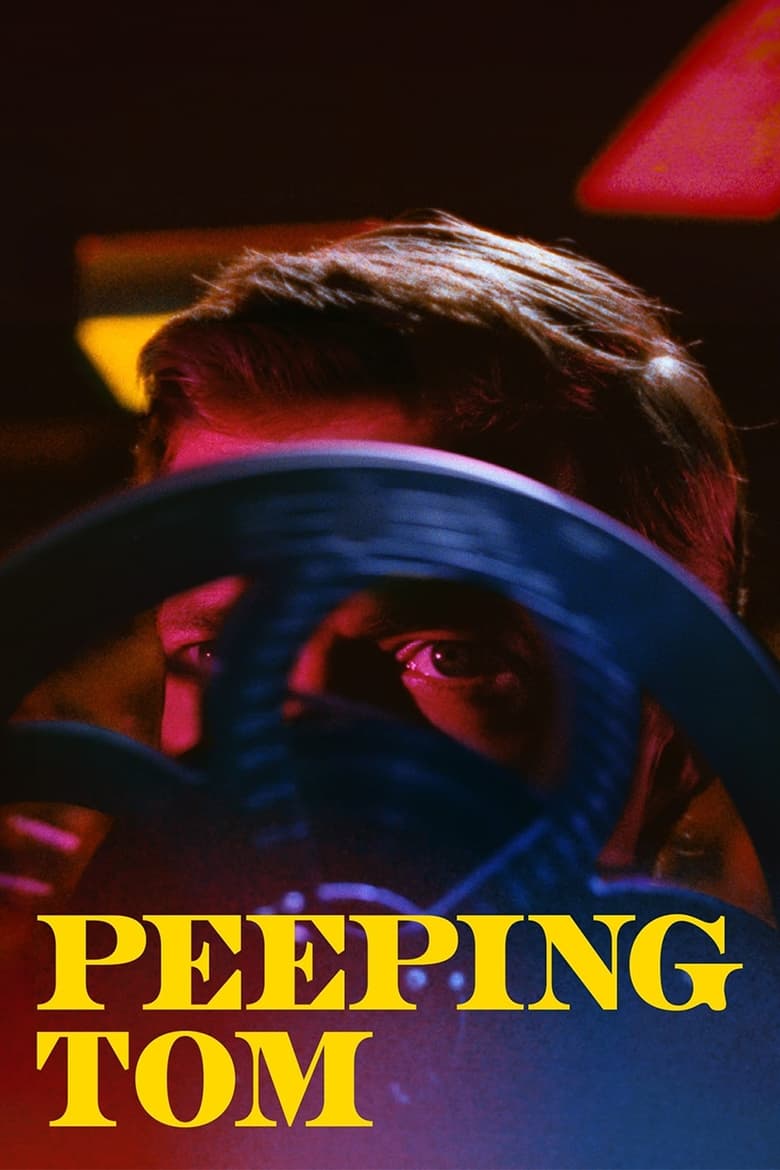
Peeping Tom
“What made this the most diabolical murder weapon ever used?”
Loner Mark Lewis works at a film studio during the day and, at night, takes racy photographs of women. Also he's making a documentary on fear, which involves recording the reactions of victims as he murders them. He befriends Helen, the daughter of the family living in the apartment below his, and he tells her vaguely about the movie he is making.
About Peeping Tom
Why Peeping Tom still works
Start with a single, uncomfortable image: a man with a camera tucked under his coat, following a woman into her flat and recording what happens. That setup — private footage made public only to the voyeur who watches it — is the engine that keeps the film moving.
Michael Powell directs a compact, 101-minute piece that never wastes a shot. Its central figure, Mark Lewis, is both the perpetrator and the audience for his own films, and the movie cartwheels around that unnerving split. Mentioning the cast doesn’t soften it. Karlheinz Böhm plays Mark; Anna Massey is Helen, the neighbour who stumbles into his life; others weave around them. But what you remember is the idea: the camera as a witness — and a weapon.
The idea that sets Peeping Tom in motion
The movie opens with the camera doing what Mark does best: spying. We see events from the viewfinder’s perspective as he follows a woman home, films her, and later watches the footage alone. That shameless point-of-view trick is the plot’s moral fulcrum.
Into that private, clinical attention walks Helen Stephens. She and her blind mother live below Mark’s rented rooms and, after his spying is discovered at her party, the two begin a tentative friendship. Helen’s curiosity is the human counterweight to his compulsion.
Mark’s obsession isn’t random. He organises a meeting with Vivian under the pretext of making a film after hours, and the arrangement turns deadly. The studio becomes another space where his camera is a pretext for control.
Small domestic details matter: Helen’s mother once waits in Mark’s flat after an evening out, and Mark’s behaviour around Helen — promises that he will never film her — create tension between intimacy and the threat that always lingers just off-frame.
Why Mark Lewis matters
Mark is not a cipher or a cartoon villain. He’s a technician of image-making who wants to be a filmmaker, which makes the camera central to who he is. That vocation gives his crimes a grim logic: he records reactions because footage is what he believes completes him.
His past explains the present. Through old home movies we learn that, as a child, he was repeatedly filmed while his father tested different ways to frighten him. Those domestic experiments are not just background detail; they’re the reason he understands fear as something to be produced and preserved.
He lives in his late father’s house, pretending to be a tenant while the building itself keeps the past close. People notice the oddities — Helen’s blind mother senses Mark’s habit of looking through the window — and those observations make the ordinary setting feel less safe.
The film ends with a final recording that reaches back to his upbringing: a voice praising him as a ‘good boy’. That connection to his father is the last piece that explains why Mark turns the camera on others rather than himself.
Peeping Tom has more on its mind than the plot suggests
On the surface it’s a thriller about a killer who films his victims. Underneath, the movie is interested in family and the way authority shapes a child. The apparatus of parenting — the father who experiments — echoes through the whole story.
The film repeatedly returns to home and safety and then quietly removes those assurances. Mark’s house, the studio, the street: none of these places feel reliably protective because his father’s work has left surveillance and recordings in their walls.
There’s also a painful logic of parental protection that’s been turned inside out. Instead of being shielded, Mark was used as a subject; fear was a lesson rather than something to be soothed, and he learns to make fear into an object he can keep. All of which explains the movie’s central grotesque curiosity: Mark makes films to catch the exact look of terror. What looks like motive becomes, in the film’s terms, a distorted inheritance — a family business of recording feeling.
Peeping Tom could not belong to any other decade
Peeping Tom was released right at the start of 1960, and that placement matters. It arrived at a moment when British cinema could still be intimate and sharp, and the film’s small scale — personal spaces, studio backlots, domestic footage — gives it a specific, early‑60s atmosphere.
The movie’s concerns are also era-shaped. The idea of psychological experiment and authority — the expert father who films his child — sits comfortably with a time fascinated by science, social engineering and the new reach of media.
Because it has one foot in studio filmmaking and another in ordinary London life, the film reads like a bridge: a domestic noir that happens to use modern tools, and which therefore feels rooted in its moment rather than timelessly abstract.
Put simply: the film carries the 1960 stamp not as decoration but in its mixture of psychological curiosity, small‑scale production and a willingness to make the private feel public.
What has aged — and what hasn't
The film’s core idea still lands: the sight of someone filming fear is discomfiting in any decade. Scenes where Mark watches police removing a body on the morning after a murder, or screens private footage alone, keep their ability to unsettle because they put scrutiny where it doesn’t belong.
Themes of family and home continue to feel sharp. A house that shelters memory as much as people — a place wired to the past — is a concept that still reads clearly now, and the movie uses that to make otherwise familiar settings feel claustrophobic.
What dates is the specific social language around some characters: certain plot conveniences and the film’s attitudes toward sex and women reflect their time. That doesn’t erase the film’s power, but it does mean modern viewers should expect a movie that sits in its era.
Where Peeping Tom really survives is in its moral curiosity. The idea that fear can be manufactured, filmed and kept as evidence of being alive still provokes a reaction. That thought hasn’t gone stale.
Why Peeping Tom still matters
People come back to Peeping Tom because it makes cinema itself part of the story. Mark isn’t just a killer; he’s a focus puller who wants to be a filmmaker, so the tools of his trade — the camera, the tripod, the darkroom — are woven into the crime. That link keeps the movie interesting to anyone who thinks about film as more than spectacle.
There are setpieces that lodge in the mind. The viewpoint murder — watched through a camera — and the habit of filming police activity the next morning are moments that turn ordinary procedures into something perverse and memorable.
The family thread is another reason the film lingers. Learning that Mark was filmed as a child during experiments reframes his actions as an inherited pathology rather than random wickedness; it gives the story a moral complication people like to argue about. And there’s a bitter finality to the way the camera is used: mirrors mounted on lenses, recordings played back, a last self-directed image. The movie ends with its own medium folded back into the narrative, which is the sort of structural neatness that keeps viewers thinking long after the lights go up.
Does Peeping Tom still hold up?
Yes — on its own terms. Peeping Tom is a tight, 101-minute inquiry into watching and being watched, directed by Michael Powell and anchored by the central idea of a man who films terror rather than fleeing it. That premise still has teeth.
It isn’t an easy watch. Mark’s impulses are shaped by a childhood where his father treated him as a subject, and the film refuses the simple consolation of turning the camera away from him. Its moral discomfort is the point; you’re meant to squirm.
If you want pure thrills or a modern slasher’s pacing, this isn’t the same animal. But if you’re curious about cinema that interrogates its own tools — a film where the camera becomes both evidence and accusation — Peeping Tom delivers.
Watch it because it still makes watching feel like a choice. It asks you to notice what you’re doing when you look, and that question has not aged a bit.