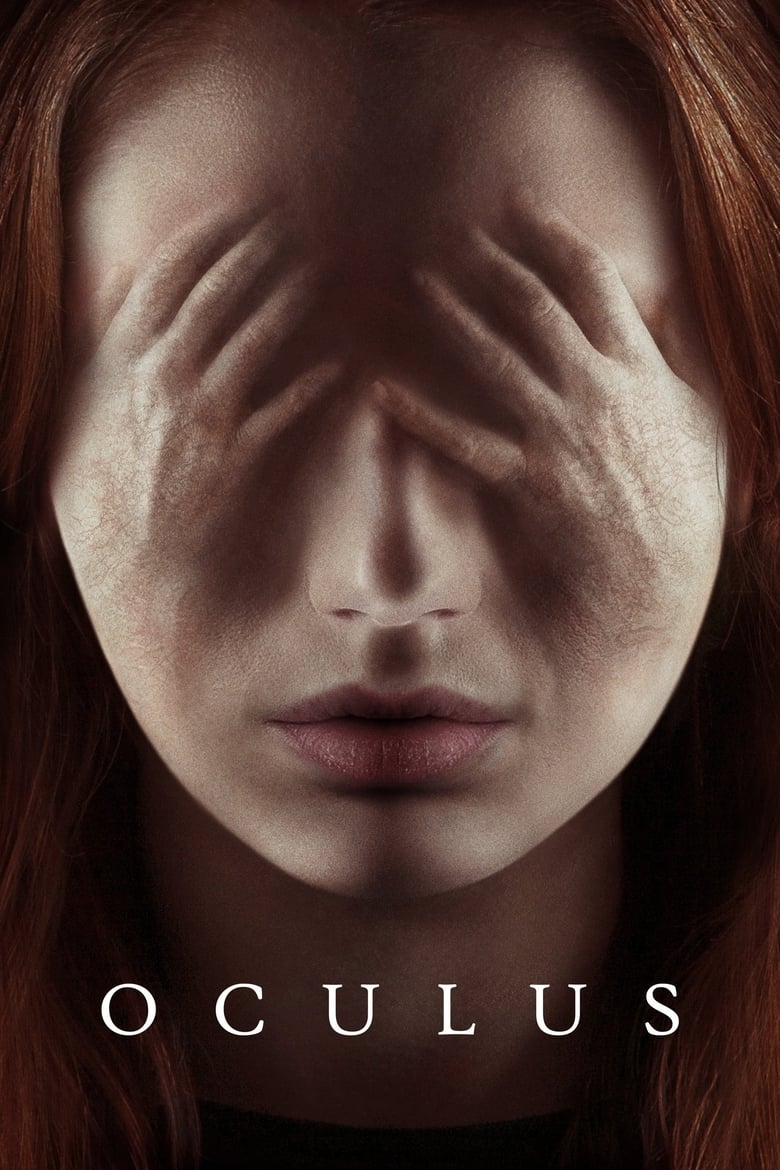
Oculus
“You see what it wants you to see.”
A woman tries to exonerate her brother's murder conviction by proving that the crime was committed by a supernatural phenomenon.
About Oculus
Why Oculus still stands out
Oculus doesn't sneak up on you so much as hold a mirror up and insist you look. Mike Flanagan stages the story in two times — a present and a childhood eleven years earlier — and keeps bouncing them together so that memory, evidence and nightmare overlap.
That structure stops the film being a single scare and turns it into a slow argument about belief: Kaylie Russell spends her young adulthood hunting the mirror’s history, unwilling to let a simple explanation — madness, grief, coincidence — be the final word. At 104 minutes the film steers clear of overstay. It’s economy with a sting: a household breakdown in the past and a tense, claustrophobic reckoning in the present, all orbiting the same antique object and the family it destroyed.
The idea that sets Oculus in motion
Flanagan gives us two runs at the same family. In 2002, Alan Russell moves his wife Marie and their two children into a new house; the film then cuts forward to a present-day attempt to pin what happened back then to evidence. The parallel timelines are not a gimmick so much as the engine: memory versus documentation.
The thing that starts everything is almost stupidly domestic — Alan buys an antique mirror to sit in his office. That mirror, as the family soon discovers, isn't decorative. It begins to warp perception, nudging Alan and Marie into violent, disintegrating behaviour.
As the parents slide into psychosis the house itself turns hostile in small ways: all the plants die and the family dog vanishes after being left alone with the mirror. Those domestic failures make the threat intimate rather than abstract.
Kaylie, who spends years researching the mirror, becomes the sibling who refuses acquiescence. She wants proof that the object did more than wreck a marriage — she wants to document and, if possible, destroy it. That determination is what brings the two timelines back together.
Why Kaylie Russell matters
Kaylie is the film’s stubborn centre. Karen Gillan plays the grown Kaylie; Annalise Basso plays her at twelve. The point is not simply that she survives but that she refuses to let the story be closed as tragedy and explanation.
Using her job at an auction house Kaylie actually gets hold of the object that ruined her family. She brings the mirror back to the house, rigs the room with surveillance cameras and bolts an anchor to the ceiling — a kill switch designed to smash the glass if anything goes wrong. It’s a very specific kind of preparation: research plus siegecraft.
Her obsession is filial as much as forensic. When Kaylie goes back into the past she finds the traces of parental collapse — a mother chained and acting like an animal — and that personal knowledge explains why she won't let others write the ending for her family.
The tragic flare of the story — moments where Kaylie's safeguards fail, like when she stabs what she thinks is her mother only to wound her fiancé instead — underlines why she matters. She's not just an investigator; she's the sibling who built an argument out of every scrap of evidence she could find.
Oculus has more on its mind than the plot suggests
On the surface it’s a haunted-object story. Underneath it’s about the labour of keeping a family safe and what happens when protection itself becomes compromised.
Parental protection and the breakdown of authority are threaded through the childhood timeline: a father isolated in his office, a mother slipping into paranoia, children left to improvise safety. Those failures turn the domestic into a battleground.
The film is also about belief — not just whether the supernatural exists but how people respond when the evidence is messy. Kaylie’s instinct is to document; others prefer denial. That conflict keeps the drama taut. Memory is another quiet theme. The two timelines and the camera room Kaylie builds dramatise how recollection and proof can collide: you can remember something vividly, but without windows that record the past, you become an unreliable witness to your own life.
Oculus could not belong to any other decade
Released in 2014, Oculus sits firmly in the 2010s habit of folding timelines together and treating uncertainty as a narrative device. The film’s present-day thread — where an adult Tim has been discharged from a psychiatric hospital — anchors the story in a near-contemporary context rather than a period pastiche.
That 2013–2014 timeframe matters because the movie’s argument — whether evidence can overcome scepticism — plays differently in a decade that expects both memory and proof to be interrogated.
Flanagan’s choice to keep cutting between childhood trauma and adult investigation feels very of-the-moment for the 2010s: the decade liked its puzzles and its moral questions bundled together rather than neatly separated.
Put simply, Oculus uses its contemporary setting and the aftermath of the young characters’ trauma to make disbelief and documentation part of the horror, which ties it closely to the storytelling preferences of its era.
What has aged — and what hasn't
The film’s insistence on family stakes still lands. Themes about family and home — parents as protectors who fail and children forced into adult decisions — are not time-limited. They feel immediate and distressing whether you first saw the film in 2014 or last week.
Kaylie’s surveillance room — bringing the mirror back, wiring cameras and rigging a ceiling anchor as a kill switch — still reads as a clever, character-driven solution. It gives the plot a practical logic: she isn’t just guessing, she’s building a case.
Small domestic details that illustrate the mirror’s rot — all the plants dying, the family dog disappearing, the mother reduced to being chained to a wall — remain effective because they register as intimate losses rather than spectacle.
Some sequences about separation and reliving childhood nightmares can feel exhausting on a rewatch — the film asks you to repeat trauma three or four times — but that repetition is also the point: trauma does not resolve neatly, and the film refuses easy closure.
Why Oculus still matters
Part of the film’s lasting interest comes from the simplicity of its promise: show us the event, then show us the attempts to prove it. The two timelines told in parallel let audiences be both witness and investigator.
The mirror as an antagonist — an apparently decorative object that induces hallucinations — turns a domestic prop into the source of all dread. It’s a compact, memorable conceit: everyday object, extraordinary harm.
Kaylie’s route back into the past — getting the mirror via her auction-house job, bringing it home and wiring the room for proof and destruction — gives the story a procedural spine. She doesn’t merely believe; she acts on that belief. And the film refuses tidy endings. The mirror tricks the children into hitting the wall, a crack appears, promises are made, and later the present-day attempt to stop the object collapses into the same tragic pattern — an outcome that keeps the film feeling thematically whole even when it’s bleak.
Does Oculus still hold up?
Yes — with a caveat. Oculus still works because it keeps its focus tight: two timelines, one malignant object and siblings who refuse to let their story be rewritten. The parallel flashbacks and the 2002/2013 split give the movie a moral friction that’s still interesting to watch.
Kaylie’s lifelong fixation — getting the mirror from the auction house, rigging the room with cameras and an anchor, wanting to document before destroying — supplies both momentum and emotional logic. The film treats her need for proof as a family duty as much as an investigation.
There are moments that are deliberately uncomfortable and sometimes repetitive: the siblings are separated and relive childhood horrors multiple times. But that repetition feeds the point — trauma is iterative — and the story’s domestic details (plants dying, the dog disappearing, a mother chained and reduced) keep the stakes immediate.
If you like horror that asks you to hold two versions of the same event in your head — evidence and memory, guilt and survival — Oculus still repays a watch. It isn’t cosy, and it doesn’t give you neat answers, but it does what it sets out to do: make home feel both precious and dangerously fragile.