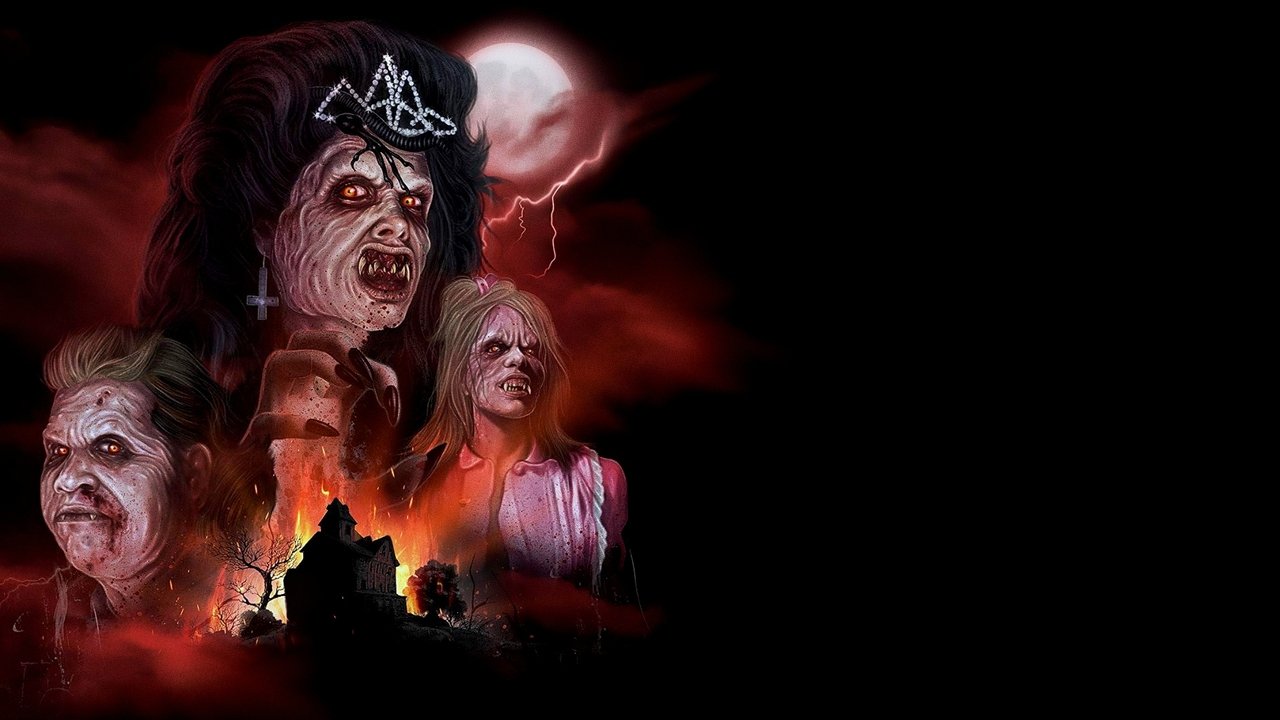
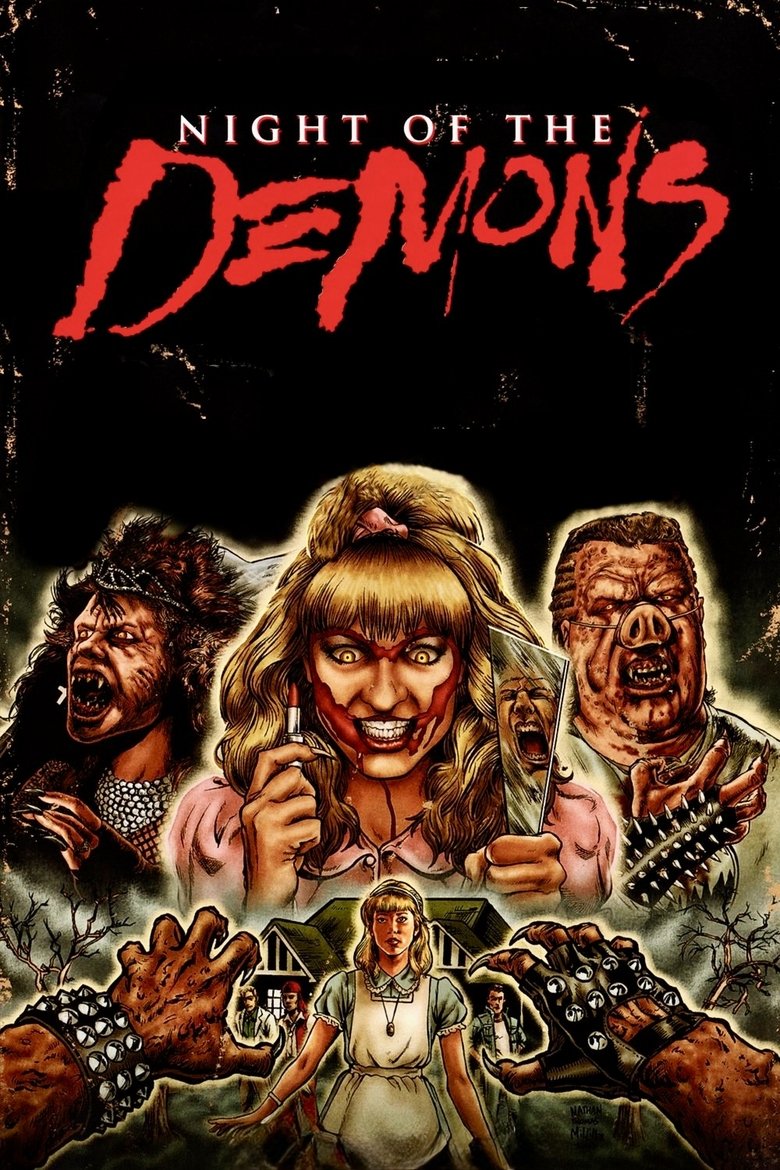
Night of the Demons
“Angela is having a party, Jason and Freddy are too scared to come... But you'll have a hell of a time.”
When partygoers at a deserted funeral home decide to have a séance on Halloween night, they awaken something evil with a thirst for blood.
About Night of the Demons
What Night of the Demons gets right
Here’s the thing: Night of the Demons sells itself on a single, attention-grabbing set-up — teenagers, a Halloween party and Hull House, a mortuary with a nasty past. That combination turns an ordinary coming‑of‑age night into a confined, combustible situation where the familiar rules don’t apply anymore.
Kevin S. Tenney keeps the engine simple and the pace sharp: it’s a tight 87 minutes that doesn’t dawdle on explanations. Because the film commits to its premise — and to the idea that the mortuary is an active, dangerous character in its own right — the chaos that follows feels immediate rather than plodding. It helps that the cast are exactly the kinds of people you expect in this film: the outsider organising the party, the mixed‑up lovers, the idiot jokers and the local ex who turns up uninvited. Put them in a house that’s rumored to be cursed, add a séance that goes very wrong, and you’ve got a movie that makes its pleasures obvious from the first hour.
The idea that sets Night of the Demons in motion
The movie opens with a very clear contract: these kids are going to treat a mortuary like a party venue, and the narrative will treat that choice as the single best way to create trouble. From the start, the place they choose — Hull House — isn’t neutral; it carries a grim past and a reputation for being cursed.
That reputation matters because it turns youthful transgression into genuine jeopardy. What begins as a dare — hold a séance, see what happens — escalates almost instantly when something trapped in the house is freed and takes a host.
The action that follows pivots on a small, effective dynamic: a rescue attempt becomes a split‑up, run‑for‑your‑life scenario. Two characters manage to get someone out of danger, only to be separated when a now openly demonic presence hunts them down.
It’s economical plotting. The set‑piece idea (party in the mortuary) produces both the atmosphere and the problems, so the movie doesn’t have to invent stakes later — everything is contained within that one, bad decision.
Why Angela Franklin matters
Angela Franklin is the pivot around which the whole film turns. She’s the teenage outsider who hosts the party at Hull House, and because the narrative centres on her choices and whereabouts, the danger always feels personal rather than random.
That personal focus lets the story keep one foot in ordinary teenage life — friendship, flirtation, family rows — while the other foot stages increasingly horrific consequences. The fact that Angela arrives at the mortuary with a best friend underlines how the film links the supernatural threat to relationships rather than to abstract evil.
Amelia Kinkade’s casting is the simple, factual scaffolding here: she plays Angela, and Angela is the figure whose fall from ordinary teenager to something else supplies most of the film’s momentum. The character matters because the film treats her as both cause and symptom of the night’s chaos.
So Angela isn’t just a scary face later on. She’s the organiser, the outsider, the friend whose bad choice pulls everyone else into it — and that’s why the movie keeps returning to her even as the body count rises.
Night of the Demons has more on its mind than the plot suggests
On its face the film is a horror comedy about possessions and screaming teenagers, but beneath the blood and the gore it nibbles at anxieties about home and safety. Hull House is a perverse inversion of sanctuary: a place that should store the dead becomes a space that endangers the living.
Freedom is another recurring idea. The party is, at least initially, about teenagers claiming a night away from parental rules. That sense of temporary liberty makes the punishments feel crueller — the night becomes the price paid for that brief independence.
Supernatural belief plays through the film like a foil to scepticism. The séance is framed as a game, and the casual invite to mess with the unknown is what opens the door. The movie is interested in how a choice to flirt with the otherworldly turns into an unavoidable confrontation with mortality. And because the story revolves around friends and family — who shows up, who stands by whom, who betrays whom — memory and relationships keep the horror anchored in human terms rather than treating the demons as merely theatrical props.
Night of the Demons could not belong to any other decade
Released in 1988, Night of the Demons sits squarely at the tail end of the 1980s horror boom. That timing matters because the film feels perfectly comfortable mixing teenage sitcom energy with full‑on gross‑out moments — a tonal blend that defined a lot of late‑decade horror.
The movie’s willingness to fuse party comedy and possession horror says something about the era’s appetite for genre mashups. It doesn’t over‑explain itself; it assumes you know the rules of both teen films and haunted‑house stories and then proceeds to enjoy breaking them.
Running to a lean 87 minutes also feels of a piece with 1980s popular horror: economical storytelling that prefers momentum over meditation. The result is a film that plays like a briskly delivered shock package — hallmarks that make it feel unmistakably of its moment.
So while the story itself is timelessly simple — kids, a bad location, bad choices — the way it’s put together carries the 1980s stamp: energetic, a touch brash, and not especially precious about subtlety.
What has aged — and what hasn't
The central conceit — teenagers partying in an abandoned mortuary — still reads as a neat, provocative gamble. That basic setup keeps the stakes immediate: you feel why being in that house is a dumb idea and, crucially, why every dumb choice matters.
Themes about home and safety, and the cost of a night away from parental supervision, are still easy to follow. When the film ends with two survivors walking home past the figure who cursed them earlier, there’s an old‑fashioned moral loop to the proceedings that modern viewers can still recognise.
Some moments age unevenly. The final, grimly comic twist involving the elderly man and his wife's pie is still effective as a last jolt — it undercuts any tidy happy ending with a reminder that danger can be mundane and petty as well as supernatural.
But the film’s straightforward focus on friendship and family, and the way memory of the night lingers for the survivors, gives it an emotional throughline that survives changes in taste. It’s not a subtle movie, but the bones of its story remain watchable.
Why Night of the Demons still matters
For a lot of viewers, the film’s afterlife comes down to a handful of vivid images and moments: the séance that goes wrong, the first possession, the way a party game becomes an actual horror, and the escalating list of terrible consequences. Those beats are compact and memorable, which helps explain why people still bring the film up.
The movie also keeps returning to its set pieces — a mirror that foreshadows doom, a demon freed from a sealed crematorium, an intimate but horrific possession that spreads through a kiss — and those elements give it a string of high‑impact moments rather than one long, slow burn.
Because the narrative is populated with recognisable teenage archetypes — the jokers, the lovers, the outsider — audiences can slot themselves into the chaos or at least feel they remember nights like it, which makes the scares feel almost personal. Finally, the closing turn into darkly comic territory — the accidental, domestic horror of the old man and the pie — leaves the film with a tone that’s both nasty and oddly wry, a cocktail that’s helped it linger in people’s memories.
Does Night of the Demons still hold up?
Yes — with a big caveat. If you’re looking for a tightly plotted, serious horror meditation, this isn’t it. But if you want a lean, audaciously giddy mixture of teen‑party antics and supernatural nastiness, Night of the Demons delivers enough memorable jolts to justify its short runtime and cheeky premise.
Amelia Kinkade’s Angela anchors the film’s trouble-making nucleus, and the early séance that reveals a demon in the mirror is the precise kind of set piece that the movie rides for maximum payoff. The possessions that follow — from a kiss that spreads the force to a grotesque, sudden act that leaves one character mutilated — keep the stakes high and the audience off balance.
It also still works as a compact example of late‑80s horror: brisk, unsubtle and determined to mix laughs and shocks in equal measure. The ending — survivors walking home only for a grim domestic gag to finish the night — keeps the tone from being earnest and reminds you that the film prefers a nasty twist to neat closure.
So should you watch it now? If you love the idea of a Halloween‑night disaster that wears its willingness to be silly and nasty on its sleeve, yes. If you expect modern psychological nuance, lower your expectations. Night of the Demons thrives when you accept it as a party film gone peerlessly wrong — and that, in the end, is exactly the appeal.