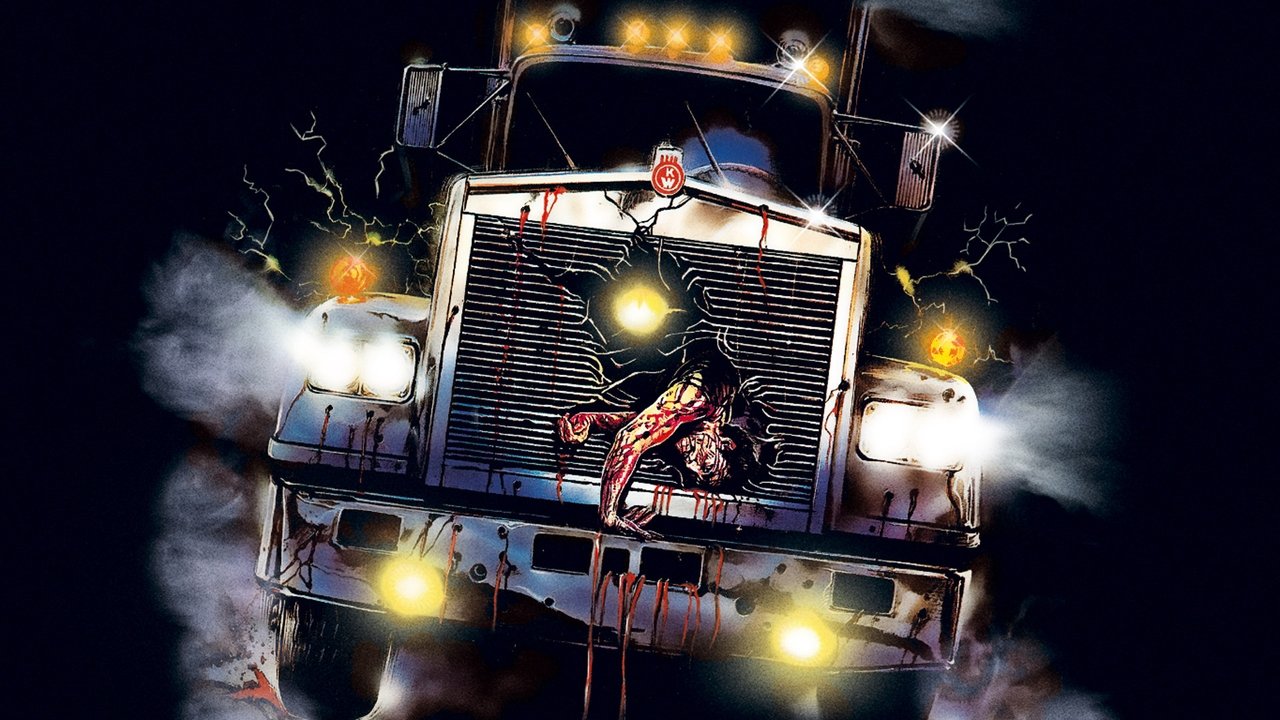

Maximum Overdrive
“Imagine your worst nightmare...machines take over the world!”
When a comet passes close to the earth, machines all over the world come alive and go on homicidal rampages. A group of people at a desolate truck stop are held hostage by a gang of murderous 18-wheelers. The frightened people set out to defeat the killer machines…Or be killed by them.
About Maximum Overdrive
What Maximum Overdrive gets right
There are two moments that usually pull people back to Maximum Overdrive. One is the film's grin-first premise: something in a comet's tail wakes ordinary machines and they start behaving as if they have wills of their own — the ATM that insults a customer is a delightful, daft early note. The other is the decision to lean into that daftness rather than apologise for it; the bridge rising and sending traffic into chaos tells you very quickly this won't be a quiet, explain-it-all thriller.
That snap decision — high-concept mayhem, personal stakes — is framed tight. Stephen King directed the film himself and keeps it brisk: 94 minutes, no padding. It moves from set-piece to set-piece, and that pace helps the movie's temperament: more live-wires than long, thoughtful pauses.
It also has a human centre. Emilio Estevez plays Bill Robinson, a cook and paroled ex-con who begins to notice the pattern in the carnage at the Dixie Boy. Around him gather a ragged crew (truck-stop owner Bubba Hendershot among them) and the film becomes, at heart, a story about people trying to look after one another when technology turns hostile.
The idea that sets Maximum Overdrive in motion
The engine of the film is simple and immediate: as machines across the planet turn murderous, a small group of people end up holed up at the Dixie Boy Truck Stop. The movie keeps its focus local, which works to its advantage — we feel the threat in bodily terms rather than abstract statistics.
The first hints that something unnatural is happening arrive in small, domestic horrors: a gas pump blinds an employee and an electric knife badly injures a waitress. Those incidents are the sort of details that make the premise feel grounded; the world isn't obliterated all at once, it's corrupted through things you expect to trust.
It's Bill — a cook with a record — who starts to smell that the accidents aren't accidental. That suspicion is the narrative's pivot: it turns the film from set-piece after set-piece into a survival story with someone asking questions and pushing for action.
When the truck stop finally becomes untenable the survivors make for the water, and the film folds its chaos into an escape plan — a small, human move against a very large, mechanical threat.
Why Bill Robinson matters
Bill Robinson isn't a blank-slate hero. The film tells us up front he's a cook and a paroled ex-con, which already sets him apart from the prototypical squeaky-clean lead. That background gives him a practical edge: he's someone used to getting by, not waiting for orders.
What makes him memorable in the context of the movie is his function as the person who notices. After the diner suffers curious, targeted injuries — the electric knife, the arcade electrocution — Bill is the character who starts to connect the dots. He doesn't just react; he questions.
Because the story spends its time in a closed, pressured environment — the truck stop — having a protagonist who's both alert and morally complicated gives the survival drama a spine. Bill's choices push the plot forward; he turns suspicion into plans.
That combination — a slightly rough past, a practical job and the willingness to act when others hesitate — is the core of why Bill keeps the audience invested in a very silly premise.
Maximum Overdrive has more on its mind than the plot suggests
On the surface it's a monster movie where machines have turned on us. Underneath that, the film keeps circling a handful of human concerns: what makes someone human, how much freedom is worth fighting for, and what you do when you have to protect the people closest to you.
Technology is the obvious antagonist, but the movie treats it less as a philosophical puzzle and more as a test: can ordinary humans organise, improvise and refuse to be dominated? The survivors' attempt to get to a place where cars are banned — a practical idea wrapped in a moral one — turns liberty into something to be defended.
Parental protection is present in the background tension: the story includes children and family connections, and those threads raise the stakes in plain, emotional terms. It's easier to accept absurd set-pieces when you can see why the characters are fighting — they're not preserving reputation, they're protecting people.
And when Bill offers a theory about the comet — that it's a broom in the hands of something alien — the film gives its madness an origin that stays reasonable within the film's own rules. It's not about explaining everything; it's about giving the threat a shape the characters can react to.
Maximum Overdrive could not belong to any other decade
Released in 1986, Maximum Overdrive sits squarely inside an era that loved big concepts with big guts. The idea of machines suddenly becoming threats taps into a particular 80s tension: technological convenience turned into menace.
That comet bit — ordinary devices coming alive as the Earth crosses a tail — is the sort of high-concept setup the decade embraced. It supplies the movie with room for spectacle and for small, human stories to play out inside it.
The film's willingness to mix genres — action, horror, a dose of comedy and science fiction — is also very much of its time. It doesn't fuss over fitting neatly into one box; it prefers the kinetic, slightly messy energy you get when you mash a few different impulses together.
Put simply: as much as the premise is outlandish, the film's temperament — brisk, loud, and not remotely coy about its thrills — is a very 1986 kind of choice.
Why Maximum Overdrive still matters
People remember Maximum Overdrive because it piles up memorable, absurd threats and treats them with deadpan seriousness. From vending machines firing cans at a Little League coach to driverless rollers causing real bodily harm, the film strings together scenes that lodge in the mind because they're both silly and viscerally scary.
The Dixie Boy Truck Stop sequence in particular — where a garbage truck kills an employee and later big rigs encircle the diner — gives the movie its centre of gravity. It's where the movie's tonal mix makes sense: human desperation against machine repetition, and a handful of characters doing what they can to survive.
There are also moments that feel specifically designed to be retold: the owner Bubba digging out rockets from a bunker, the trucks communicating by horn in Morse code and demanding fuel, the survivors' attempt to reach an island free of motor vehicles. Those beats turn the film into a catalogue of inventive, if sometimes brutal, ideas.
Finally, the film's ending — the survivors forced to sail away and the comet-related explanation for the machines' behaviour — gives the whole affair a tidy, if extraordinary, frame. It leaves you with a clear image: a small group of people refusing to be erased by something massive and indifferent.
Does Maximum Overdrive still hold up?
If you want a tidy, subtle horror film that asks sober questions, this isn't it. But if you're after a compact, feverish piece of 80s pulp that combines unhinged set-pieces with a stubborn human core, Maximum Overdrive still works. It runs for 94 minutes and wastes little time: the comet event turns everyday objects into threats and the film keeps moving.
A lot of the film's staying power comes down to its cast of characters and the choices they make under pressure. Emilio Estevez's Bill Robinson is the practical eye for the audience — the cook and paroled ex-con who starts to suspect foul play and pushes the group forward — and he's surrounded by a roster of plainly sketched allies and victims, from Bubba Hendershot to Wanda June and the young Deke Keller. Those personal stakes matter more than any attempt to fully explain the phenomenon.
The movie can feel messy and gleefully unsubtle: trucks encircle the diner, rockets and machine guns enter the argument, and survivors resort to desperate improvisations. That's part of its charm. It turns a global absurdity into a small, human scramble for survival — and that makes the film watchable, even when it's being deliberately over the top.
So should you watch it today? If you're in the mood for a short, noisy ride where people try hard to protect each other against a ludicrously specific menace, yes. If you want nuance and restraint, perhaps not. Either way, Maximum Overdrive remains an entertaining example of what happens when Stephen King decides to point the camera at mayhem and see who holds the fort.