
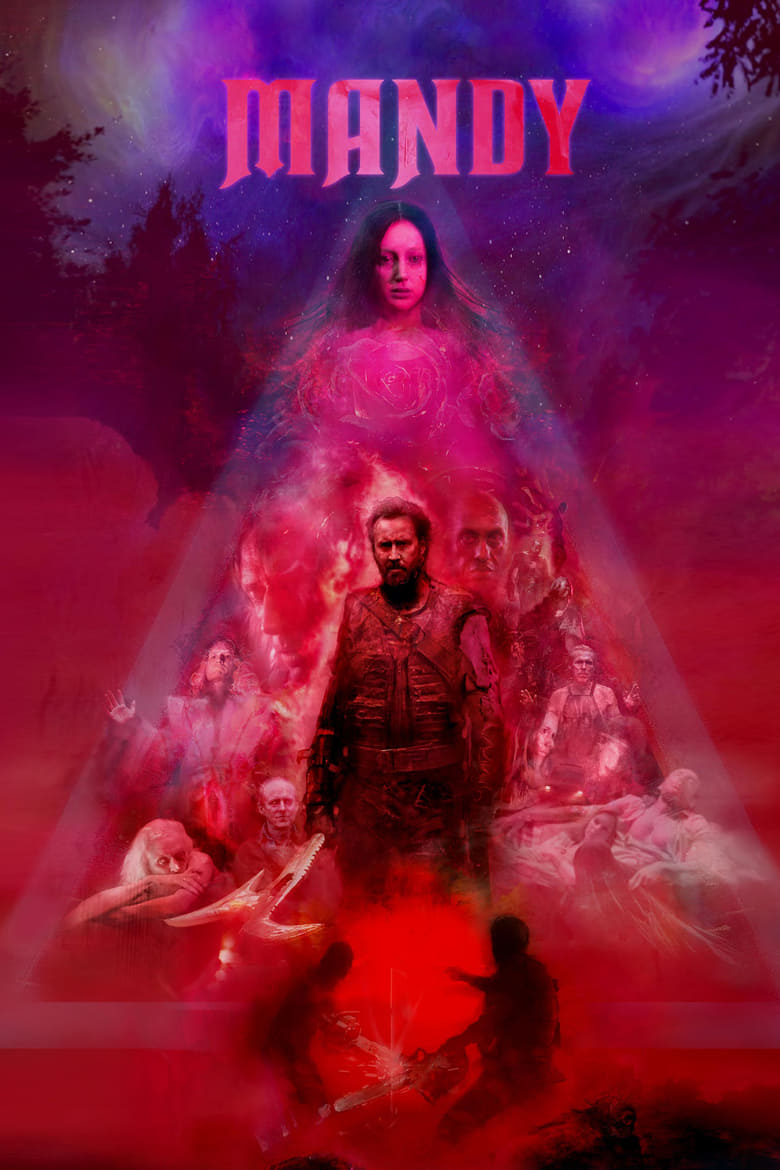
Mandy
“A BRUTAL JOURNEY TOWARDS THE WILDEST REVENGE.”
The Shadow Mountains, 1983. Red and Mandy lead a loving and peaceful existence; but when their pine-scented haven is savagely destroyed, Red is catapulted into a phantasmagoric journey filled with bloody vengeance and laced with fire.
About Mandy
Why Mandy still stands out
Start with two people: Red Miller, a recovering alcoholic ex-soldier living in the Pacific Northwest, and Mandy Bloom, the artist he adores. That quiet, strange domesticity is the emotional anchor of a film that spends a lot of its runtime ripping everything around it to pieces.
Panos Cosmatos made Mandy in 2018, and he deliberately wears six genre badges — action, horror, thriller, fantasy, drama and vigilante — like a set of party invitations. Nicolas Cage plays Red; Andrea Riseborough is Mandy. The movie takes its time setting up what matters before unleashing the violence that follows.
It’s not subtle, and it doesn’t want to be. What keeps people talking is how the tender centre — Mandy’s art and the life the couple build — collides with a chain of grotesque choices and a cult that won’t leave them alone. The result is peculiar, uncompromising and hard to forget.
The idea that sets Mandy in motion
There’s a simple, brutal pivot at the heart of the film: Mandy becomes the focus of a cult, and that attention spirals into an act that shatters Red’s world. The invasion of the couple’s life is sudden and absolute — the kind of wrong that leaves no room for half-measures.
After the cult and a drug-fuelled biker gang break into their home and take Mandy, Red wakes to the aftermath. What follows is not a police procedural or a cautionary tale; it’s a private vow — a quiet man swearing vengeance in the only language left to him.
From there the story moves with grim logic: Red pieces himself back together, gathers the tools he needs and follows leads. One of those leads comes from a figure known as the Chemist, who, after a strange mental contact, points Red toward the place where the cult has gathered.
The setup works because the emotional core is immediate. The plot is basically: person you love is taken, you go after the people who did it. Cosmatos turns that straightforward engine into something operatic — but the motor driving it is the very human grief and determination at its centre.
Why Red Miller matters
Red Miller is a compact bundle of backstory and obligation: an ex-MACV-SOG soldier, a recovering alcoholic and a lumberjack who has found some small peace with Mandy. Those facts explain why losing her breaks him the way it does.
He’s not a mythic avenger at the start. He’s a man who admires his partner’s art, makes his living with his hands and contains a history that makes violence a familiar tool. That history gives his later choices weight — they feel like the unfolding of a life already lived, not a sudden movie-spark catharsis.
Red’s path underlines the film’s central concern with family: the couple’s bond reads as chosen kin, and the ferocity of his response is grounded in that private loyalty. He visits friends for help, re-arms himself and, step by step, becomes the instrument of his own retribution.
The character carries the story. What happens to him — the decisions he makes, the objects he forges, the places he goes — keeps Mandy from becoming merely spectacle. He’s the human fulcrum on which the film tips from terrible loss to single-minded pursuit.
Mandy has more on its mind than the plot suggests
Strip away the gore and grind, and Mandy keeps returning to a single idea: family. Not the tidy, biological kind, but the people you choose and the ways you protect them.
Red and Mandy’s relationship functions as a private world with its own rules — her art, his steadiness — and when that world is violated the film treats it like an existential theft, not just a plot complication.
The revenge that follows reads less as spectacle and more as an extreme form of guardianship. It’s brutal because the thing being defended was everything Red had made for himself: a life with another person.
That focus on chosen bonds gives the film its emotional backbone. Underneath the mythic violence, Mandy insists on the small human fact that some losses are non-negotiable.
Mandy could not belong to any other decade
Being released in 2018 places Mandy firmly in the 2010s, and that matters because of how the decade treated genre. This is a film that happily collects labels — action, horror, fantasy, vigilante — and refuses to tidy them away.
That willingness to mix tonal registers feels of a piece with the decade: films that blurred boundaries, mixed arthouse impulses with pulpy extremes and leaned into strangeness rather than smoothing it out.
Mandy reads like a product of that era because it uses those genres to make a single emotional point, rather than as packaging. The decade gave filmmakers permission to be bold; Cosmatos used that permission to make something very particular.
So yes: the fact it arrived in 2018 is not incidental. It’s the moment when audiences and creators were already comfortable seeing familiar forms reassembled into something stranger.
What has aged — and what hasn't
The movie’s premise — a cult targeting Mandy and a home invasion that shatters a couple’s life — still lands. The central wrong is clear and unambiguous: she’s taken, he’s left with grief and a vow. That emotional clarity is timeless.
Characters who instigate the plot, like the disciple ordered to kidnap Mandy, retain their narrative function; their actions set up the moral logic that propels Red. The human mechanics are simple and remain effective.
The film’s insistence on family as the driver of vengeance also holds up. When a story’s engine is an unmistakable personal stake, audiences can still follow it even when the surrounding imagery grows more baroque.
What feels of its moment are the choices around how far the film pushes its extremes. If you’re prepared for an intentionally over-the-top journey, the setup and the emotional throughline will continue to carry you.
Why Mandy still matters
There are memorable details that make Mandy stick in the mind: Mandy’s art-life by day and fantasy work by night; the moment a religious leader notices her and everything tilts; a biker gang that’s more than a nuisance and behaves like a force of chaos. Those elements give the film a mythology of its own.
Then there are the beats that turn private grief into an epic arc: the awful act that destroys the couple’s life, Red’s silent vow and the way his quest is aided by figures like Caruthers and the enigmatic Chemist, whose knowledge redirects him toward the cult.
The film’s structure — tenderness at the start, a grotesque crime, a relentless pursuit and a finale in which Red methodically hunts the perpetrators — reads like a myth rewritten for late-night cinema. It’s the combination of odd specifics and elemental story that keeps conversations going.
Finally, the way the story closes — with Red driving away while visions of Mandy ride with him and the world shifting into something fantastical — leaves the film perched between the real and the unreal. That lingering image is exactly the sort of thing people take home with them.
Does Mandy still hold up?
If you want a neat, polite thriller, Mandy is not the ticket. If you want a two-hour ride that begins with a small, tender life and then refuses to stop until it has exacted a mythic kind of revenge, it still delivers. The film’s engine is simple — a man and the woman he loves, a violent breach, and a vow — and that clarity is its strength.
Panos Cosmatos built a film around that single personal stake and then leaned into extremes. Nicolas Cage plays Red Miller, a former soldier whose loss propels him to arm himself, visit allies and track the people responsible. The story’s logic — the kidnapping, the murder, the journey to the cult’s hideout — never loses that human centre.
There are scenes you will not forget: the act that destroys Red and Mandy’s life; Red forging a new weapon and setting out; the Chemist’s unsettling role as a guide; and the funerary, hallucinatory image of Mandy beside Red as he drives away. Those moments combine tenderness and ferocity in a way that feels deliberately theatrical.
So should you watch Mandy today? Yes, if you’re up for a film that trades subtlety for a distinctive, volatile mood and an uncompromising translation of personal grief into action. It’s a love story that becomes a burning map — and the last image, with Mandy smiling in the passenger seat as the world turns strange, is the sort of final note that lingers.