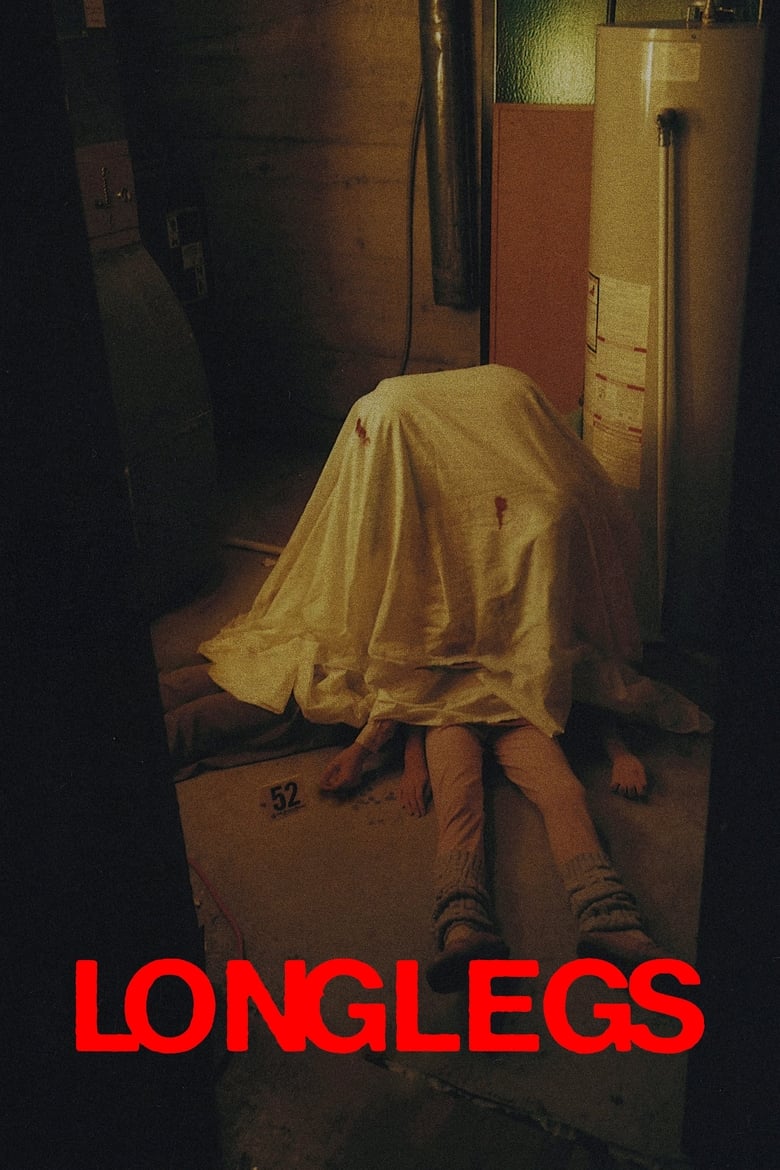
Longlegs
“Say your prayers.”
FBI Agent Lee Harker is a gifted new recruit assigned to the unsolved case of an elusive serial killer. As the case takes complex turns, unearthing evidence of the occult, Harker discovers a personal connection to the merciless killer and must race against time to stop him before he claims the lives of another innocent family.
About Longlegs
Why Longlegs is still worth talking about
That opening — a small girl, a Polaroid camera and a pale, erratic man answering a voice — is the sort of image that lodges under your skin. It’s tidy, specific and immediately worrying in a way that sums up Longlegs’ approach: small domestic details delivering big dread.
Oz Perkins funnels the film through Lee Harker, now an FBI agent, so the scares have procedural teeth as well as the uncanny. The plot asks a simple, nasty question repeatedly: what happens when the thing that should protect a family becomes the instrument of its destruction?
It’s compact — 101 minutes — and populated with a tight cast (Maika Monroe as Lee, Alicia Witt as her mother Ruth, Blair Underwood as a supervising agent, and Nicolas Cage in the title role). That concentration of characters and themes — family, parental protection, home and loss — is why Longlegs still sparks conversation.
The idea that sets Longlegs in motion
Start with a pattern: several families in Oregon, fathers turning on their own households, each massacre signed by the same strange set of glyphs and the name Longlegs. The detail that links them is oddly intimate — each family has a nine-year-old daughter born on the 14th — and the dates line up to form an occult triangle on a calendar, with one corner still empty.
Lee Harker, now an FBI agent, is drafted in to untangle the pattern. The case quickly becomes personal: someone using Lee’s name has already visited the one known survivor, and a missing calendar date lands squarely on the present day.
There are investigative beats — interviews at a hospital, a Polaroid that ties the monster back to Lee’s childhood, and the discovery of a doll concealing a high-energy orb — but the whole thing is driven by a ticking domestic threat: if the triangle completes, another family dies.
That pressure is literal and emotional. When the missing date arrives, Lee is racing not just to stop a killer but to protect the people connected to her life and past. It’s an economy of premise that keeps the movie focused on family and on who gets to keep children safe.
Why Lee Harker matters
Lee Harker matters because she’s the intersection where childhood trauma and adult responsibility meet. Twenty years after whatever happened to her as a child, she’s the agent trying to stop a string of familicides that echo that early wound.
The personal stakes are baked into the investigation: Lee receives a coded birthday card from Longlegs while on the phone with her mother, and a Polaroid from Ruth’s things ties the pale man of the opening back to Lee’s ninth birthday. This isn’t an investigator looking in from the outside — she’s implicated by memory, by evidence and by proximity.
The family angle deepens because Ruth, Lee’s religious mother, is not simply a victim. The film reveals a terrible bargain: to save Lee, Ruth agreed to a servitude that let Longlegs live in their basement and create dolls that would turn fathers into killers. That twist rearranges the moral geometry of the story and makes Lee’s choices feel like the only backstop left.
Put simply: Lee is memorable because the movie insists the case is hers in every sense — professional, historical and familial. The danger isn’t only in the world; it’s also threaded through her own home.
Longlegs has more on its mind than the plot suggests
On its face Longlegs is about an occult killer and a police case. Underneath, it’s quieter and nastier: it’s interested in what families owe one another and how that duty can be corrupted. Fathers turning on their own households makes the central unit of safety into the very site of vulnerability.
Parental protection is twisted into a transaction here. Ruth’s bargain — allowing Longlegs into the family in order to spare her daughter — reframes 'keeping a child safe' as an awful choice between who must be sacrificed and who must live.
Home and safety are treated as fragile, not sacred. The recurring motif — dolls delivered into households, the pattern of birthdays and the occult triangle — turns domestic rituals and keepsakes into vectors of harm. Things you trust to signify care become instruments of loss.
Loss hangs over the whole film: loss of memory, loss of agency and the loss implied by fathers murdering wives and children. That accumulated sense of small personal tragedies is what gives the horror its emotional weight.
Longlegs could not belong to any other decade
Longlegs arrived in 2024 and therefore sits squarely in the 2020s conversation about horror that looks inward — at families, trauma and the private home.
Its compact runtime and tight focus feel of the moment: a single premise allowed to stretch just enough to pull the audience through a personal, rather than spectacle-driven, scare.
Being a 2024 movie means it’s part of the current crop of supernatural horror that favours psychological stakes over broad franchise hooks.
What has aged — and what hasn't
The film’s insistence on family as the site of horror still lands. The pattern of fathers murdering their families, the ritualised calendar triangle and the recurring presence of nine-year-old girls keep the stakes immediate rather than abstract — that specificity helps the premise hold up.
Small domestic beats remain effective: a coded birthday card delivered while Lee is on the phone with her mother, a Polaroid turning up in old belongings. They’re the kinds of tactile clues that age better than flashier gimmicks because they tie scares to everyday life.
That said, the movie’s reliance on the twist about Ruth’s servitude — the idea that Longlegs was allowed into the Harker basement and that Ruth delivered the Satanic dolls posing as a nun — is the sort of reveal that will divide viewers. For some it deepens the horror; for others it asks you to accept a large moral compromise and then move on.
Overall, the central questions — whose job is it to protect children, and what happens when protection itself is weaponised — still read as sharp and relevant today.
Why Longlegs still matters
People remember the image that starts it: the small girl with a Polaroid and the pale man who answers a voice. It’s the kind of early moment that becomes shorthand for the film’s tonal promise.
The structural neatness — letters signed Longlegs, an occult triangle formed by birthday dates, and the doll that houses something ominous — gives the story hooks that stick in the mind. They’re easy to describe and hard to forget.
The revelation that the horror runs through Lee’s own home and her mother’s past turns the movie from 'case-of-the-week' into family tragedy. That rearrangement — detective story colliding with intimate betrayal — is what keeps the film from sliding into generic territory.
Finally, the ending beats — Lee racing to the Carter household, shooting a possessed William to protect his daughter, and the small unresolved image of a child mesmerised by a doll — leave a residue. Longlegs lingers because it makes the domestic feel dangerous in an ordinary, believable way.
Does Longlegs still hold up?
Yes — if you want horror that bites into family life rather than chasing big shocks. Longlegs is short, focused and built around a premise that keeps the threat close to the people we care about: nine-year-old girls, birthday dates and the idea that familiar keepsakes can be deadly.
What makes it worth watching today is how the case isn’t only procedural. Lee Harker’s history — the Polaroid from her childhood tying the pale man to her ninth birthday, the coded birthday card that threatens her mother — keeps the emotional urgency high. The film makes the investigation feel like a personal duty, not a distant puzzle.
There are concessions the movie asks of you — the moral cost of Ruth’s bargain, and the way possession and dolls are used to explain the familicides — but those choices are coherent with the themes of parental protection, home and loss that run through the story.
If you care about horror that wants to make you uneasy about your own living room, and about who keeps our children safe, Longlegs is still worth the watch.