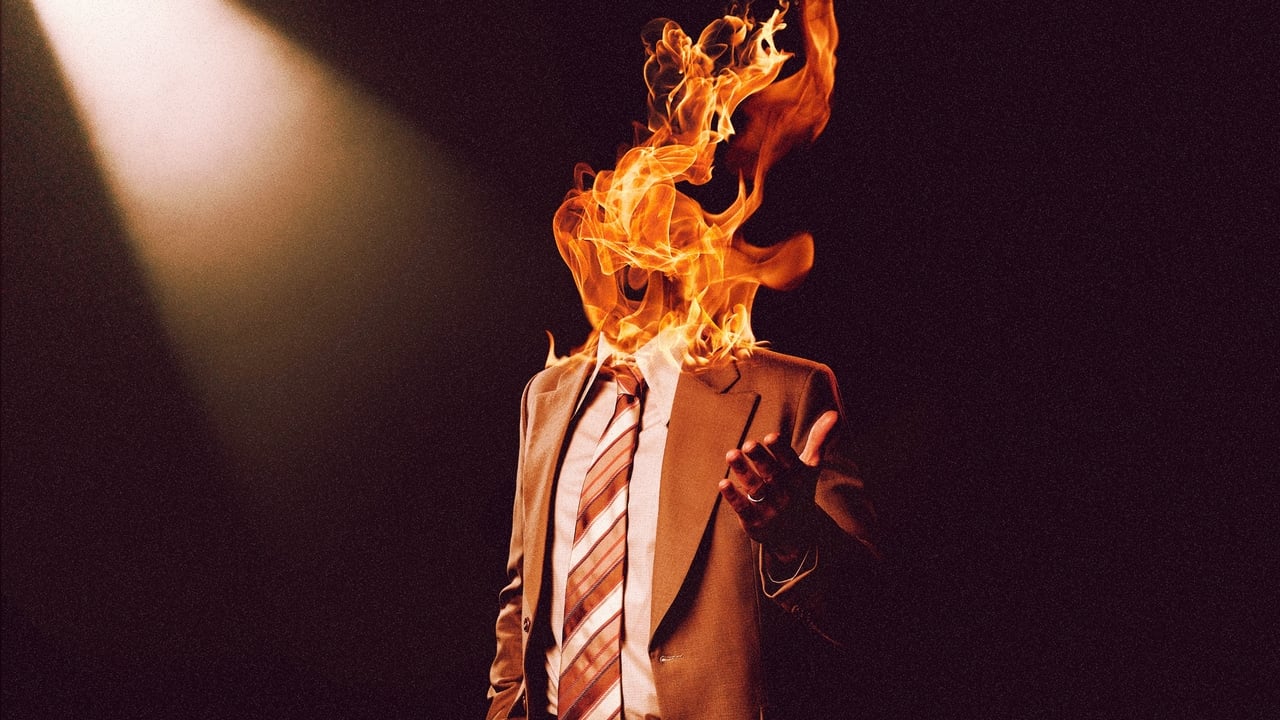

Late Night with the Devil
“Do not adjust your set.”
A live broadcast of a late-night talk show in 1977 goes horribly wrong, unleashing evil into the nation's living rooms.
About Late Night with the Devil
Why Late Night with the Devil still stands out
There’s an immediate, deliciously knotted premise at the heart of Late Night with the Devil: a documentary voiceover taking us back to Halloween 1977 to pry open what went wrong during a live late-night variety show. It’s the sort of setup that invites you to lean in because you already know the rules of the game — late-night TV, live audience, things that should be controlled — and then pulls the rug out from under them.
Cameron Cairnes keeps things compact; the film runs just over an hour and a half and wears its found-footage and horror labels on its sleeve. That economical running time matters: there’s no indulgence, just a steady escalation from uneasy charm to something much darker. The cast is centred on Jack Delroy, the troubled host, and the show’s occult-themed Halloween special that’s supposed to lift his ratings back into the black. What makes it stick in memory — beyond the jump scares and spectacle — is how the film mixes familiar TV mechanics with strange, personal stakes. Through the Night Owls broadcast we meet a parade of guests: a medium, a sceptic, a parapsychologist and the girl at the heart of everything. That crowd gives the film texture; it’s not only about a programme going wrong, but about the people who chose to put this night on air in the first place.
The idea that sets Late Night with the Devil in motion
At its simplest, the film is driven by a very human bit of calculus: Jack Delroy's show is faltering after the personal tragedy of his wife’s death, so he stages an attention-grabbing Halloween special. It’s a familiar career move — shock, spectacle, a promise of viewers — but the consequences here are far from routine.
Into that broadcast come a collection of contrasting voices: a self-styled psychic, a former magician turned sceptic, a parapsychologist and the young girl who’s said to be possessed. The variety-show format does two clever things: it gives the audience someone to root for and it creates a public theatre where private horrors can be exposed.
The night’s veneer of control collapses in stages. On one segment the girl levitates in her seat; later the possession becomes grotesque and violent. Those twin beats — the eerie levitation and the later, much darker turn — are the set pieces the movie builds around, and they make the stakes feel immediate rather than abstract.
Because the film frames the story as recovered footage and testimony, the setup never strays into melodrama. The central question is practical: what happens when a programme meant to revive a career invites forces nobody can contain?
Why Jack Delroy matters
Jack Delroy is the anchor of the whole story — literally. He’s the host whose show is the stage for the nightmare, and that placement matters because the film interrogates what happens when someone in a position of authority chooses spectacle over truth.
David Dastmalchian plays the role of Delroy, but the character’s significance comes less from star turn and more from what he represents: a man whose career and grief intersect. After his wife’s death the show stopped; his return for a Halloween special is a deliberately risky attempt to reanimate both his public life and his private identity.
There’s also a shadowy layer to Jack that the film teases out. He’s not merely trying to entertain; through his connections he’s part of a circle that spends time at an elite place called The Grove. That link hints that his compromises weren’t accidental — they’re embedded in a network with its own rules.
Because he’s the host and gatekeeper of the broadcast, every choice he makes raises the cost of the horror that follows. When events spin out, it’s Delroy who must face the consequences, which gives the film its moral friction: a showman who parasitically fed off other people’s beliefs and pain, and who ultimately sees those choices return to him on live television.
Late Night with the Devil has more on its mind than the plot suggests
On the surface it’s a straightforward satanic shocker, but the film keeps nudging larger questions of belief. Who do we trust when the lights and cameras are on — and what happens when that trust is performative? The show’s mixture of a medium, a sceptic and a scientist creates a small arena where belief is both spectacle and currency.
Mortality threads through the picture in a concrete way. The host’s bereavement is not just backstory; it’s an engine for his choices. Death is both the personal wound he carries and the public commodity he’s prepared to trade off to revive his programme.
Linked to mortality is the film’s attention to lifespan and consequence. There are bargains made — dark pacts and negotiated compromises — that stretch the idea of influence across years. The narrative keeps suggesting that decisions made in private can ripple into broadcast, into history. Finally, it’s quietly a film about authority. Who gets to decide what is real on television? The host, the sceptic, the experts and the audience all jostle for control, and the horror arrives when those authorities fail each other or are shown to be compromised.
Late Night with the Devil could not belong to any other decade
Although the story is set in 1977, the film’s career — and the way audiences talk about it — is very much of the 2020s. Released in 2024, it arrives to viewers already steeped in recovered-media horror and found-footage sensibilities, which the movie leans into without apology.
That placement matters because the film is playing with contemporary appetites: the desire for authenticity, the fascination with archival mysteries, and the appetite for horror that feels like a discovered truth. Those are cultural currents of the 2020s that helped the film find its tone.
At the same time, its tight running time and documentary framing feel pitched to modern attention spans: concise, efficient and built to maintain an uneasy forward momentum. The result feels like a 2020s take on a period piece — nostalgic in subject but current in rhythm.
So while the narrative lives in the late 1970s, the movie’s instincts — how it stages revelation, how it uses recovered footage as an organising idea — are stamped with the decade that produced it.
Why Late Night with the Devil still matters
The film’s afterlife comes from how it folds a public spectacle and a private confession into the same frame. The prologue’s documentary voice — looking back at that Halloween live broadcast — gives the movie a mythic aftertaste: this wasn’t just a bad night on TV, it’s an event people keep returning to.
Part of the lasting impression is the evening’s escalation from weirdness to real horror. Small outré moments — a medium’s shocking collapse, a levitation in a studio seat — harden into irreversible acts of violence. That progression makes the film linger in the mind long after the credits.
There’s also the moral knot that clings: the suggestion that Jack’s career was built on compromises made with a powerful circle, and that one of those bargains had devastating consequences. That revelation reframes everything you’ve watched; the horror isn’t only supernatural, it’s the cost of ambition.
Finally, the movie’s closing images — a host confronted by the bodies the broadcast created and a final on-screen line that feels like a punctuation mark — give it a grim neatness. It isn’t tidy solace; it’s the kind of ending that keeps people talking because it closes the story while leaving its questions buzzing.
Does Late Night with the Devil still hold up?
Yes — and not for the obvious reasons. It’s not just that Cameron Cairnes has fashioned a slick 92-minute found-footage horror; it’s that the film uses the talk-show set-up to make questions about belief and responsibility feel immediate. The live broadcast conceit turns every ethical choice into a public moment.
There’s a clever game at play with scepticism and proof: a magician-turned-sceptic promising money for supernatural evidence, a demonstration that turns out to be a shared hallucination, and other events that resist easy explanation. Those beats stop the movie becoming a simple shock piece and make it a conversation about what we accept as real.
Crucially, the story’s moral centre is never merely abstract. Jack’s personal bargain — his ties to a powerful circle and the suggestion that his wife’s illness is tied to those choices — gives the final horror teeth. When the broadcast concludes with violence and a chilling on-screen line, it feels earned rather than just sensational. If you’re curious about a tight, idea-driven horror that uses a familiar public format to interrogate fame, belief and consequence, this is still worth your time. It’s short, smartly focused and leaves you with an image of a television host forced to confront exactly what his show has become.