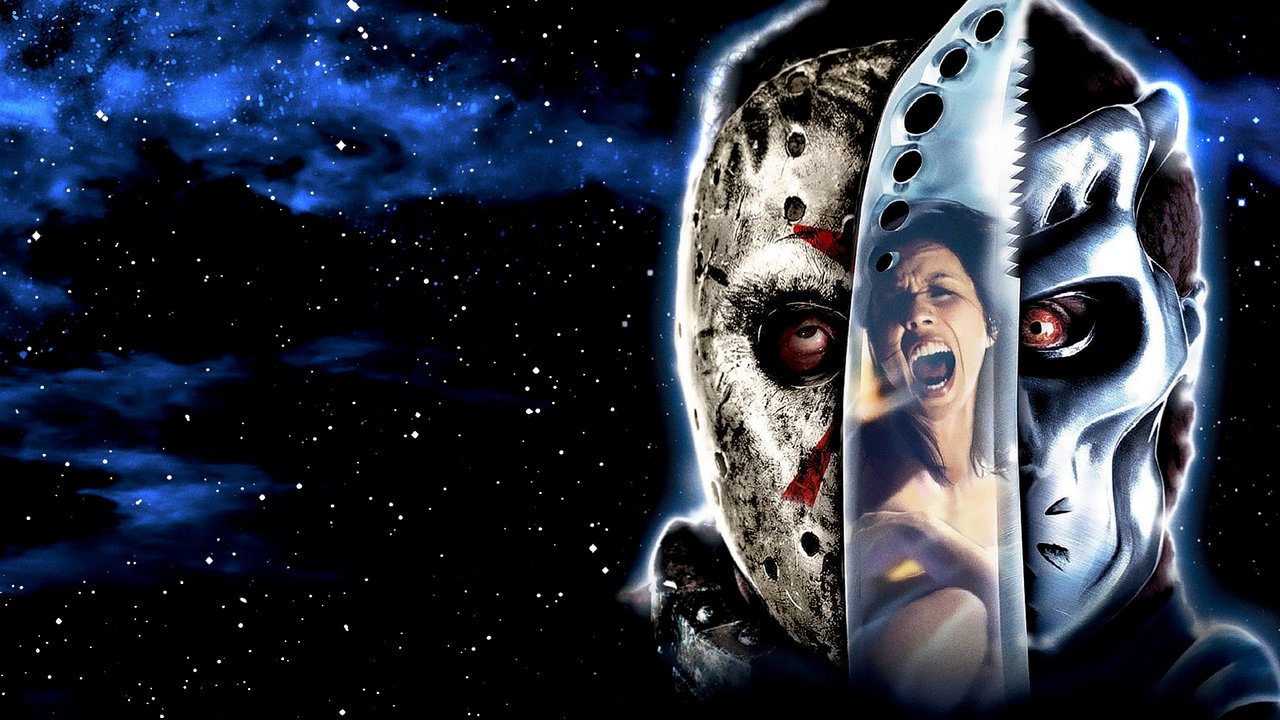

Jason X
“Evil gets an upgrade.”
In the year 2455, Old Earth is now a contaminated planet abandoned for centuries -- a brown world of violent storms, toxic landmasses and poisonous seas. Yet humans have returned to the deadly place that they once fled, not to live, but to research the ancient, rusting artifacts of the long-gone civilizations. But it's not the harmful environment that could prove fatal to the intrepid, young explorers who have just landed on Old Earth. For them, it's Friday the 13th, and Jason lives!
About Jason X
Why Jason X is still worth talking about
Say the title and people either laugh, groan or grin. Jason X is one of those movies that announces itself by throwing an old horror figure into a new, deliberately daft situation — and then running with it for 88 minutes. It's a compact, blunt piece of business: fast to the point, no filler.
What the film actually does is simple and brazen. A captured Jason Voorhees — yes, the same murderous presence from Camp Crystal Lake — ends up frozen, only for the far future to present the franchise with an unfamiliar playground. James Isaac directs the whole thing with its eye clearly on pace and novelty rather than solemnity. If you're curious about the casting shorthand: Kane Hodder remains the physical centre as Jason, and Lexa Doig turns up as Rowan LaFontaine with an android companion in the mix. Those choices tell you everything about the movie's attitude: a classic monster anchored in familiar human faces, then shuffled along into ever stranger company.
The idea that sets Jason X in motion
The engine is a neat, audacious premise rather than a complicated scheme. After a stretch of attempts to stop him, Rowan LaFontaine decides to freeze Jason in cryogenic stasis — a classic containment idea with a sci‑fi twist.
Then the clock jumps forward. By the far future Earth is no longer lived on and humanity has moved elsewhere, which is the perfect excuse to take the franchise somewhere it couldn't have gone before.
From there the film keeps the logic tight: Jason is confronted again, people split up to deal with him, and the usual slasher economy — hide, search, die — plays out in a different register. The future setting allows new missteps too: attempted escapes go wrong, and improvisations that might have worked at Crystal Lake have lethal side effects in zero‑g and on damaged shuttles.
And when technology fights back, the consequences escalate in ways a lakeside cabin never would. Old wounds get worse, parts are lost, and what should have been an ending becomes a fresh problem.
Why Jason Voorhees matters
Jason is the blunt instrument the movie keeps returning to. The fact that he has been captured and suspended by the authorities gives him a different kind of menace: he is no longer merely a local legend, he's a specimen, a problem to be studied and contained.
That containment angle is important because it turns Jason into a question rather than just a threat. He's something human systems try to categorise and control — which, in a film that later hands him to technology, is deliciously ironic.
Crucially, Kane Hodder is the centre of that physical continuity. Even when the story changes location and tone, Jason is recognisably Jason: a presence that the plot keeps bumping into until someone decides to do something extreme about it.
So what makes him memorable here isn't new psychology; it's how the film toys with the idea that monsters can be managed — and how badly that management goes when you combine hubris with future gadgets.
Jason X has more on its mind than the plot suggests
On the surface it's a slasher with future toys. Below that, a few persistent ideas give it extra teeth. Freedom is a running motif: the film moves from containment to escape, and the characters' attempts to control or flee Jason repeatedly misfire.
Humanity creeps in through the survivors' choices. When people attempt to study and profit from Jason's regenerative abilities, you sense a larger discomfort about treating life like data or an asset rather than something messy and dangerous.
And artificial life is woven through the proceedings. An android companion and later technological responses to Jason mean the movie asks — without ever becoming solemn — what happens when machines try to imitate or outdo life itself. Combined, these themes make Jason X feel less like a novelty stunt and more like a film that enjoys asking what monsters do to systems designed to manage them.
Jason X could not belong to any other decade
Released in 2001, Jason X wears its era like a shrug: confident enough to send an established horror figure into unfamiliar territory and assume audiences will follow. That willingness to mash genres and tones was one of the decade's traits.
It sits alongside other early‑00s curiosities that mixed franchise familiarity with high‑concept hooks — a movie that asks ‘what if we took this thing and put it somewhere completely unexpected?’
The film's timeline framing — the character is captured in the near past before being frozen and effectively moved centuries forward — is emblematic of a time when filmmakers loved reinventing rules rather than patiently polishing them.
So yes, it's of its decade because it favours the joke, the surprise and the bold idea over solemn reverence. Whether that reads as bravery or cheekiness depends on your patience for genre hijinks.
What has aged — and what hasn't
A few beats still land. The gag where the survivors use a holographic Camp Crystal Lake as a distraction is a neat, self‑aware twist: the franchise's memory is weaponised against the monster. It reads now as a clever piece of stagecraft rather than a throwaway trick.
The closing image — a charred mask sinking in a lake while two teenagers spot what looks like a shooting star — keeps the film's playful relationship with its own myth intact. It's a tidy, slightly mischievous coda that respects the franchise's appetite for a final scare.
Where the film shows strain is not in its ideas but in how relentlessly it leans on spectacle to solve problems. But as long as you're in the mood for that, those spectacle beats remain entertaining.
Put simply: the jokes about memory and simulation still feel sharp; the film's appetite for escalation is either its charm or its flaw, depending on how much coherent horror you require.
Why Jason X still matters
People remember Jason X because it took a familiar monster and asked a single mischievous question: what happens if you stop treating him like folklore and treat him like a science project instead? The movie's future setting and its willingness to let technology make the situation worse are what stick.
There are a handful of beats that lodge in the memory: the discovery of frozen figures in an abandoned facility, the tension of hurried revivals, the desperate upgrades to an android with real firepower, and the audacious moment when medical nanites rebuild the killer as something more than he was.
Character choices matter too. Small acts — a soldier taking a one‑man stand, a friend sacrificing themselves to buy time — give the film an emotional friction it otherwise skirts around. Those human moments make the spectacle feel anchored. Finally, the film closes with a wink rather than a period: survivors escape, the threat seems dealt with, and yet the mask drifting under a lake insists the story can surface again. For the people who grew up with this one, that's the kind of tidy, teasing ending that keeps midnight‑movie chatter alive.
Does Jason X still hold up?
If you're expecting a sombre reinvention of the franchise, you'll be disappointed. But if you're after a compact, 88‑minute piece of high‑concept nonsense that plays to its oddness, Jason X delivers. James Isaac's film knows what it is: a 2001 experiment that mixes horror instincts with futuristic curiosities.
There are genuine thematic threads that reward a rewatch — freedom, the ethics of studying life, and what happens when machine responses meet something stubbornly alive — all sitting behind the film's more obvious appetite for spectacle.
Kane Hodder's Jason remains the fixed point, Rowan and the upgraded android offer a human and technological counterweight, and a few sincere sacrifices give the plot some weight when it needs it. The movie is short; it doesn't overstay its welcome.
So should you watch it today? Yes — if you enjoy seeing a familiar monster pushed into unusual territory and don't mind a film that prefers big ideas and campy set‑ups to quiet plausibility. It survives best as an amused, slightly mad entry in the franchise: not definitive, but defiantly its own thing.