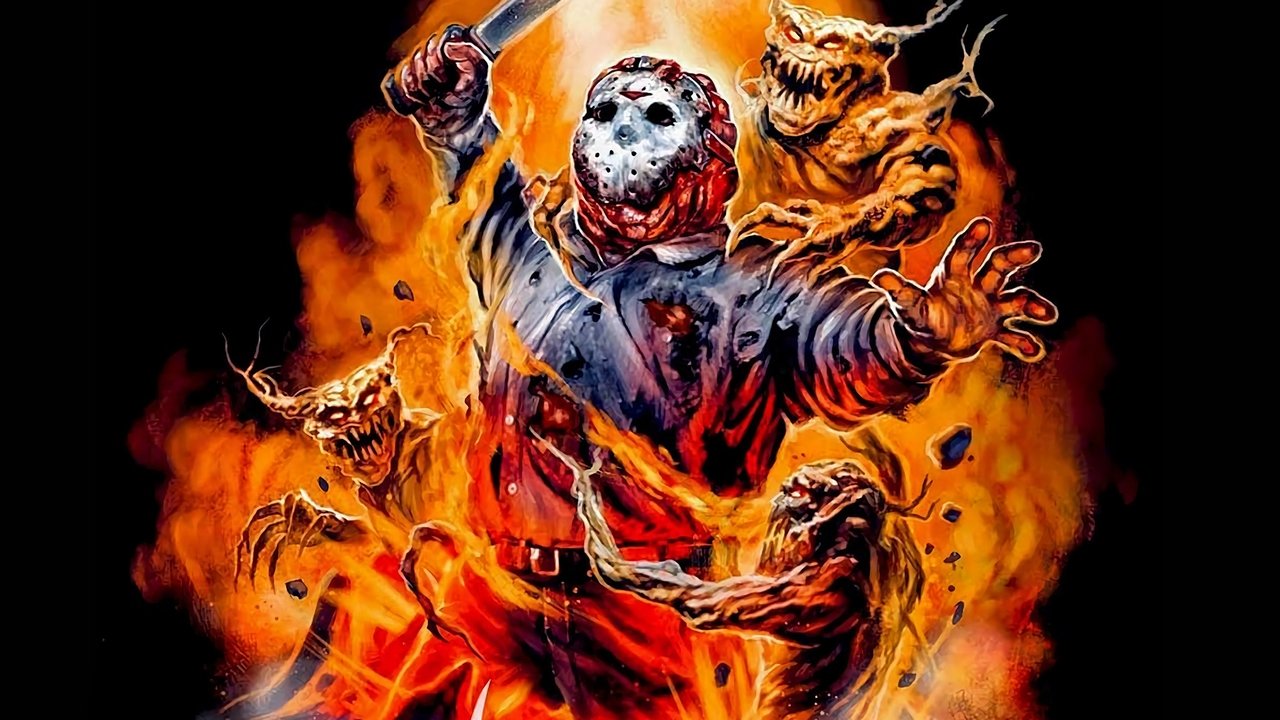

Jason Goes to Hell: The Final Friday
“Evil has finally found a home.”
Jason Voorhees is tracked down and blown to bits by a special FBI task force, reborn with the bone-chilling ability to assume the identity of anyone he touches.
About Jason Goes to Hell: The Final Friday
Why Jason Goes to Hell: The Final Friday is still worth talking about
Right from the start the film sets a tone: Jason Voorhees is out hunting at Crystal Lake, and the set-up looks like the usual slasher beat — until the hunters turn out to be the FBI. An undercover agent lures him into a trap where SWAT teams finish him off with a grenade launcher. That jolt — franchise violence turned military — still surprises.
It’s short and fast: Adam Marcus directs an 87-minute ride that rarely lets the audience settle. The movie keeps moving through weird decisions and odd alliances, and that pace is part of its personality. You either enjoy being thrown from one bold idea to the next, or it’ll grate — there’s very little middle ground. At the centre of that chaos is Kane Hodder’s Jason, the physical presence the film keeps returning to. You can argue about whether every plot choice works, but the movie backs up its bravado with a clear, if eccentric, set of concerns — family, safety and the lengths people will go to protect one another.
The idea that sets Jason Goes to Hell: The Final Friday in motion
The movie rests on a small but ruthless premise: Jason can’t be permanently killed unless a member of his bloodline is involved. That single rule changes what the film has to be — it moves the danger inwards, toward family, rather than keeping it as random late-night terror.
From there the plot funnels around a handful of people: a man who believes he can stop Jason, a young woman tied to Jason by blood, and a mysterious bounty hunter who knows the rules of the monster. The information Steven gets in prison from Creighton Duke is the practical spark: it tells him who matters and why he must act.
There’s also a slightly strange but effective emotional switch: the usual victim-list is replaced by a lineage you can trace. That’s why the dagger Jessica is later given matters so much — it’s meant to be the one blunt instrument able to settle a family curse for good.
So the set-up works because it narrows the battlefield. Instead of random killings, the story forces the characters into choices about protection and inheritance, and those choices are what keep the action moving.
Why Jason Voorhees matters
Jason is the blunt instrument the film keeps returning to. Played here by Kane Hodder, he’s first set up in the familiar pose — stalking a woman at Crystal Lake — but then the movie does something slightly strange with him: it makes the question of who is related to him the key to stopping him.
That bloodline rule reshapes how you think about Jason. He’s no longer merely an anonymous force of slaughter; he becomes, in narrative terms, a problem that has to be understood and solved by family. That gives the character a different weight: he’s terrifying because he threatens lineage and inheritance.
The film also uses ordinary institutions — reporters, police, the FBI — as places Jason can invade or exploit. When a TV reporter tries to boost his ratings by revealing Jason’s return, the monster’s menace stretches into public life rather than being confined to dark lakeside nights.
Put simply: Jason matters because the movie makes him personal. He’s not just a reason for kills; he’s the engine that pushes the family into acts of courage, desperation and, ultimately, violence.
Jason Goes to Hell: The Final Friday has more on its mind than the plot suggests
At heart, the film keeps circling a set of simple, human concerns: parental protection, home and safety. When a child and her mother become the story’s focal point, the horror has a domestic urgency; it isn’t just about surviving the night, it’s about keeping a family intact.
Freedom and courage are also threaded through the action. Steven’s choice to break out of prison and race to protect Jessica and Stephanie reframes him as someone fighting for another person’s liberty as much as his own survival.
Authority — police, FBI, even the bounty hunter — plays an odd double role. Institutions try to contain the threat, but the movie repeatedly shows them failing or being infiltrated, so protection becomes something the family has to wrestle with directly. All of these themes tie back to the bloodline rule. When the way to end Jason involves his relatives, the film turns a slasher premise into a story about inheritance, duty and the lengths people will go to protect home and family.
Jason Goes to Hell: The Final Friday could not belong to any other decade
Released in 1993, the film wears its decade in the way it mixes genre playfulness with outright nastiness. The early 90s felt like a moment when franchises were free to try odd tonal shifts, and this entry is a clear example: it’s willing to be monstrous and silly in close succession.
That period also tolerated brash, compact filmmaking: an 87-minute horror that races through set pieces and refuses to over-explain. The result is a movie that feels impatient by design — which, depending on your taste, is either exhilarating or exhausting.
The film’s willingness to push the Friday the 13th formula into stranger territory — FBI ambushes, possessions, family curses — is exactly the sort of risk-taking that feels very early-90s: noisy, high-concept and unafraid of its own nastiness.
So while it’s easy to pigeonhole it as a 90s horror curiosity, the film’s specific blend of brisk storytelling and eccentric ideas is what fixes it to that moment.
What has aged — and what hasn't
Some of the movie’s choices feel sharper today: the move to centre the story on family and home still gives the film an emotional point of view you can latch onto. Making lineage the problem to solve keeps the stakes human, and that focus survives a few decades better than set-piece gore.
At the same time, the casual way the plot disposes of three teenagers at Crystal Lake is a reminder this is firmly a film of its time. Those kinds of throwaway victim beats are less resonant now and can come off as blunt rather than narratively meaningful.
The bloodline rule — that only Jason’s relatives can finally put an end to him — remains a clever way to retool the villain for new stories. It’s the sort of central mechanic that gives the film an identity beyond another checklist of kills.
So parts of the movie age into something unexpectedly personal, while other elements keep the film tethered to early-90s horror habits that don’t always feel thoughtful by modern standards.
Why Jason Goes to Hell: The Final Friday still matters
People who remember this film tend to remember its daring weirdness. It starts with an FBI ambush that feels intentionally overplayed, and then goes further: Jason’s remains are carted to a morgue only for the coroner to consume his beating heart, which allows Jason’s soul to possess him. It’s grotesque and specific — the kind of image that lodges in the memory.
The possession beats ripple through the movie: Jason inhabits coroner and officer bodies, escapes the morgue and infiltrates public institutions. That willingness to let the villain move through familiar roles — reporter, cop, coroner — gives the film a restless, almost paranoid energy.
On the other hand, the movie doubled down on myth-making. Creighton Duke’s discovery about killing Jason only through family ties reframes the entire series’ logic, and Jessica’s later receipt of a magic dagger hands the franchise a neat if strange ritual to end the terror. And then there’s the finish: after demons take Jason, the film leaves a final visual — a glove with bladed fingers bursting from the ground to drag Jason’s mask underground — a wink that refuses tidy closure. For many viewers that mixture of audacity and cheek is why the film still gets talked about.
Does Jason Goes to Hell: The Final Friday still hold up?
If you want a tidy, polished reboot of Friday the 13th, this isn’t it. What Jason Goes to Hell is instead is a 1993 horror chapter that tries to do two things: keep the franchise’s central terror alive visually, and twist the story inward toward family and protection. That ambition is the film’s strongest card.
The film is short, lean and often deliberately abrasive — it opens with a hunted figure at Crystal Lake who is taken down by a grenade launcher and then lets the nightmare continue in the most literal sense when Jason’s heart enables possession. Those choices make the film feel risky rather than safe.
Whether it works for you depends on taste. If you appreciate a horror movie that isn’t frightened to be ugly, mythic and a bit odd, the Krewe of strange ideas here is entertaining. Its focus on parental protection, home and family gives the gore a reason beyond spectacle.
So should you watch it? Yes, if you’re prepared for a brisk, occasionally bonkers entry that wears its 90s nerve on its sleeve. And if you don’t mind leaving the theatre with a glove bursting through the soil in your head — well, that’s very much in keeping with the film’s tone.