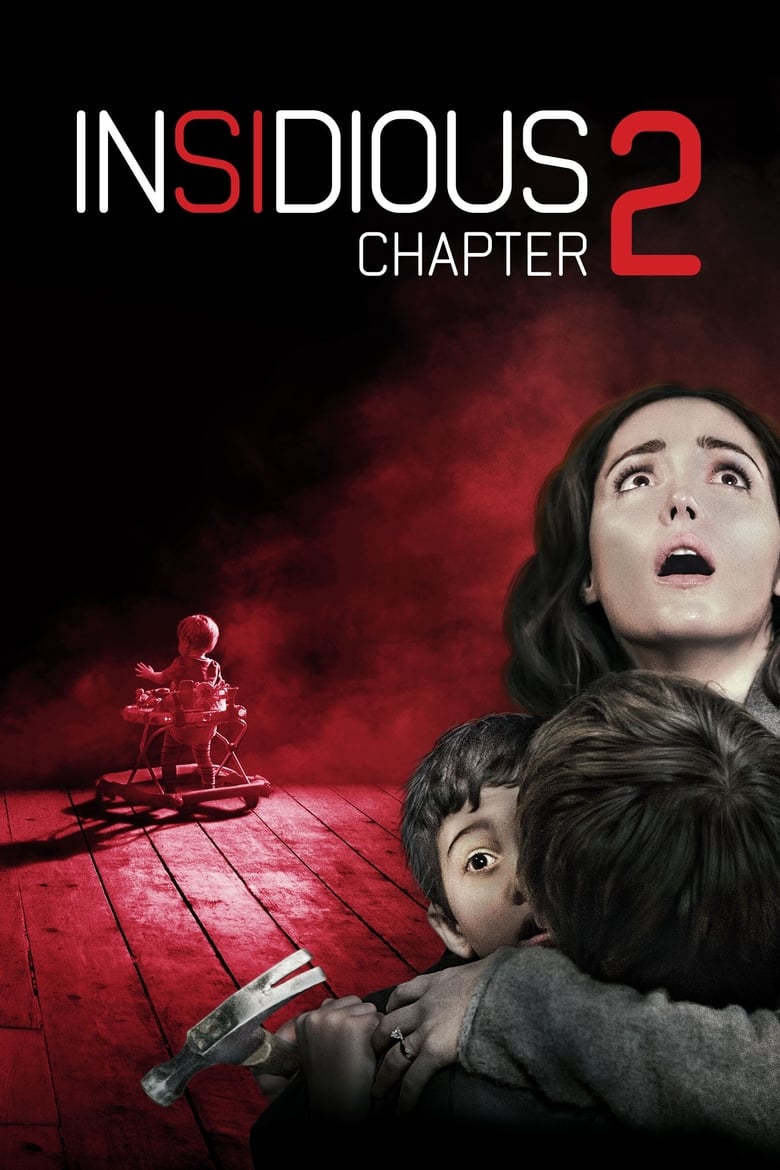
Insidious: Chapter 2
“It will take what you love most.”
The haunted Lambert family seeks to uncover the mysterious childhood secret that has left them dangerously connected to the spirit world.
About Insidious: Chapter 2
What makes Insidious: Chapter 2 worth revisiting
Start with a picture you won’t forget: twenty-four years before the main action, Lorraine brings a terrified little boy to Elise Rainier because something in their house won’t stop following him. That early scene — an older grief stitched to a child’s fear — sets the tone for the whole film.
This is James Wan’s 2013 follow-up: a horror-thriller that refuses to be merely a repeat. It spends 105 minutes unpicking a family’s past, the mechanics of possession, and the odd practical business of planting memories so someone can sleep at night again. And at its heart is Elise Rainier. Lin Shaye’s presence — the woman the family calls when the normal options have failed — gives the movie a fixed point. Even when the plot hops between years and the spirit world, there’s someone who insists on doing the sensible, grim work.
The idea that sets Insidious: Chapter 2 in motion
The engine of the film is simple and a little nasty: memories and the mind can be tampered with to keep someone safe. Early revelations show that years earlier Elise and the group deliberately suppressed Josh’s ability to leave his body and even altered what he remembers so he wouldn’t be endangered by it.
That interference has consequences. When the present-day house strikes again, men like Carl, Specs and Tucker try to help — only to find themselves dragged into other kinds of trouble. In one nightmarish moment Carl wakes up inside the spirit realm known as The Further and meets the real Josh and Elise there.
Time in The Further doesn’t behave. It’s elastic. That allows the living characters to communicate with different versions of themselves, to chase answers through memory and location rather than a straight line of detective work.
What makes the premise work is how it keeps switching registers: the practical, almost clinical idea of memory suppression sits next to full-on ghost-hunting and a boy who willingly walks into the spirit world to pull his family back.
Why Elise Rainier matters
Elise isn’t there to be glamorous. She’s the person you call when polite explanations fail — the pragmatic responder to a problem that has outlived ordinary solutions. The early summoning of Elise in 1986 frames her as the professional presence who can read a home’s history and, crucially, act on it.
Her importance becomes obvious in the film’s key moments. When the family faces the most dangerous escalation — Josh deteriorating under a possession that urges him to kill — Elise’s intervention is the thing that ultimately stops the violence. The movie repeatedly returns to the idea that she can enter that dark business and make it end.
She also represents continuity. The story moves across decades, but Elise’s role ties together the earlier case and the present-day family crisis. Even after she’s gone from the living world, her spirit keeps being the hinge that lets other people find a way back to each other.
Finally, Elise matters because the film treats her as the slow, determined answer to chaos. Where other characters react, she organises; where they panic, she performs the grim work that lets a family sleep again.
Insidious: Chapter 2 has more on its mind than the plot suggests
On paper it’s a haunted-house movie. Underneath it’s chiefly about family — about what people will do to keep their own safe when ordinary institutions can’t or won’t help. That threat to the home is constant: a father hearing a voice telling him to kill, a child dreaming of a woman in a white dress, and a family forced from its own house into someone else’s care.
Supernatural belief is not treated as mere spectacle. The film asks what happens when belief becomes practice: the group don’t just accept that something supernatural exists, they build procedures — memory suppression, spirit-contact — to manage it. Those rituals are attempts at authority over things that otherwise seem uncontrollable.
Parental protection is at the emotional core. Dalton’s willingness to enter The Further and help his father reframes the usual rescue beat: the child is not only the one who needs protection but also the one who can save. It’s a neat flip that keeps the family axis moving even when the plot detours into grisly revelations. And lurking beneath the protection is mortality and freedom. The movie juggles questions about whether erasing memory is a kindness or a theft of freedom, and whether surviving the past means living with truth or with a comfortable lie.
Insidious: Chapter 2 could not belong to any other decade
This is a 2013 film through and through. It sits in the middle of the 2010s horror scene where sequels and extended supernatural worlds were a straightforward way to keep stories moving and audiences returning for more.
Released in 2013, the movie wears its era not as a fashion plate but as a production fact: it’s part of the decade’s taste for tightly packed, idea-driven horror-thrillers that kept hitting cinemas every few years.
That timing matters because the film expects viewers to bring back what they already know about the family and the rules of The Further. It’s a continuation rather than a reinvention, and that’s very much a 2010s move.
What has aged — and what hasn't
The core horror — a home that stops being safe — still lands. The film keeps its menace domestic: a possessed parent, terrified children, a locked closet. Those beats are timeless because people understand, viscerally, what it means when the place you should be safest turns hostile.
Some elements show their age in other ways. The discovery of Parker Crane and the film’s revelation-heavy digging into his crimes is gruesome and plot-heavy in a way that can feel more like checklisting than mystery; it’s a lot of explanation stacked onto atmosphere.
Moments where the supernatural becomes physical still work. A search for paranormal phenomena that ends with Elise injured by an unseen force is a blunt reminder that the stakes are real — the threat has teeth, and the movie refuses to pretend otherwise.
Finally, the emotional centre — the family’s attempts to protect one another — hasn’t dated. Dalton walking into The Further to help his father remains a simple, affecting idea. If you respond to horror that keeps the family at its core, the movie still hits those notes.
Why Insidious: Chapter 2 still matters
People who grew up with the first film tended to follow the family story here because Chapter 2 asks for emotional investment rather than just another round of jump scares. It ties its present-day problems back to that 1986 case — Lorraine bringing Elise in to help the young Josh — and the continuity gives the scares a human weight.
The movie also leans into mythology-building. The videotape reveal, the enhanced footage showing an adult Josh behind his younger self, and Carl’s venture into The Further all add layers to the world. Those moments reward viewers who care about how the pieces fit together.
And Elise’s role in the ending — her spirit moving between rooms and finally encountering something that makes her gasp — leaves a lingering, unsettled note. It’s the sort of last image that keeps people talking because it refuses neat closure. Ultimately, the film matters to its audience because it combines the familiar — family in peril, a haunted past — with the promise that the ghost story has rules you can learn. If you followed the Lamberts once, the film gives reasons to keep following them.
Does Insidious: Chapter 2 still hold up?
Yes — if what you want is a family-centred ghost story that keeps returning to its own rules. The film is built around the idea that memory, possession and protection are practical problems to be solved, and that gives even the scarier beats a kind of internal logic.
Elise’s presence is a big part of the recommendation. The narrative repeatedly shows her as the person who can enter the danger and stop it; that through-line keeps the film grounded even when the plot dives into the non-linear business of The Further.
There are rough edges. The digging into Parker Crane’s crimes and the secret room full of corpses is heavy-handed and can feel like the film shaking a box to prove there’s something inside. But the central emotional engine — parents trying to keep children safe, a boy choosing to help his father back from another realm — still has bite.
So, watch it tonight if you like your horror centred on a household that won’t let the past rest. It’s not a perfect sequel, but it’s a sequel that understands why the family matters — and that, in this franchise, is everything.