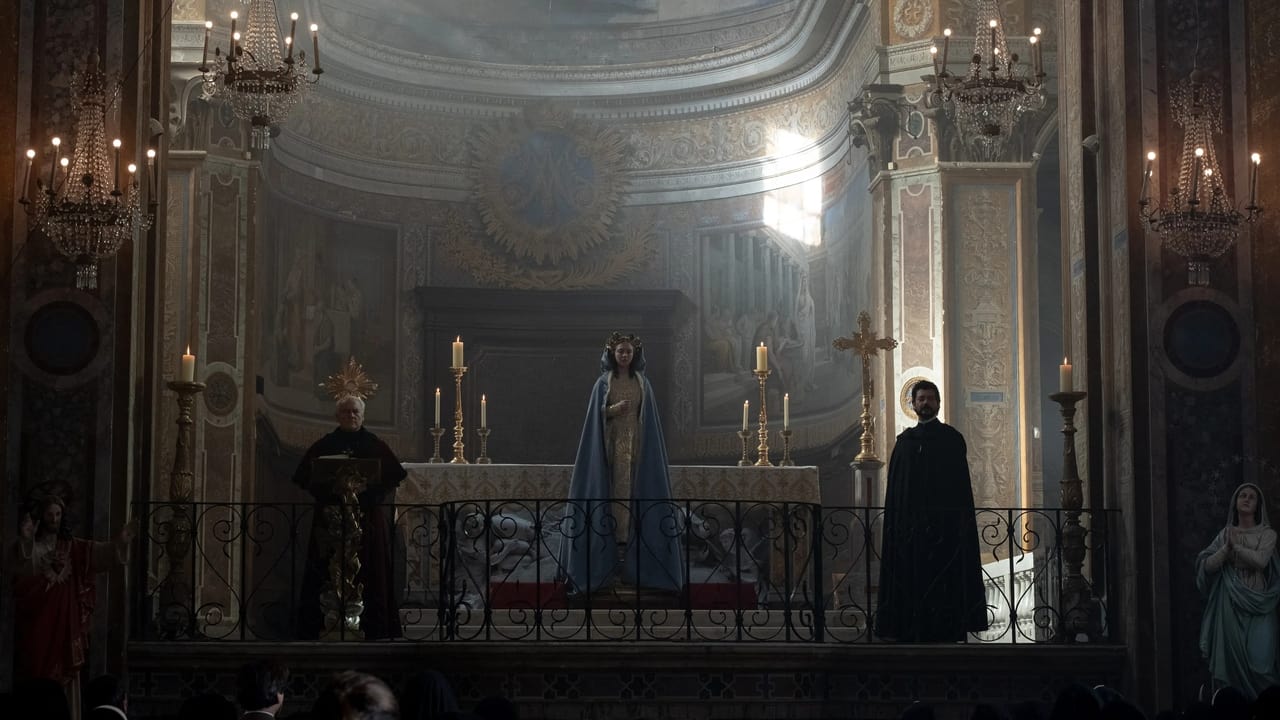

Immaculate
“Not every intervention is divine.”
An American nun embarks on a new journey when she joins a remote convent in the Italian countryside. However, her warm welcome quickly turns into a living nightmare when she discovers her new home harbours a sinister secret and unspeakable horrors.
About Immaculate
What Immaculate gets right
Immaculate lands because it trusts one clear, horrible premise and then refuses to look away. Sydney Sweeney’s Sister Cecilia arrives with a backstory that reads like destiny: she survived a childhood near-death episode and interprets that survival as proof she was kept for a reason. From there, Michael Mohan sets up a small, claustrophobic world where what should be sacred is quietly violent.
The film keeps things economical — it’s under an hour and a half — and that breathless runtime helps. There’s no bloat: the mystery about Cecilia’s pregnancy, the odd rituals around the convent relic and the unnerving details (elders with cross-shaped scars on their feet, a chapel nail worshipped like treasure) all feed one another until the pressure bursts.
What makes it worth revisiting is how the horror is personal rather than grand. This is less about apocalypse and more about a young woman boxed in by claims of destiny, surrounded by people who see her as an answer, a project or a threat. That concentration gives the film its teeth.
The idea that sets Immaculate in motion
At its centre is a simple switch: Cecilia believes she was spared from death for a purpose. That conviction carries her to an Italian convent dedicated to tending the dying, where reverence rapidly curdles into something far less holy.
Soon after arriving she is confronted with a biological impossibility — a pregnancy despite her virginity — and the convent reacts the way any tight-knit institution might when handed a miracle: some see blessing, others see opportunity.
The plot tightens when Cecilia fights back. Her repeated attempts to escape and the violent confrontations that follow turn the convent from refuge into trap. At one point she lashes out with a crucifix; later she flees into the catacombs as those who control the house close ranks.
All of those moves work because the engine is personal. The setup isn’t about global stakes. It’s about a single woman discovering that the reason she was spared may be someone else’s design, and then deciding she will not be owned.
Why Sister Cecilia matters
Sister Cecilia is the movie’s tether. We never get a wandering ensemble piece; everything is filtered through her. She isn’t a blank saint to be venerated — she’s the person who keeps asking questions the convent doesn’t want answered.
Her past survival is crucial: it’s why she accepts the notion of a calling in the first place, and it’s what makes her inability to leave feel like theft. When she discovers private records about her childhood and sees evidence that others have been marked like her, her faith and her freedom collide.
Cecilia’s relationships inside the convent give the film its heartbeat. She befriends Sister Gwen, notices unsettling signs — like elders marked on their feet — and watches solidarity dissolve under pressure. Other novices try to flee; one, Sister Mary, literally attempts an escape and faces a brutal punishment. Those incidents show what the place does to people who resist.
Crucially, Cecilia refuses to be passive. She demands medical care and is denied. She fights back physically. The picture that emerges is of a woman for whom survival has become two things at once: a burden and a mandate to choose her own life.
Immaculate has more on its mind than the plot suggests
On the surface it’s a ritualised horror: miracles, relics, hooded figures. Underneath it’s arguing about who gets to decide what a life is for. Freedom shows itself as the movie’s quiet obsession — whether a person belongs to God, to an institution, or to themselves.
Mortality and lifespan are woven through the story. The convent’s work with the dying, Cecilia’s near-death history and the repeated attempts to manufacture (and control) new life all bend the film toward questions about how long a life should last and who defines its value.
Family is twisted here, too. The convent pretends to offer a chosen family, but it’s often a substitute for ownership: sisters bound not by mutual care but by a hierarchy that permits exploitation. That’s where the film’s darker emotional charge comes from — the way loss and control can masquerade as care.
Finally, exploitation is explicit. The reveal that scientific meddling — using relic-derived DNA — underpins the so-called miracle re-frames every act of devotion as potential abuse. When salvation is engineered, trust curdles into something dangerous.
Immaculate could not belong to any other decade
Immaculate is of the 2020s in the way it turns small-scale suspicion into a bigger social idea. Released in 2024, it slots into an era where genre films often ask whether institutions can be trusted — and then make that suspicion personal.
There’s a confidence here: compact runtime, focused cast, a single provocative concept. That straightforwardness feels very of-the-moment, a 2020s habit of doing more with less and letting audiences fill in the moral blanks.
The film’s bilingual setting and cross-cultural production also speak to modern horror’s global reach: stories no longer need to be hometown-specific to feel intimate. Immaculate travels its concerns — faith, ownership, bodily autonomy — across borders without diluting them.
In short, it’s a product of its time because it treats contemporary anxieties as intimate horrors rather than broad allegories.
Why Immaculate still matters
People keep talking about Immaculate because it gives a recognisable horror feeling — the slow discovery that something supposedly holy is rotten — and then takes that feeling to a physical extreme. Small moments lodge: a novice trying to flee through locked gates, another waking up buried alive, the sickening discovery of mutilation in the dark.
But the film’s aftertaste isn’t just shock. It’s the way those shocks are anchored to concrete betrayals: a priest who was a geneticist using a sacred relic to meddle with DNA; elders branded with crosses that mark them as part of a secret; the community celebrating a pregnancy that may have been engineered. Those specifics turn generic dread into moral outrage.
There are scenes that stick because they splice horror with moral consequence: Cecilia stabbing an antagonist with the chapel’s Holy Nail; the bloody, exhausted birth that follows her flight down into the catacombs. Those moments don’t exist for cheap thrills alone — they’re the climax of a story about being claimed and fighting back.
Finally, the characters matter. Cecilia’s arc from saved child to hunted woman who refuses to be reduced to somebody else’s plan gives the story its emotional spine, while Father Sal Tedeschi and the convent hierarchy show how power can dress itself as piety. It’s why the film lingers: its scares are grounded in human choices, not just monsters.
Does Immaculate still hold up?
Short answer: yes, for the right reasons. Immaculate is best experienced as a tight, provocative ride rather than a sprawling statement. Its focus on a single woman who survived death and then discovers she might be part of someone else’s plan gives the film a sharp moral centre.
The movie leans into nasty ideas — engineered miracles, institutional denial of medical care, branding of the vulnerable — and those choices give the horror weight beyond shock. When the narrative turns physical, the film pays off its setup: the chases, the confrontations with the convent hierarchy, the violent birth sequence all feel earned because the emotional groundwork has been laid.
It won’t be everyone’s cup of tea. There’s little ambiguity about who has agency in the story, and the film isn’t aiming for subtlety when it needs to land blows. But that directness is also its strength: it asks you to care about freedom, lifespan and who profits from creating life — and then forces you to watch what happens when those questions are ignored.
If you’re curious about current psychological horror that trades spectacle for moral pressure, Immaculate is worth a watch. It remembers that terror is never just about what’s hidden in the dark — it’s about who decides how a life should be lived.