
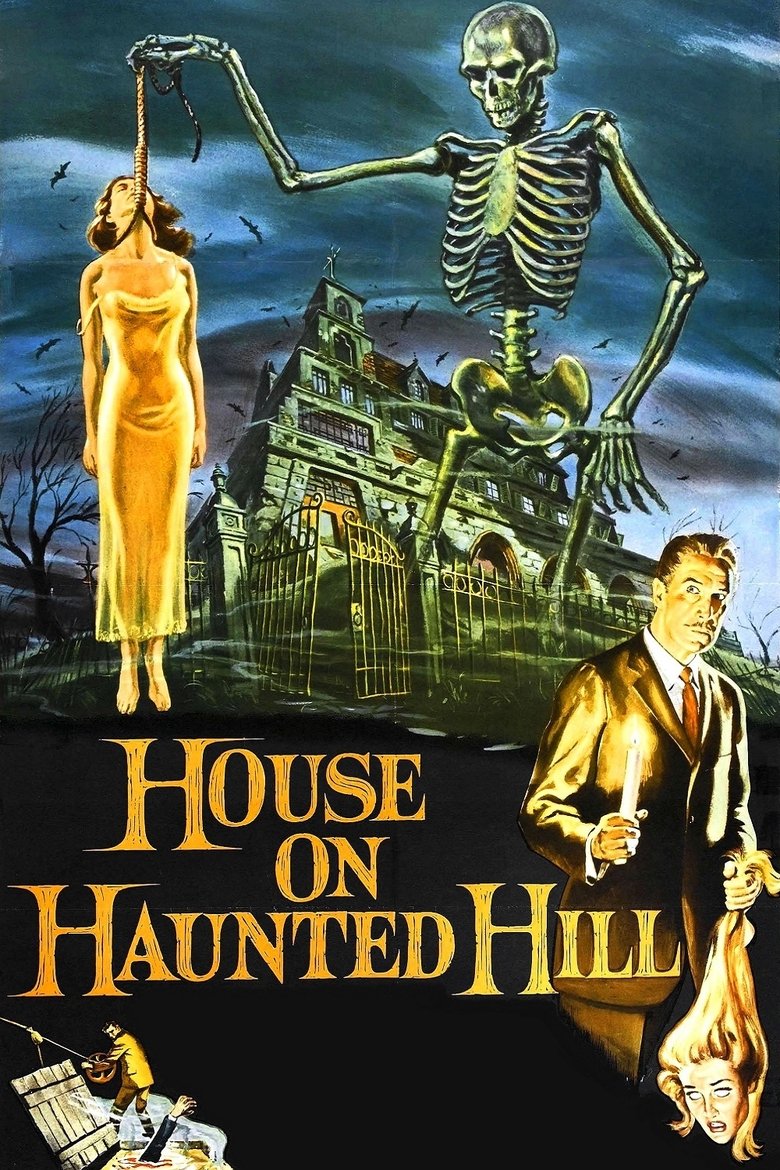
House on Haunted Hill
“Consult your doctor! Bring your seatbelt!”
Frederick Loren invites five strangers to the party of a lifetime and offers each of them $10,000 if they can stay the night in the reportedly haunted house. Armed with a gun for protection, each guest arrives in a hearse and will either leave in it much richer…Or dead.
About House on Haunted Hill
Why House on Haunted Hill is still worth talking about
The pitch is deliciously simple: a millionaire offers five strangers ten thousand dollars each if they will spend a single night in a rented, allegedly haunted house. You can already feel the bargain-basement menace — prize money on one hand, barred windows and cut-off communications on the other.
It’s a compact piece of business. Directed by William Castle and running a brisk 75 minutes, House on Haunted Hill wastes no time setting up its rules and watching them go horribly wrong. Vincent Price plays the millionaire Frederick Loren; Carol Ohmart turns up as his fourth wife, Annabelle. The cast includes a handful of recognisable faces who shuffle the story’s power and paranoia around the rooms. Label it horror, call it a mystery, tip a hat to the comedy in its scheming — the film sits somewhere between pulpy thrills and straight-faced melodrama. That mix, and the way the set-up forces strangers to test whether a house can still be a refuge, is why it keeps getting rewatched.
The idea that sets House on Haunted Hill in motion
At its centre is a single theatrical gamble: money to anyone willing to stay the night after the doors are locked. That promise turns the private horror of a house into a public experiment — suddenly strangers are contestants, and their motives are as sharp as the cash on offer.
Annabelle, Frederick's wife, quietly warns a young guest that her husband might not be quite what he seems. The warning injects doubt into the party line and hands the film a useful double-take: is this a money-grab, a terror stunt, or something nastier?
Because the arrangement forces every character to stay and face whatever happens, the premise keeps pressure on. The locked doors and the guests’ own choices turn the house into more than a backdrop; it becomes the mechanism that turns suspicion into action.
That’s why the set-up works: it supplies clear stakes and a moral squeeze. Stay and take the money, or leave and forfeit the prize — but there’s no easy exit and no neutral ground once the night begins.
Why Frederick Loren matters
Frederick Loren is the engine of the whole evening. Vincent Price plays the millionaire who proposes the experiment; without that offer, there is no party, no rules and no locked-in paranoia.
He’s not just a host with money — his marriage is strained, and that tension colours everything in the house. The friction between him and Annabelle makes suspicion feel personal rather than atmospheric.
Because Frederick lays down the challenge and sets the rules, he functions as authority and provocation in one. Guests arrive as strangers, but his wager forces them into a community of distrust under his roof.
That positioning — rich man, instigator, and focal point for the household’s unease — is what keeps him memorable long after the plot’s twists have unspooled.
House on Haunted Hill has more on its mind than the plot suggests
On paper it’s a night of scares. Underneath, it’s obsessed with mortality — not just the threat of sudden death, but the arithmetic of how long people will hold their nerve under pressure. The wager forces characters to measure their courage against a countdown.
It’s also a film about home and safety, and how easily both can be revoked. A house is supposed to be refuge; here it’s a stage for manipulation and fear, its locked doors making that reversal literal.
Authority hangs in the air. Frederick creates the rules, hands out guns for protection and effectively governs who may leave. That power dynamic—who gets to decide safety—drives a lot of the film’s conflict. Finally, the film toys with belief. Some characters insist on a supernatural explanation; others see clever hands at work. That uncertainty keeps the movie lively because it makes every creak and sighting a test of what you choose to trust.
House on Haunted Hill could not belong to any other decade
Released in 1959, this is very much a film of the late 50s. Its short running time and direct plotting reflect a kind of economical storytelling that the era favoured — get to the premise, then milk it for tension.
The movie’s appetite for mixing genres — horror with a whiff of mystery and even a touch of dark comedy — is typical of the period’s taste for entertainment that could be sold in a single, attention-grabbing concept.
There’s also an old-fashioned clarity to how the rules are set out: the terms of the wager are explicit, the house is physically sealed, and the moral choices are simple to read. That kind of clarity is part of why the film still feels of its time.
Seen through a 50s lens, House on Haunted Hill reads as a compact, showy exercise in audience engagement: a premise you understand at once, and a night you’re invited to watch fall apart.
What has aged — and what hasn't
The central set-piece — strangers sealed inside a house with a cash incentive — still lands. The locked-doors logic and the way money sharpens suspicion make the situation feel immediate, even now.
Where the film shows its age is in some of the melodrama around relationships. The Lorens’ tense marriage is a useful engine for the plot, but certain beats are played with an older-fashioned bluntness that modern viewers might find stagey.
Watson’s insistence that the house is genuinely haunted keeps a strain of old-school superstition alive in the story, which can feel either charming or stubborn depending on how much you like an ambiguous ending.
Overall, its compactness helps: there’s no filler to bog it down, and the basic mechanics — the wager, the sealed house, the arguments about trust — still make for a watchable eighty minutes.
Why House on Haunted Hill still matters
People who remember this film often recall that tight central dare: the millionaire’s invitation, the cash, and the bars on the windows. That brisk, almost game-like premise is the kind of thing that lodges in the memory.
The practical, showman’s details — the sealed house, the guns handed out as if safety could be commodified, and the lurking threat in the cellar — left a clear impression of how to stage a haunted-house story as an event.
The domestic discord between Frederick and Annabelle gives the scares a human source. It’s not only unknown spectres that unsettle the guests; it’s a marriage that has already poisoned trust between people who should be allies. And finally, the film’s appetite for revealing tricks — the moment when the house’s mysteries are pulled back to expose human plotting — keeps the story talkable. Whether you prefer ghosts or schemes, there’s something in the film to argue about at the end of the night.
Does House on Haunted Hill still hold up?
Yes — if you enjoy tidy, economical horror with a social premise. The wager that sends five strangers into a barred, communication-free house is still a neat engine for suspense, and Vincent Price’s Frederick Loren is the pivot around which the evening turns.
It helps that the film gets to the point quickly: a 75-minute running time means there’s no padding — just the setup, the pressure of the night and the consequences. That lean shape is a virtue for modern viewers who don’t have patience for slow burn for the sake of atmosphere alone.
If you’re after psychological subtlety or modern scares, it can feel dated: the marriage’s tensions are played large, and the balance between supposed supernatural happenings and human scheming is blunt. But that same bluntness is part of its character; it’s honest about being a piece of entertainment rather than an exercise in ambiguity.
So watch it for the premise, the pressure and the way a house ceases to be refuge when someone in authority decides to put a price on staying. It’s a compact, enjoyable reminder that horror often begins at the kitchen table, when the person you’re meant to trust hands you a gun and a rulebook.