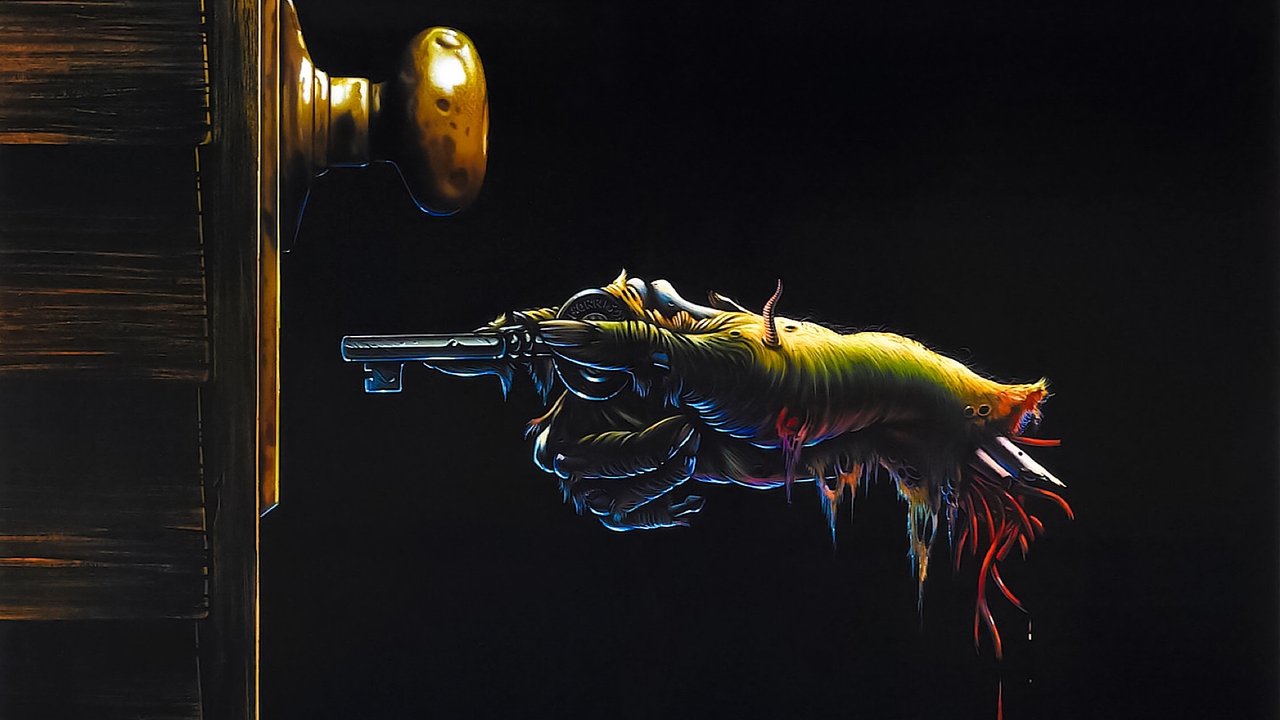
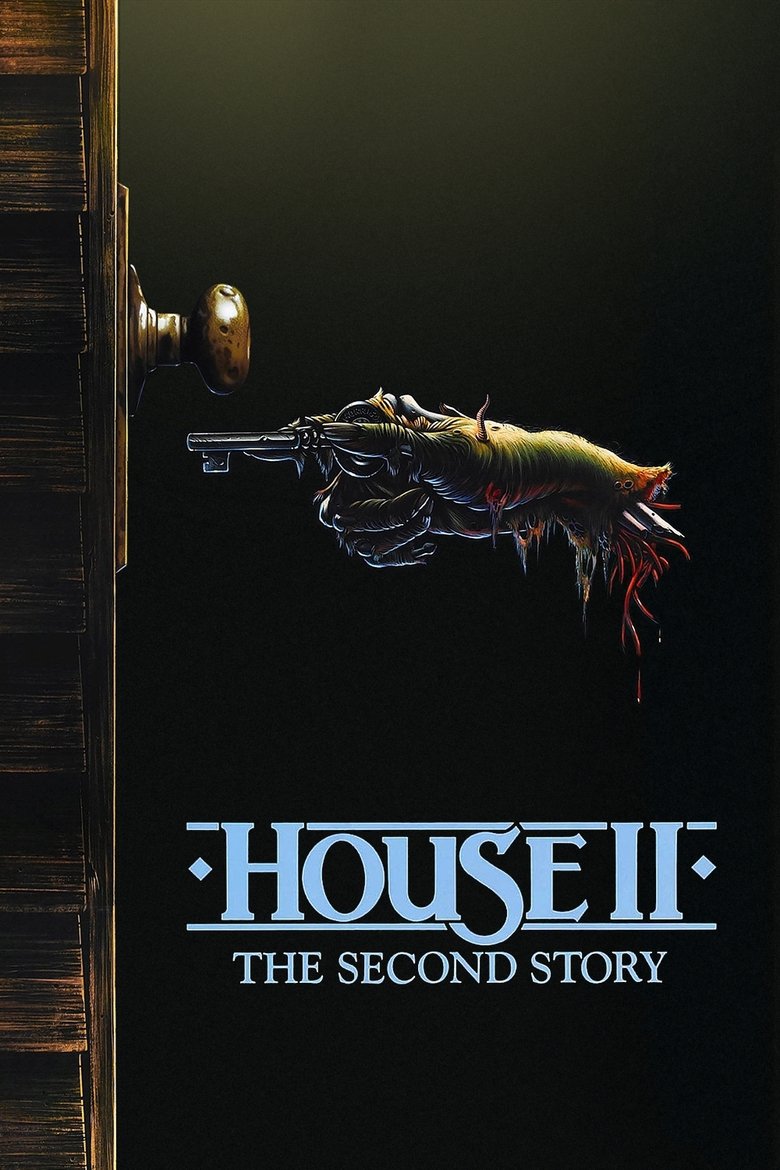
House II: The Second Story
“It's getting weirder!”
Jesse moves into an old family property where his parents were mysteriously murdered years before. He soon finds himself with unexpected guests in the form of his mummified great-great grandfather, a mystical crystal skull, and a zombie cowboy.
About House II: The Second Story
Why House II: The Second Story still stands out
There’s a particular pleasure in a movie that refuses to be tidy. House II: The Second Story opens with two clean-cut yuppies moving back into the family pile — Jesse and his girlfriend — and then promptly turns the place into a curiosity shop of misadventure. That contrast between ordinary adults and extraordinary domestic chaos is the film’s opening gambit, and it still has a way of catching you off-guard.
Ethan Wiley directs at a pace that never lets the sillier ideas sag; at 88 minutes the film moves like someone determined to show you every mad thing it can before the kettle boils. On paper it’s a comedy-horror with zombies and time portals. On screen it’s a houseful of characters — Jesse at the heart of it — who keep you curious and, crucially, amused. Part of why it’s interesting to revisit is the cast’s sheer willingness to lean into the absurd. Jesse’s decision to dig up a long-buried family secret and the arrival of a cowboy corpse called Gramps are the kind of plot choices that make you say, ‘Right — now we’ll see what they do with that,’ and then the movie obliges.
The idea that sets House II: The Second Story in motion
The movie begins with a straightforward premise: Jesse McLaughlin returns to his ancestral mansion, the place his family has owned for generations. There’s an obvious emotional hook underneath the jokes — Jesse isn’t just house-hunting; he’s back because his parents were murdered when he was a baby — and that gives the proceedings a little more weight than a mere string of gags.
Jesse isn’t alone for long. His daft mate Charlie turns up with his diva girlfriend, and what starts as an attempt to settle in quickly becomes an expedition when a photograph in the basement points to a buried family mystery: a crystal skull with sapphires for eyes.
It’s the kind of idea that promises both treasure-hunting and trouble, so the duo do the reasonable thing and dig up the great-great-grandfather’s casket. The corpse proves to be less murderous than memorable — he’s friendly once Jesse proves his lineage — and they bring the cowboy zombie, Gramps, back home.
From there the house proves to be less a static setting and more a portal playground. A Halloween party, stolen skulls, prehistoric pets and time-slipping rooms all flow from that initial conceit: a house that has been folded into other times and wants the skull as a key. It works because the film keeps the stakes readable while gleefully piling on the weirdness.
Why Jesse matters
Jesse isn’t a brooding antihero. He’s a fairly ordinary man shoved into an extraordinary situation and asked repeatedly to make sensible choices while surrounded by nonsense. That groundedness is useful: when the house starts to behave like a collection of locked doors through time, Jesse’s personal stakes — returning home to face family history — keep the plot anchored.
Played by Arye Gross, Jesse is the film’s emotional through-line. He’s not simply along for the ride; the house and the skull tie back to his family, which means his choices are also about belonging and closure. Those quieter motives sit beside the comedy and the set pieces, so when the film asks him to defend the skull it feels like a moment of responsibility rather than a one-note gag.
Jesse’s relationship with Charlie matters too. Charlie is the goofball who drags Jesse into situations he might otherwise avoid, and that friendship turns the house from a haunted relic into a living — if chaotic — home. Their bond makes the film feel like a mates’ adventure rather than a cold occult mystery.
The final beats underline why Jesse matters: he faces the man responsible for his parents’ deaths, and the story allows him a form of resolution. In the end, he opts for adventure over revenge — using the skull to travel to the Old West with his friends — which says something about the film’s appetite for escapism over bitter closure.
House II: The Second Story has more on its mind than the plot suggests
Beneath the time portals and comic set pieces, the movie carries very ordinary concerns: family, the safety of home and the value of friendship. Jesse’s return to his ancestral house frames the action as more than an excuse for spectacle; it’s a film about reclaiming, or at least re-examining, what was left behind.
Family runs as a quiet motive under the chaos. The skull and its history are tied to Jesse’s great-great-grandfather, so the supernatural plot reads as an extended family secret. That linkage gives the film warmth: the weirdness is personal, not purely cosmic.
Home and safety are played with. The mansion should be a haven, but instead it’s a place where time leaks and strangers turn up. The contrast is intentionally comic, yet it also lets the film ask whether a house is defined by its walls or by the people who try to make it a home again. Friendship completes the trio of quieter themes. Charlie’s loyalty — even if it’s occasionally foolish — turns the story from a lone-man quest into a group enterprise. When the skull becomes something to defend against outside forces, the film is essentially saying that what matters is sticking together, however unlikely the company.
House II: The Second Story could not belong to any other decade
Released in 1987, the film wears its era lightly but unmistakably. The late 80s liked its high-concept premises with a wink attached — take a handful of genres, mix them liberally and let the fun come from the collisions. House II does exactly that: comedy and horror, a dash of zombie business, and a family-friendly appetite for spectacle.
That blend is part of why the film feels of its time. Rather than smoothing off rough edges or collapsing into one tone, it trusts the audience to enjoy a plurality of moods — silly, spooky and sentimental — all within an hour and a half.
There’s also an 80s pragmatism at work: the story keeps its mechanics simple enough to be understood quickly (a skull as a key, rooms that open onto other times), which suits an era when audiences expected to be entertained first and theorists second.
In short: House II is recognisably an 80s object because it embraces mash-ups and big, uncomplicated ideas rather than slow-burn complexity. That trust in premise and pace is very much of the decade.
What has aged — and what hasn't
The core themes — family, home and friendship — hold up far better than you might expect for a film that sometimes behaves like a sketch show. Those elements give the sillier moments emotional ballast; you care because Jesse’s quest feels personal, not just plot-driven.
The premise of heirs returning to an old family house still reads clearly. A duo of yuppies moving back into an ancestral mansion is a setup that modern viewers can understand instantly, and that practical clarity helps the story survive the more eccentric set pieces.
Where the film is more vulnerable is in its willingness to pile on visual oddities and comic beats without always smoothing transitions. Modern tastes can be less patient with abrupt tonal shifts, so some viewers might find the jumps — from domestic argument to time-jumping caper — a little jarring.
Still, if you come for the idea of friends defending something weird because it ties them to a family past, the movie’s emotional engine remains serviceable. The story’s heart is simple, and simplicity is often what allows older films to stay watchable.
Why House II: The Second Story still matters
Love it or loathe it, the film leaves you with memorable beats: Gramps’ Old West stories, the idea that the house is literally built from an Aztec temple’s stones, and the sheer audacity of a Halloween party that ends with prehistoric pets in the living room. Those specific, slightly mad images are the sort that stick.
The movie also has a fondness for ensemble eccentricity. Jesse and Charlie are the anchors, but the supporting roll-call — from the smarmy record-company boss to the wandering electrician who turns out to know his way through time portals — gives the film a carnival of characters to enjoy.
There’s an emotional through-line too: Gramps’ final moments, his warning about the skull and his relationship with Jesse give the antics a surprisingly warm coda. It’s a reminder that even in a comedy-horror that favours oddity, a small, true connection can make the whole enterprise feel worthwhile. Finally, the ending — Jesse choosing to head off into the Old West with his friends — leaves the film with a deliberately upbeat note. It refuses to close the door on adventure, which is part of why viewers who grew up with the film remember it as more than a cheap scare: it’s a mates’ romp that loved the idea of sticking together.
Does House II: The Second Story still hold up?
Yes — with a caveat. House II: The Second Story, a brisk 88-minute comedy-horror from 1987, isn’t subtle and it isn’t trying to be. It is, however, resolutely entertaining when you accept its terms: genre mash-ups, a fondness for whimsy and a lead (Jesse) whose personal stakes keep the nonsense honest.
If you enjoy films that prize invention over polish — zombies who become raconteurs, time portals inside a family home, and the near‑accidental acquisition of a baby pterodactyl — this one will still deliver the sort of offbeat pleasure the 80s did best. The friendship between Jesse and Charlie holds the film together when the plot leaps from party to past.
If your tolerance for tonal whiplash is low, or you demand tight logical cohesion from genre premises, it may feel messy. But messiness is part of the charm here; the movie wants to be a weird house party more than an airtight mystery.
So should you watch it? If you’re in the mood for an energetic, slightly daft adventure where the rules are flexible and the emphasis is on camaraderie and fun, House II still works. It’s the kind of film that hands you a crystal skull and says, ‘Let’s see where this goes’ — and most of the time, that’s enough.